


- Singapore’s equity market, which delivered over 80% USD total returns in three years, is at an inflection point.
- The Monetary Authority of Singapore (MAS)’s Equity Market Development Programme (EQDP) is unlocking mid- and small-cap potential.
- A virtuous cycle of liquidity, valuations and listings is reshaping the market beyond large-cap names.
- The Singapore market’s sector mix is evolving beyond banks and REITS and towards renewables, technology, logistics and sustainability-focused businesses.
- Heading into 2026, Singapore offers a rare combination of stability, yield and access to the next wave of regional growth.
Introduction: Singapore’s market at an inflection point
Over the past three years, Singapore’s equity market has quietly matched the S&P 500 in US dollar (USD) total returns, delivering more than 80% and surprising many global investors who once saw it as merely a defensive play. This performance is not a coincidence. It reflects a market in transition, balancing its traditional strengths with new engines of growth and a bold policy push that is reshaping its future. As we enter 2026, Singapore offers a rare combination: stability, yield and access to the next wave of regional growth.
Defensive roots, new growth drivers
Singapore’s reputation for stability is well-earned. It remains one of the world’s most competitive economies, one of only nine countries with a triple-A rating from all three major rating agencies, and a government with deep fiscal and monetary firepower. This foundation allowed Singapore to weather global shocks and support growth through crises like the COVID-19 pandemic.
But the narrative is shifting. MAS’s EQDP is now at the heart of this evolution, signalling a structural transformation that could define the market’s trajectory in 2026 and beyond.
EQDP: the game changer for liquidity and growth
More than just another government initiative
The EQDP is more than just another government initiative, but a structural catalyst as well. With a total of Singapore dollar (SGD) 5 billion earmarked for investment in the Singapore market, including SGD 1.1 billion already placed with three asset managers, the EQDP aims to:
- Improve market liquidity and valuations beyond the large-cap names.
- Revive the Singapore Exchange (SGX) as a vibrant venue for fundraising.
- Crowd in third-party capital alongside MAS seed money.
The focus is squarely on small- and mid-cap stocks, a segment that has long lagged in liquidity and investor attention. The EQDP is already making waves, with performance among select mid- and small-cap names with strong fundamentals proving robust. The market is seeing the early stages of a virtuous cycle: stronger investor interest, higher valuations, improved trading liquidity, and better-quality listings. With the mid- and small-cap universe being far larger than the blue-chip segment and given the still-attractive valuations, there appears to be ample room for further gains.
A virtuous cycle in the making
The EQDP’s impact is expected to be sustained over the longer term. By drawing in institutional and third-party investors, the programme is setting the stage for a more dynamic, liquid and diverse market. Different asset managers bring different styles and perspectives to the small-cap universe, broadening the opportunity set and encouraging innovation in stock selection. As more capital flows into these segments, Singapore’s equity market is poised to become a regional leader in stability, growth and innovation.
Navigating global crosswinds
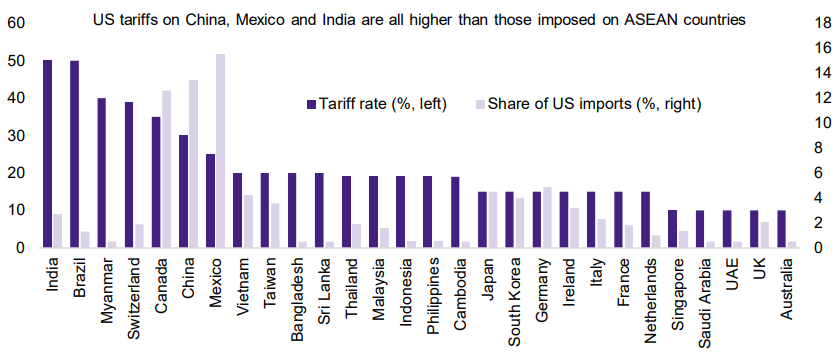
Singapore’s open economy is not immune to global headwinds. US-China tensions and shifting supply chains have redefined the region’s trade landscape. While new tariffs will dampen global trade and impact Singapore’s export demand, ASEAN—including Singapore—remains a net beneficiary of supply chain realignment. Tariffs faced by ASEAN nations are lower than those imposed on China, India, or Mexico, and Singapore’s role as a hub for ASEAN trade provides a buffer against external shocks.
Chart 1: Singapore and other ASEAN countries have a tariff advantage

Source: BBC, August 2025
Currency and capital flows
The Singapore dollar’s strength is both a testament to the country’s appeal and a factor in market dynamics. Given the Singapore dollar’s status as one of only nine triple-A rated currencies, SGD-denominated assets have attracted global capital, helping drive local interest rates lower even as US rates ease. While a strong Singapore dollar can be a headwind for exporters, Singapore companies are adept at managing currency risk, and the overall effect is supportive for equities.
Dividends: the reliable engine
Singapore’s market is renowned for its high dividends, and this remains a key attraction. Over the past three years, more than a third of Singapore’s total equity returns came from reinvested dividends—compared to just 10% for the S&P 500. In a world of falling interest rates, this income stream is more valuable than ever. Strong balance sheets and rising payout ratios mean companies can keep increasing dividends, even if earnings growth moderates. Firms are unlocking hidden value through restructuring and asset sales, with the proceeds returned to shareholders via dividends or buybacks.
Beyond banks and REITs: the New Singapore
While banks and REITs still dominate the market, real growth is happening among mid- and small-cap companies, especially in “New Singapore” sectors: renewable energy, data, technology and logistics. These companies are not only growing faster but also driving the market’s transformation. Singapore’s push towards sustainability is creating opportunities in energy transition, with companies like Sembcorp Industries pivoting from coal to renewables and others exploring hydrogen energy, renewable imports and even nuclear energy.
The tech and innovation story is also gaining traction. While the sector’s representation is still small, Singapore is home to data centre operators, semiconductor equipment makers and life sciences firms serving global niches. E-commerce giant Sea, though US-listed, is based in Singapore and now ranks as one of the most valuable companies in ASEAN.
Conclusion: Singapore enters 2026 with momentum and new sense of possibility
Singapore’s equity market is entering 2026 with momentum and a new sense of possibility. The EQDP is unlocking the potential of the mid- and small-cap universe, dividends remain a powerful engine of returns and the market’s sector mix is evolving in step with the broader economy. For investors, Singapore offers a rare combination: stability, yield, and access to the next wave of regional growth.