


- We have a positive view of Asian equities as we head into 2026 as the region's fundamental backdrop has improved on a confluence of macroeconomic, policy and market-specific factors.
- The Federal Reserve (Fed)'s pivot towards monetary easing and US fiscal expansion has set the stage for renewed capital flows into Asia.
- China is showing stabilisation while Indian growth is showing signs of recovery.
- Reforms across Asia are gathering momentum, notably in South Korea and Singapore.
- Four key themes are expected to drive opportunity in 2026: Chinese artificial intelligence (AI), Chinese healthcare, India's consumption revival and the Equity Market Development Programme (EQDP) in Singapore
- Asia offers a compelling mix of stability and transformation, creating a strong case for long-term allocation.
Macro backdrop: stability meets transformation
Global liquidity: a turning point
The global monetary environment has shifted. After an extended period of restrictive policy, the Fed has signalled a clear pivot towards easing. This transition marks a reversal in the cost and availability of capital for risk assets globally. Historically, periods of Fed easing have coincided with renewed flows into emerging markets, and Asia stands to benefit disproportionately given its scale, depth, and improving fundamentals.
External demand: resilience and fiscal tailwinds
Despite persistent geopolitical tensions and the ongoing realignment of global supply chains, external demand for Asian exports remains robust. The anticipated fiscal expansion in the US, particularly through the Offshore Balanced Budget and Borrowing Act (OBBBA), is expected to provide a meaningful boost to global consumption and investment. For Asia, which remains a critical node in global manufacturing and services, this translates into sustained demand visibility for key sectors.
Regional economic conditions: stability and early signs of recovery
Asia’s two largest economies, China and India, have undergone periods of consolidation and adjustment. In China, policy support and targeted stimulus have helped arrest the slowdown, with leading indicators now pointing to stabilisation in industrial activity and consumer sentiment. India, following a cyclical dip in consumption, is seeing the early effects of structural reforms and fiscal measures, with growth forecasts being revised higher by both domestic and international agencies. Across the broader region, economic conditions are stable, with ASEAN and North Asia showing resilience in the face of global headwinds.
Financial reform: structural catalysts emerging
The reform agenda across Asia is gathering momentum. South Korea’s “Three Arrows” initiative is driving improvements in corporate governance, capital market efficiency and shareholder returns. India’s rationalisation of the goods and services tax (GST) is stimulating consumption and unlocking efficiencies for businesses. Singapore’s Equity Market Development Programme (EQDP) an initiative launched by the Monetary Authority of Singapore (MAS) to stimulate the country’s stock market, is a notable structural catalyst. The programme channels significant capital into mid- and small-cap equities and enhances market liquidity. These reforms represent a broader commitment to market modernisation and investor protection.
Harnessing change in Asia
Change is the defining characteristic of Asian markets, manifesting through policy reform, technological advancement, demographic evolution and shifting consumer behaviours. Our investment philosophy is centred on the conviction that sustainable returns are achieved by systematically identifying and capitalising on fundamental change—whether at the company, industry or policy level.
We distinguish between cyclical fluctuations and true structural transformation. The most compelling opportunities arise where enduring improvements in profitability or growth coincide with significant change. Our approach is bottom-up, leveraging rigorous fundamental research and local market insight to uncover companies undergoing genuine transformation.
Four major areas of change in 2026
Building on this philosophy, we identify four structural themes that are expected to exemplify opportunities in 2026. These themes are not isolated trends—they represent deep, enduring shifts in technology, healthcare, consumption and market structure. Each illustrates how macro stability and reform translate into tangible investment opportunities.
1. Chinese AI: pragmatic innovation and global scale
China’s artificial intelligence (AI) sector is in the early stages of a major capital expenditure (capex) cycle, with leading tech firms investing heavily in infrastructure, data centres, and large language models. ByteDance, Alibaba, Tencent and Baidu have all initiated substantial capex programs, focusing on building out AI data centres and application development. The investment wave began in late 2024, paused briefly in 2025 due to graphics processing unit (GPU) shortages, and is now set to accelerate as domestic chip foundries resolve capacity constraints.
Unlike the US, where tech giants prioritise speed and scale, Chinese companies are pragmatic, focusing on cost efficiency and scaling investments in line with tangible business outcomes. Capex in China’s AI sector remains below US levels, but the gap is narrowing as domestic supply chains strengthen.
Business models are evolving. AI companies in the US typically monetise through subscriptions, driving annual recurring revenue growth. Chinese firms, in contrast, leverage their massive user base, offering free AI-powered applications and monetising indirectly through advertising, gaming and e-commerce. As AI applications mature, hybrid models are emerging, with premium features offered alongside free basic services.
Adoption is fastest in highly digitalised sectors such as software, high-tech manufacturing, media, and new retail. The cloud market is expanding rapidly, with AI cloud revenue projected to grow at a 26.8% compound annual growth rate (CAGR) from 2025 to 2030, and Model-as-a-Service (MaaS) expected to outpace all other segments at a 72% CAGR. Monetisation is evolving, with enterprise solutions generating significant revenue in video generation, image editing and object recognition.
Risks remain, notably US export controls and legal challenges around patents and data privacy. However, China’s scale, cost advantage and pragmatic approach are reshaping the global AI
landscape. As domestic supply chains strengthen and business models mature, China is poised to become a true innovator in AI.
2. Chinese healthcare: the world’s new engine for innovative drugs
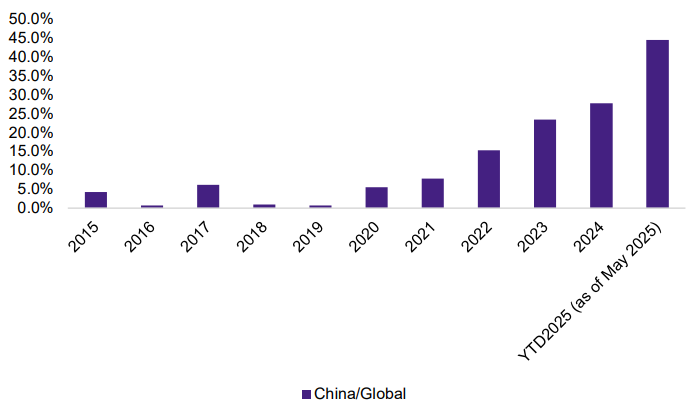
2025 marked a watershed for China’s pharmaceutical industry, with Chinese biotech firms expected to account for more than half of all major global out-licensing deals. Years of investment, policy reform and a focus on scientific excellence have propelled China from a domestic player to a global leader in drug innovation.
Chart 1: China as percentage of global innovative drug deal size
Source: JP Morgan, Pharmcube database
The sector’s edge lies in targeting unmet needs, including cancer, rare diseases and next-generation biologics. Antibody drug conjugates (ADCs), for example, are transforming cancer treatment, with Chinese firms leading both scientific breakthroughs and commercial success. The pace of innovation is accelerating, supported by regulatory reforms, a vast patient population and a collaborative ecosystem.
The data is compelling. Out-licensing deals with upfront payments above US dollar (USD) 50 million have surged from zero in 2018 to over 50% of the global total in 2025. The quality of Chinese innovation is being recognised by global partners, who are willing to pay top dollar for access to new therapies. These deals are bringing Chinese science to patients around the world and reshaping the global pharmaceutical landscape.
The broader ecosystem of talent, regulation and collaboration is compelling. Duality Biotherapeutics illustrates the sector’s transformation. The company has built a pipeline of next-generation ADCs and is running global clinical trials from day one, partnering with international firms to bring new drugs to market.
3. The return of India: consumption revival and digital leap
India’s equity market is at an inflection point. After a period of sluggish returns, structural shifts are gathering momentum. The now simplified two-slab GST system has catalysed consumption, lowered prices, and boosted demand across segments. Early results show robust growth in consumer durables, fast-moving consumer goods (FMCG) and passenger vehicles.
Premiumisation and digital adoption are reshaping consumption dynamics, with quick commerce platforms transforming retail. Platforms such as Blinkit, Zepto and Swiggy Instamart are making quality products more accessible, driving convenience, customisation and value. The potential market is vast, with USD 100 billion in the top 30 cities and 10% CAGR projected to reach USD 160 billion by FY2030.
Government initiatives are also supporting manufacturing and innovation, while margin recovery is on the horizon. The GST reset is restoring consumer confidence and supporting household budgets, while correcting long-standing inverted duty structures and unlocking new efficiencies for businesses. Structural drivers such as rising incomes, urbanisation and digital adoption are set to drive the next wave of consumption.\
For investors, India offers a compelling case for long-term allocation, driven by resilient domestic activity, policy support and digital disruption. The next wave of growth is set to be broad and deep, encompassing both traditional and digital channels.
4. Singapore EQDP: unlocking the mid- and small-cap universe
Singapore’s equity market has quietly matched the S&P 500 in USD total returns terms over the past three years. Its open economy remains resilient amid global headwinds, benefiting from supply chain realignment and a strong currency. Dividend yields remain a key attraction, with more than a third of total returns coming from reinvested payouts. The sector mix is evolving, with growth in renewables, technology and logistics. Singapore’s market is approaching 2026 with momentum and a new sense of possibility.
MAS’s EQDP is a structural catalyst, with Singapore dollar five billion earmarked to improve market liquidity and valuations, especially among small- and mid-cap stocks. The programme is creating a virtuous cycle comprising stronger investor interest, higher valuations, improved trading liquidity and better-quality listings. Performance among select mid- and small-cap names with strong fundamentals has been robust—the market is already seeing the early stages of a virtuous cycle. With the mid- and small-cap universe being far larger than the blue-chip segment, and valuations still attractive, there could be significant scope for further gains.
Conclusion: harnessing change, delivering sustainable returns
As we enter 2026, Asian equities stand at the intersection of stability and transformation. Improving global liquidity, stable external demand, and economic stabilisation in China and India provide a solid backdrop. Financial reforms across the region are unlocking new opportunities and enhancing market resilience.
Against this backdrop, our philosophy, “Harvesting Growth, Harnessing Change”, remains our guiding principle. By focusing on fundamental change and sustainable returns, and by leveraging our diverse team and local insights, we aim to deliver superior alpha.
The four major areas of change—Chinese AI, Chinese Healthcare, the return of India and Singapore’s EQDP—illustrate the breadth and depth of opportunity in Asia. Instead of viewing change as a risk to be managed, investors can perhaps consider it as the engine of growth and innovation. For investors willing to embrace change, Asia offers a compelling landscape for sustainable, long-term returns.
Any reference to a particular security is purely for illustrative purpose only and does not constitute a recommendation to buy, sell or hold any security. Nor should it be relied upon as financial advice in any way.