


Corporate governance reform and the move from capital returns to earnings power
Corporate governance (CG) reform, introduced more than a decade ago, has clearly changed the behaviour of many Japanese companies. Share buybacks, higher dividends and the unwinding of cross-shareholdings have continued, while corporate management teams have become more conscious of return on equity and engagement with shareholders. These changes are now entrenched and can be regarded as more than a temporary market fad. Nevertheless, CG reform should not automatically be treated as the main reason for the sustained rise seen in Japanese equities.
So far, the reforms have mostly addressed issues that were relatively easy to identify and correct. Many companies accumulated excessive cash, invested too little and allocated capital inefficiently. In such cases, companies were able to raise capital efficiency relatively quickly by increasing dividends or buying back shares.
Progress has been seen on these fronts, in turn improving the corporate mindset and facilitating dialogue between firms and shareholders. Investors can now discuss return on equity, balance-sheet efficiency and capital policy with management teams more directly than in the past. PBR reform has also encouraged companies that had taken little action to begin tackling obvious weaknesses. In that sense, the governance agenda has produced a genuine change in awareness and behaviour across a large number of listed companies.
However, reform is still a work in progress and the next stage is likely to be more difficult. The main concern is no longer just how profits should be distributed, but how companies can strengthen their underlying earnings power. Returning surplus cash to shareholders is not the same as creating new sources of growth. Companies must decide how retained earnings can be used for productive investment, business expansion, innovation and strategic repositioning. This requires management teams to articulate a credible long-term vision and, in some cases, to accept more leverage and risk than they have traditionally been comfortable with taking.
On this measure, Japan's transformation remains incomplete. A decade after the introduction of the CG and stewardship codes, the earnings power of leading Japanese companies as a whole has not risen to the level of their US or European peers. Even in fields where Japanese companies are performing relatively well—such as those related to AI and semiconductors—some companies remain cautious about expanding capacity or borrowing to pursue growth. This suggests that animal spirits are yet to fully return.
The question for investors is therefore not whether governance reform will reverse—it is whether reforms can advance beyond short-term improvements in capital distribution. Institutional investors also have a role to play by improving their dialogue with companies, focusing not only on buybacks and PBR but also on strategy, investment and sustainable profit growth. The next phase of reform could be judged by whether Japan can produce more companies with internationally competitive earnings power. Japanese companies have changed, but there is still room for further improvement.
The case for dual-use technology in economic security and defence
The expansion of defence spending and economic security policy in Japan is another theme that appears to be attracting investor attention. Japan has been ramping up its defence budget as it moves towards doubling spending to 2% of its GDP. The broader backdrop is a change in global security policy; US allies including Japan are under greater pressure to strengthen their own defence capabilities. This makes higher defence spending a potentially long-term global theme in which Japan could be closely involved.
For Japan, traditional heavy industrial companies and shipbuilders may benefit from stronger demand for conventional defensive hardware. That said, a more interesting opportunity may lie in dual-use technology: products and capabilities that can serve both military and civilian markets. The nature of warfare is changing, increasing demand for drones and other forms of hardware that differ from traditional heavy weapons. This could broaden the range of participating companies beyond the established defence contractors. Japan's strengths in manufacturing and hardware may allow a wider group of firms to enter these markets.
Dual-use applications are important because they reduce dependence on military procurement alone. Government spending can provide an initial push, but a sector is more likely to experience long-term growth if the technology being utilised also has substantial civilian demand. Drones, for example, may have applications across a variety of civilian industries. This creates potential synergies between the defence and private sectors.
Japan’s policy environment may play a role in supporting the development of dual-use applications. Under a strategy of public-private investment, the government can encourage companies to enter new fields that are considered important for economic security. Investment in stable energy supplies, power networks and other critical infrastructure can also link public policy to commercial demand. If government spending helps establish capabilities that later expand into civilian markets, the economic impact could extend beyond the defence budget itself.
However, any development will not be without risks; it remains to be seen whether initial policy support can produce a self-sustaining market. Japan does not possess world-leading technology in every defence-related field, and expansion based only on military expenditure may ultimately remain limited. A distinction should therefore be made between businesses that depend almost entirely on government orders and those with scalable civilian applications. The key question is whether dual-use technologies can turn an increase in public spending into a broader industrial growth story. If they can, economic security priorities may create opportunities across a much wider range of Japanese companies than the traditional defence sector alone.
Japanese stocks mixed in September: banks’ gains support but higher yields weigh
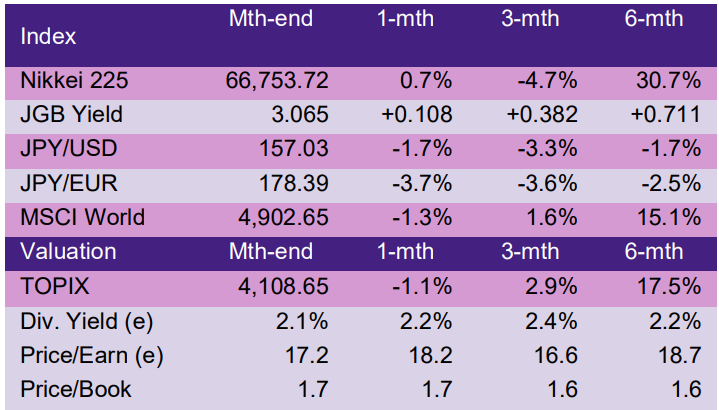
The Japanese equity market was mixed in September, with the TOPIX Total Return Gross Index falling 0.27% on-month and the Nikkei Stock Average (Nikkei 225) Total Return rising 1.26% (both in JPY terms). On the one hand, expectations grew that the Bank of Japan would accelerate the pace of interest rate hikes, supporting bank stocks on the prospect of wider net interest margins, while information and communication stocks rose on expectations for growth driven by increased investment in high tech. On the other hand, the market was weighed down by the accelerated rise in long-term yields, reflecting fiscal uncertainty and concerns over prolonged inflation due to the lack of visibility on an end to the conflict in the Middle East, which heightened perceptions that equities had become relatively richly valued.
Of the 33 Tokyo Stock Exchange sectors, seven sectors rose, with Oil & Coal Products, Information & Communication, and Banks posting the strongest gains. In contrast, 26 sectors declined, including Mining, Other Products, and Fishery, Agriculture & Forestry.
Exhibit 1: Major indices
Source: Bloomberg, 30 September 2026
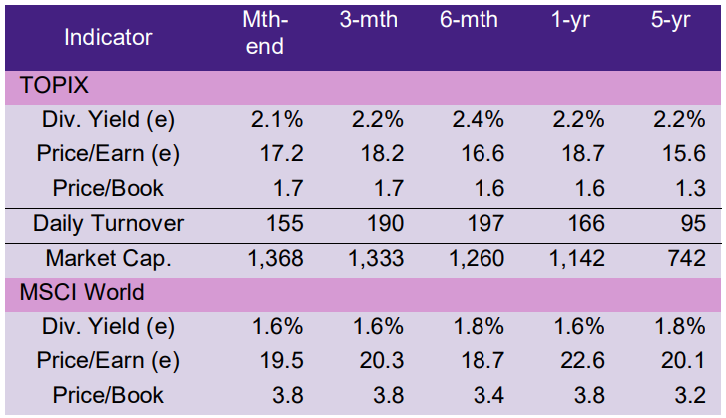
Exhibit 2: Valuation and indicators
Source: Bloomberg, 30 September 2026