
Key takeaways
- Global growth remains resilient but increasingly conditional on the market regime. Risk tolerance, carry and equity duration remain the defining characteristics of the current regime, which we anticipate will remain intact in the near term as our base-case.
- A possible easing of US-Iran tensions involving the lifting of any blockage of the Strait of Hormuz underpins our expectation of declining oil prices, and, by extension, the growth and inflation assumptions in our base case. The transition, however, has yet to be completed.
- The conditions supporting continued global resilience are interdependent. Risks are less about visible recession catalysts and more about fragility in self-reinforcing markets.
- Japan remains our preferred equity market. Growth remains structurally resilient as the Bank of Japan (BOJ) combats above-target inflation. Meanwhile, the yen and Japanese government bonds (JGBs) continue to test the underlying financial conditions.
- China’s recent growth disappointments were part of a policy pivot, partly in response to the Hormuz crisis and subsequent disruptions in global supply chains. Growth is expected to remain stable yet two-speed.
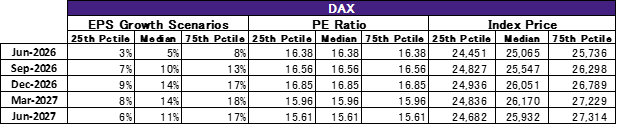
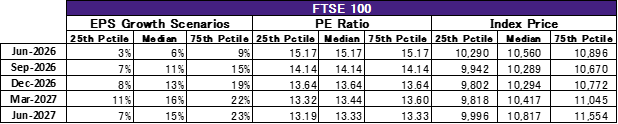
- Europe’s underperformance may be linked to the European Central Bank (ECB)’s recent shift towards tightening. This market is more likely to provide stability than lead in the current regime, although it may still offer diversification value in the event of a regime shift.
Global growth: strong base, broad risk envelope
Compared to the backdrop of our last Committee meeting (immediately following the outbreak of hostilities between the US and Iran), the prospects of an imminent off-ramp in the conflict are positive. However, this must be considered in the context of a yet-to-be-achieved transition to a stable peace agreement. In addition, lagged spillovers from the conflict as well as other factors, such as impacts on inflation expectations, may offer negative surprises to risk assets. The persistence of our base case is highly contingent on several conditions: continued moderation in producer prices across major economies, the absence of de-anchoring of inflation expectations and sustained risk appetite among global investors.
Firstly, it is clear that global growth has exceeded market expectations. Much of the outperformance has been due to the faster-than-expected pace of investment in technology and surrounding infrastructure, as evident in both macroeconomic data and equity market performance. It is also evident that the expansion itself, despite its impact beyond the immediate technology sector, remains narrowly based.
The absence of immediate catalysts for an interruption to risk asset investments may remain supportive in the near-term; however, we are increasingly emphasising the conditionality of this trend as we look ahead to 2027.
In the near term, the Committee’s view remains contingent on completion of the transition away from the US-Iran conflict, the re-opening of the Strait of Hormuz and a subsequent retreat in oil prices. Lower oil prices may have a significant impact on the near-term inflation outlook, supporting disinflation expectations and, in turn, household real income and portfolio duration. Beyond this, however, the Committee expects core inflation to remain sticky and, due in part to resilient growth, sees central bank policy rates staying higher for longer.
Looking ahead to 2027, there is increasing dispersion in the Committee’s views on growth and inflation. One key area of discussion was whether financial conditions are, or have been, as restrictive as most central banks had assumed—implying that “neutral” rates may be higher than initially estimated across economies.
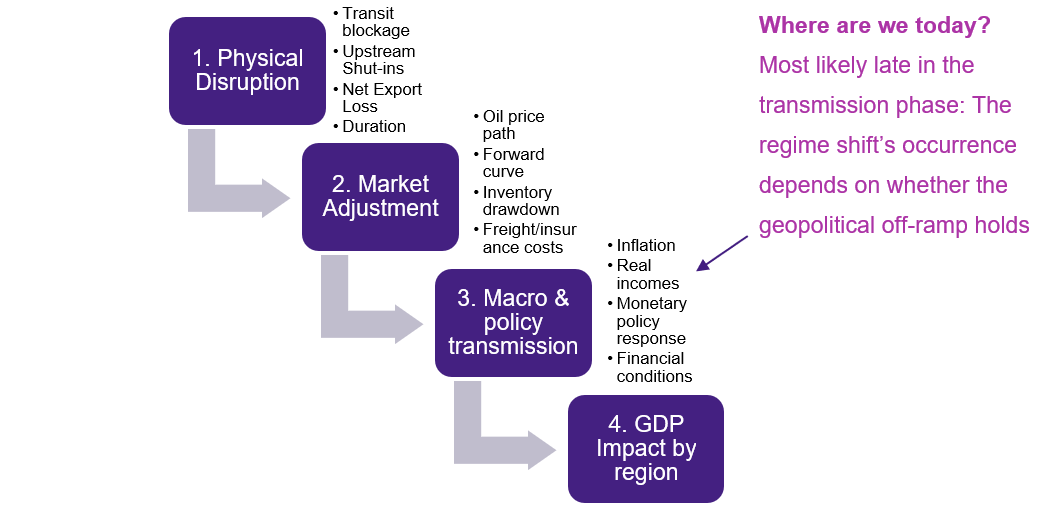
We previously introduced our framework of analysis for the energy shock transmission loop associated with the Iran conflict and continue to monitor progress against our regime transmission ladder (see Exhibit 1). In this context we are paying particular attention to the possibility of an ongoing impact from a long-lasting terms-of-trade shock upon the Japanese economy.
Although we continue to view our base case as separate from the risks of a protracted shock, we emphasise that in the absence of signals marking the completion of this transition, the probability of such a risk scenario becoming our main scenario is increasing.
Exhibit 1: Regime transition ladder
Source: Amova Asset Management
Global bonds, rates and credit: higher-for-longer meets carry demand
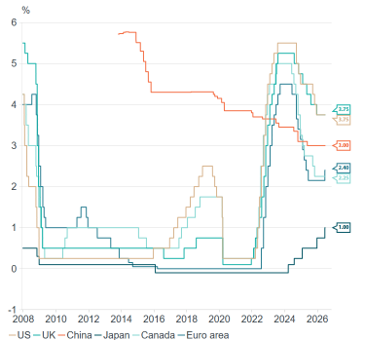
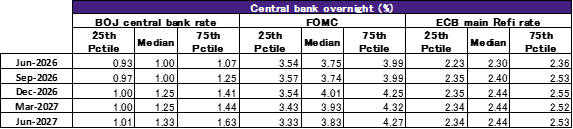
One key shift this quarter compared to the previous one is that policy is no longer framed around imminent easing and a prolonged pause has instead become the central assumption. Just as the market priced out cuts from the Federal Reserve (Fed), the GISC’s base case is for the Fed to remain on hold through the remainder of 2026. Although the distribution is wider on both sides for 2027, the median outlook continues to point to the Fed holding steady over the coming year.
Similarly, the Committee expects the ECB to keep rates unchanged over the one-year horizon, while in contrast we anticipate at least one additional hike from the BOJ. The outlook for BOJ normalisation is one of the clearest consensus views among Committee members; the median expectation for the overnight rate in one year’s time is 1.325%, with some possibility of the policy rate surpassing 1.5%.
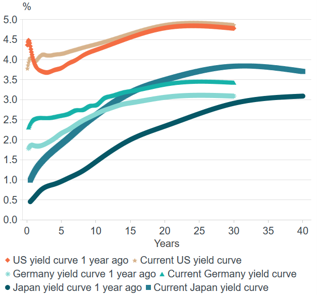
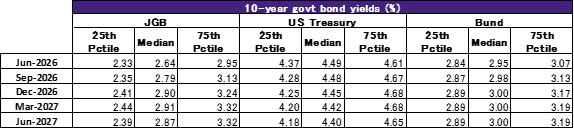
Given the long end of major yield curves has already been under upward pressure amid uncertainty surrounding the Strait of Hormuz, there may be some room for yield curves to flatten in the short term, as front end re-pricing brings focus to the shorter maturities. This, in turn, reflects debates over how restrictive rates actually are and therefore where “neutral” rates lie.
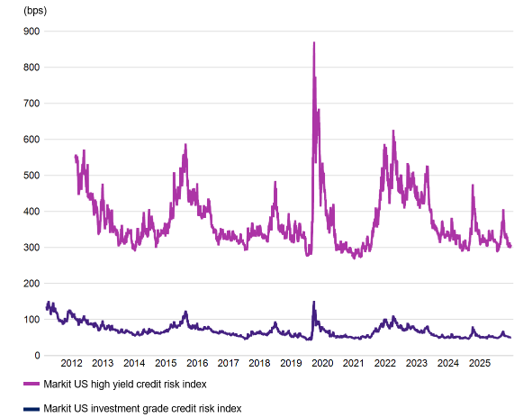
Meanwhile, credit spreads (both investment grade and high yield) remain historically tight even despite the shift to assumptions of higher-for-longer policy and the recent steepening of yield curves. This underscores the ongoing high demand for carry. However, it remains to be seen if this balance will hold up should expectations for policy rates move higher. Compensation for tail risk in the credit market looks limited, and both public and private indicators of risk bear watching, including High Yield/CCC spreads, leveraged loans, CLOs and private credit indicators such as PIK prevalence and amend-and-extend activity.
Chart 1: Policy rates in major economies
Source: Macrobond as of June 2026
Chart 2: Government bond yield curves
Source: Macrobond as of June2026
US: resilient but also duration-sensitive, thanks to AI
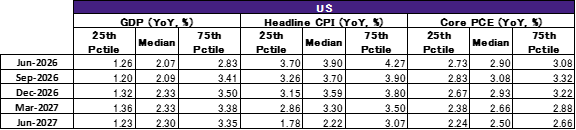
The median outlook for US GDP growth remains resilient. The committee expects US GDP to expand by over 2% in the year to June 2027. The composition of growth is expected to remain biased towards investment as the capex boom continues. This supports the “K-shaped” economic trend, in which healthy corporate revenues contrast with softer conditions in real household income and employment.
Thanks in large part to an anticipated easing in oil prices, headline CPI is also expected to fall towards—but still be above—the Fed’s 2% target over the next year. The Committee, however, expects core inflation to remain sticky, seeing core PCE as less likely to fall much below 2.5% over the same period.
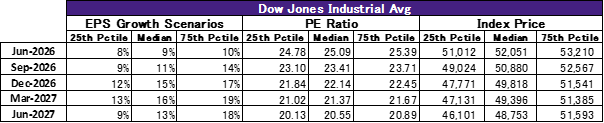
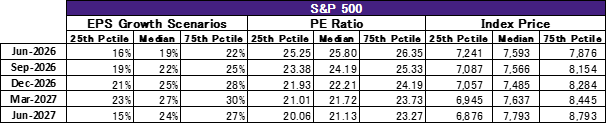
The sustainability of US growth depends on a multitude of factors. These include not only oil prices but also credit stability, the credibility of ongoing AI-related capital expenditure and valuations—even as markets adjust to higher-for-longer policy rates. As such, transmission risk has shifted somewhat from the real economy to financial conditions. Although earnings are expected to remain in healthy double-digit territory, valuations may already have peaked and could become more duration-sensitive from here.
Japan: weak yen-JGB mix shifting from tailwind to test
Japan remains attractive, but the breadth of its equity rally is narrow. Meanwhile, the weak yen-JGB mix is shifting from tailwind to test. The challenge is a terms-of-trade shock that is beginning to propagate, spurred partly by elevated import prices amid disrupted commodity markets, and compounded by yen weakness. However, this does not signify a wholesale loss of confidence. The terms-of-trade shock explains the persistence of imported inflation, but the carry regime explains why the yen has not strengthened despite BOJ normalisation—these operate through different transmission channels.
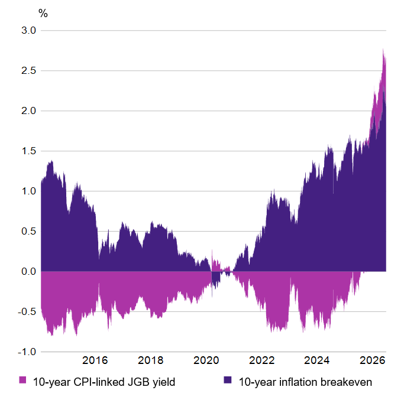
Thus, although both long-term JGBs and the yen are weaker than they were a quarter ago, they are better understood within a controlled carry regime, with market participants also gauging the credibility of the BOJ’s inflation-fighting credentials and the government’s long-term fiscal credibility. On the former, we might observe that although inflation expectations have moved steadily higher, expectations for a sustained period of high real interest rates have not. This suggests that markets generally expect inflation to moderate without requiring a prolonged period of aggressively tight monetary policy. In turn, this implies that the BOJ is not broadly perceived as “behind the curve”, even if that perception persists among a subset of the market.
The Committee expects BOJ hikes to continue at roughly the present pace (approximately once every six months), recognising that the central bank most likely has further to go before rates are neither expansionary nor restrictive. One counter-consensus view held by the committee, which is consistent with the outlook for demand for carry to persist in the short term, is for the yen to remain weak against both the euro and the dollar over the coming year. A greater amount of confidence is placed on nearer-term observations than on those for 2027, where, as indicated above, there may be a greater risk of regime transition.
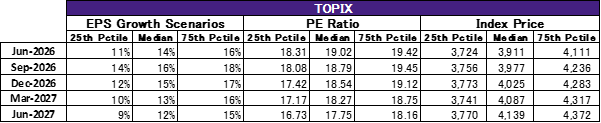
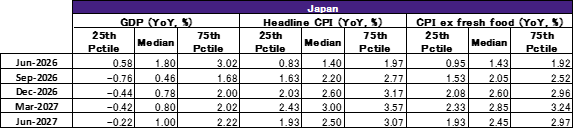
GDP growth is expected to remain positive but low, recovering to 1% year-on-year (YoY) by June 2027. Both headline and core CPI are projected to remain above the BOJ’s 2% target throughout this period. Earnings are expected to remain robust, not only for AI-related firms, but more broadly across the market, with double-digit YoY growth anticipated for the more economically representative TOPIX.
Importantly, the Committee sees Japanese equities remaining structurally supported not only by robust earnings but also by improving governance and the emergence of positive real wages. Another equity-supportive factor is the potential for domestic reflation broadening and in turn supporting financial institutions and other sectors as they benefit from the ongoing resilience and reflationary tendencies of the domestic economy.
Chart 3 : 10-year JGB yield (inflation expectations and real yield components)
Source: Amova AM, Macrobond and Bloomberg as of June 2026
Note: 10-year JGB breakevens show that expectations have normalised around the BOJ’s 2% objective. Meanwhile, there is no evidence as yet that markets are expecting a sustained period of high real interest rates, which indicates that the market is not yet broadly pricing the BOJ as “behind the curve”.
Europe: stabilisation rather than leadership
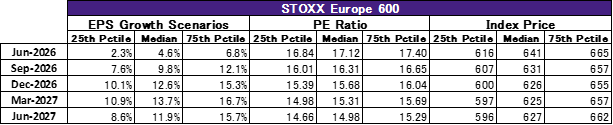
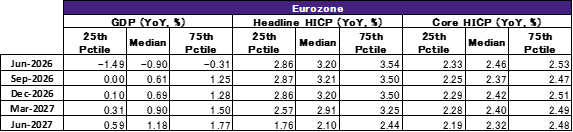
The Committee anticipates that growth in Europe will remain in low positive territory, with GDP growth likely to recover to above 1% YoY by June 2027. Inflation is similarly expected to normalise towards the ECB’s 2% target by the end of this period, although similarly to the US and Japan, core inflation is expected to remain stickier and therefore elevated well above target over the full period. Having pivoted toward rate hikes as of June, the ECB’s stance remains more proactive on inflation than the Fed’s at present. However, the Committee sees a good chance that the ECB will remain on hold for the foreseeable horizon so long as core CPI continues to retreat from recent highs. Meanwhile, the tightening of rates may have put a brake on equity market expectations, and therefore on valuations, which the Committee expects to remain below those of the US or Japan, even factoring in a slow recovery in earnings over the period. This may, however, provide a stable counterpoint to tech-fuelled fluctuations elsewhere.
China: managed slowdown to give way to policy catch-up
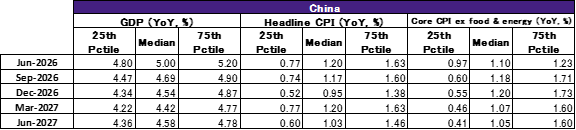
Since the start of the Strait of Hormuz disruptions, Chinese growth has underperformed expectations, while imported inflation has pushed consumer prices further into positive territory. China’s response to the Hormuz crisis demonstrated that its economy remains tightly managed by policy, rather than being driven by the cyclical recovery evident across many other major markets.
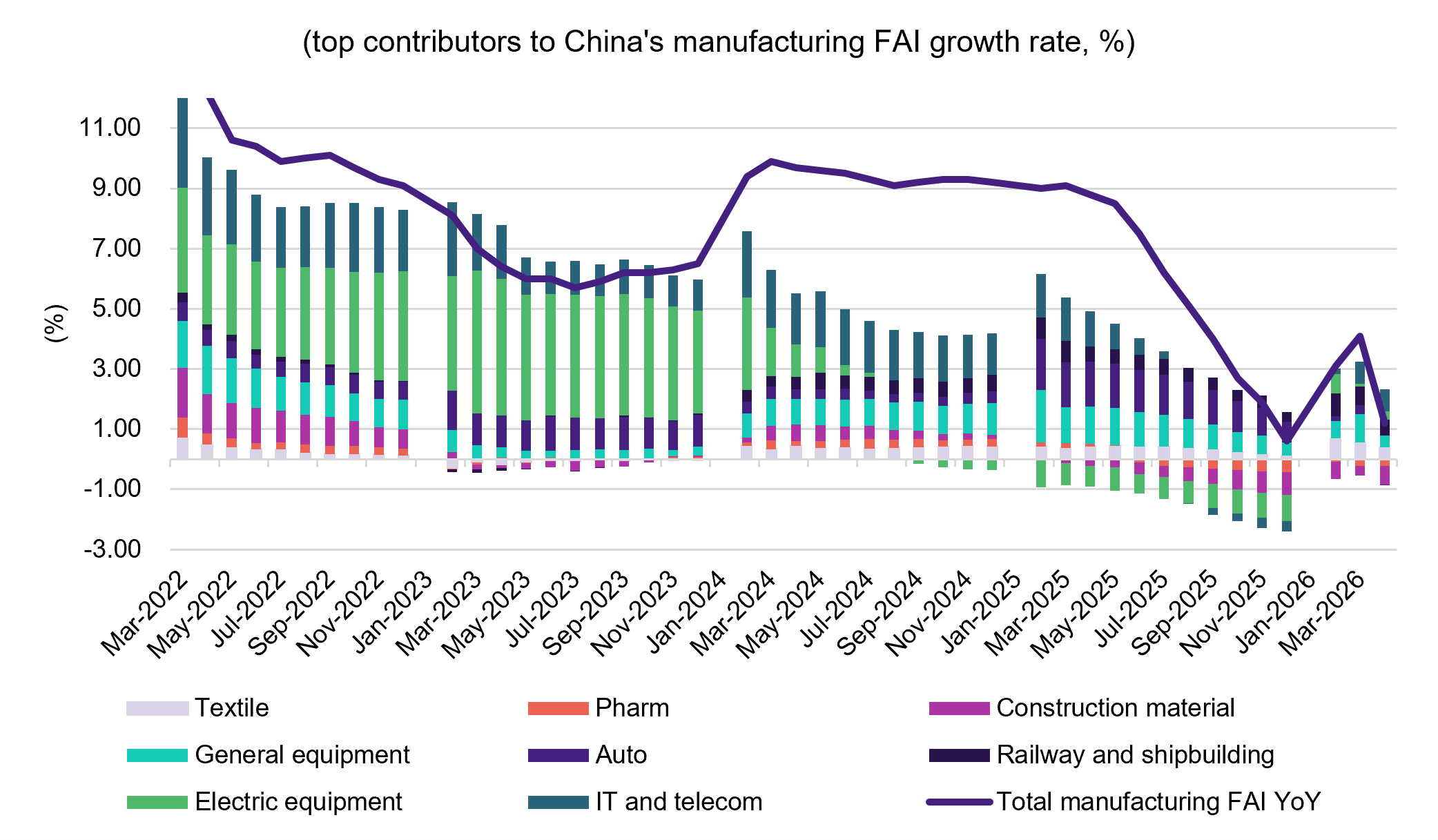
Growth during the first half of 2026 was extremely uneven. This reflected not only the impact of the Hormuz disruptions—but also the Chinese government’s response, which was to pivot sharply from public investment strategies intended to offset softness in the residential property market and consumption. Both challenges still persist, together with intense competition within industrial sectors.
The two-speed nature of China’s economy remains intact and will likely persist until the country’s property market bottoms—a development that may be outside of our immediate one-year horizon. In the meantime, the government could make up for growth lost during the Middle East crisis and its subsequent policy pivot in Q2, while supplementing investment in the latter half of 2026 to keep growth within its 4.5–5% target range.
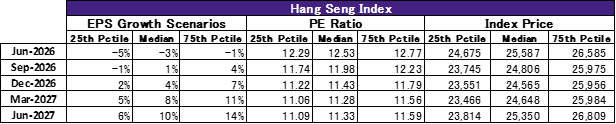
For this reason, the Committee expects any bounce in Chinese GDP to be temporary, with growth unlikely to surpass 5% YoY before retreating once again at the start of 2027. Paradoxically, amid the de-escalation in the US-Iran conflict and hopes for traffic through the Strait of Hormuz to be fully restored, the government may have less incentive to stimulate consumer spending. Instead, the government may continue to prioritise its investments under the strategic “Six Networks” strategy—especially in energy transmission and storage—even as ongoing fiscal consolidation by local governments and weak household demand continue weighing on growth. In the meantime, the July Politburo meeting will bear close watching.
Chart 4: Energy shock, property and subsidy taper explain China’s fixed asset investment slowdown
Source: PRC Macro
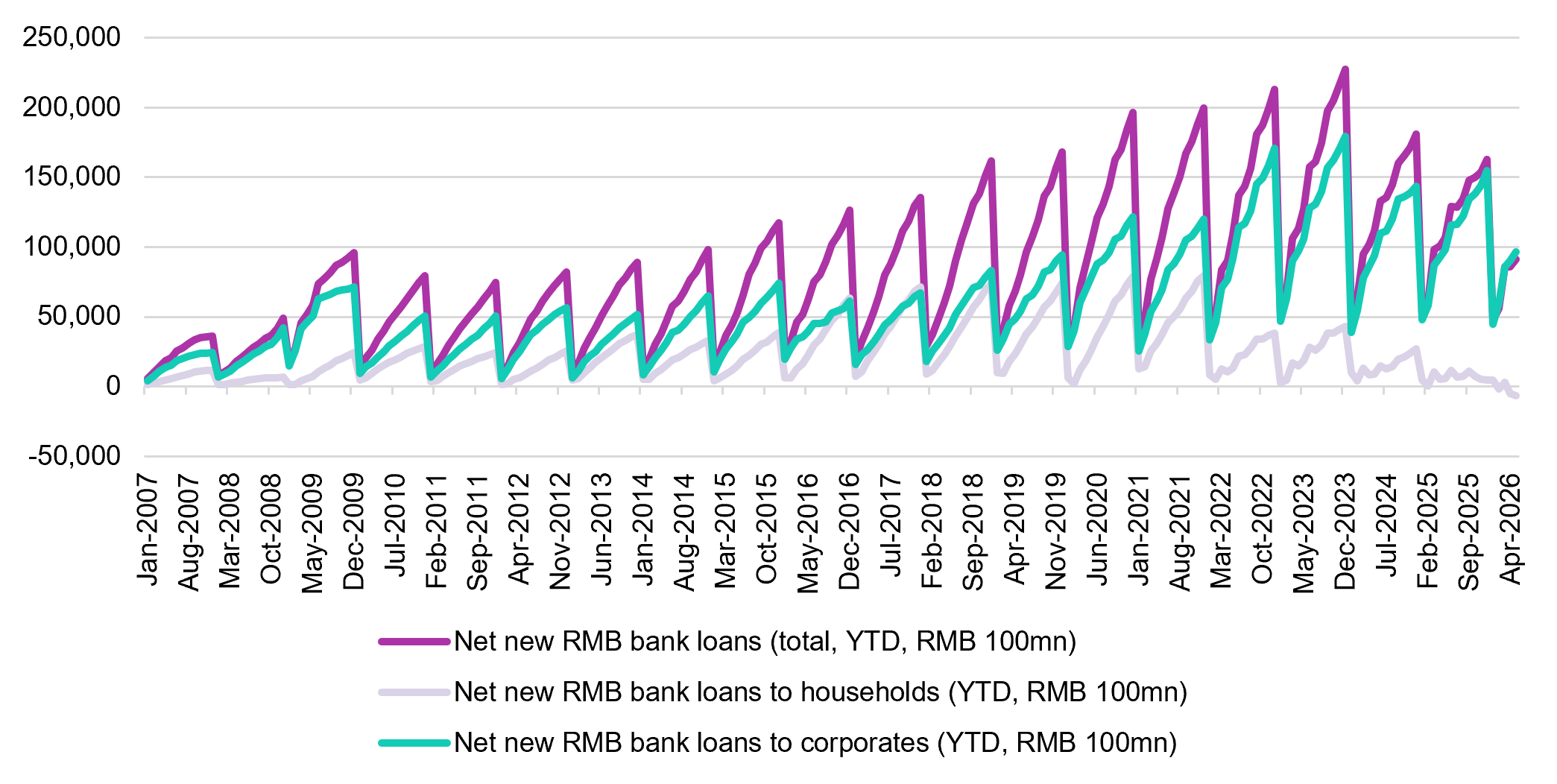
Chart 5: Household deleveraging in China has accelerated
 Source: PRC Macro
Foreign exchange and commodities: how far can carry stretch?
The dollar has remained more resilient than the Committee anticipated in March, particularly against the yen. However, several apparent inconsistencies have emerged in market reactions to recent events.
First, although the demand for petrodollars was assumed to have kept the dollar supported against the yen as oil prices surged, the reverse logic has not applied as oil prices have retreated in anticipation of de-escalation between the US and Iran. Second, the aggressive repricing at the front end of the US yield curve following better-than-expected payroll data and the hawkish market reaction to Fed Chair Kevin Warsh’s inaugural speech contrasted with the muted market response following the BOJ’s rate hike in June.
Over time, hawkish central banks can be expected to ultimately become a headwind to carry trades, because tighter financial conditions could reduce leverage and risk appetite. For now, the Committee perceives the carry trade to be the dominant near-term trend, and for this reason expects dollar/yen to remain above 160 for much of the coming year, while euro/yen is seen remaining above 180, which is a significant shift from the Committee’s previous expectations. Conversely, the Committee sees the euro and the pound remaining range-bound versus the dollar, with EUR/USD and GBP/USD trading around 1.15.
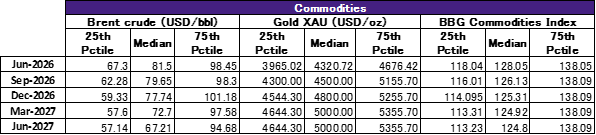
Meanwhile, the Committee puts much emphasis on the assumption that oil prices will continue retreating, with Brent crude expected to fall from the low USD 80s per barrel to high USD 60s by June 2027, albeit with significant fluctuations along the way. In contrast, metals—including gold—may be able to regain some ground, even with more hawkish central banks, by benefitting from monetary policy lags.
Principal risks to the outlook: pressure points amid no evident catalyst
Last quarter, the Committee’s risk discussions focused on the following five main risk areas:
1. Energy shock and escalation in the Middle East
2. Persistent inflation and global tightening shock
3. AI investment and technology-cycle disruption
4. Private credit shock and financial-system stress
5. Long-rate and fiscal-sustainability shocks
None of these risk areas have gone away; however, their perceived mix has shifted somewhat. For example, the energy shock and Middle East escalation (1) indeed materialised. Yet the impact on equity markets was substantially offset by the absence of any disruption to the AI/technology investment cycle (3). Instead, enthusiasm towards AI was amplified even further with each positive earnings release and announcement of new capital investment.
During this meeting, the Committee therefore focused on elements of fragility most likely to eventually interrupt the ongoing cycle of risk tolerance and appetite for carry-funded duration. While this is not our central scenario, such vulnerabilities remain visible sources of risk.
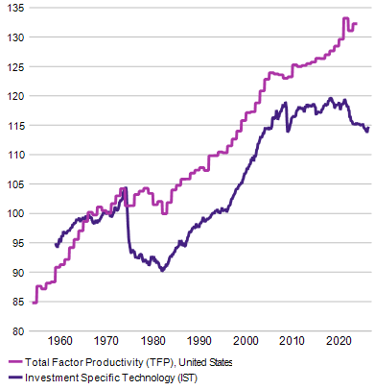
Given the central importance of the AI monetisation question, as well as the difficulty in assessing the timing of any potential disruption, we have addressed the longer-term topic of what needs to happen in order to realise the broader gains of the current investment cycle. We are aware that these developments may fall outside our immediate review horizon. Such considerations are addressed in Box A at the end of this report.
Separately, we also discussed the potential for early indicators of financial-condition stress and remain vigilant for signs of disruption in credit markets. Credit spreads have been supported by high appetite for carry. We therefore see any material widening as reason for caution over imminent financial-condition stress (See Chart 6).
Chart 6: US investment grade and high yield credit default swap spreads
Source: Amova AM, Macrobond and Bloomberg as of June 2026
Additionally, given the contingencies in our base case, we have considered several potential areas of fragility in the Outlook. These include the following:
- Systemic or cross-asset transmission of any significant AI disappointment: Traditional risk models may not capture systemic risks between asset classes affected by the AI capex boom. This may mean that fragility could surface in a non-core asset class, and that rising correlations may dampen the benefits of cross-asset diversification.
- Accelerated yen weakness and a less orderly rise in JGB yields: A combination of fiscal expansion and a growing perception that inflation expectations may come unanchored could undermine the benign, risk-seeking aspect of the yen-funded carry trade.
- More generalised inflation instability: This risk, which is not specific to Japan, considers the possibility that inflation expectations may become unanchored, either through the persistence of investment-led demand and easy financial conditions, or through a different path in which a sharp oil price decline may not only ease inflation concerns but could be emblematic of a shift in future consumption and investment intentions.
- Political and geopolitical disorder: So far, thanks to the capex investment boom, geopolitics have not cooled global economic growth or equity market valuations. This is not to say they never can or will. With US midterm elections approaching, and uncertainty still surrounding the path towards de-escalation between the US and Iran, geopolitical developments still pose a risk to market and economic activity.
Conclusion: unknown timing, known contingencies inform diversification
The Committee remains constructive on the near-term outlook for global growth, in the absence of an immediate visible hurdle to the ongoing AI-related Capex boom. While the Committee generally agreed on the mechanisms underpinning the current expansion, views diverged more substantially on their durability and ultimate market implications.
The Committee remains aware that the current regime underpinning its base case may not be permanent. A recurring theme throughout the discussion was that the current equilibrium appears to be self-reinforcing but increasingly contingent on the alignment of several key conditions. Lower oil prices, resilient AI investment, accommodative financial conditions and stable credit markets reinforce one another. Conversely, deterioration in any of these areas could transmit more broadly through asset classes and market segments.
Different macroeconomic shocks can produce different cross-asset correlation structures, implying that the benefits of diversification are regime dependent. Effective diversification, therefore, requires consideration of a broad range of possible shocks.
In sum, while we expect our base case to prevail over the coming year, we also see a strong role for diversification in preserving exposure to our highest-conviction investments through periods of temporary market dislocation.
Chart 7: IST has contributed steadily to US total factor productivity
Source: Amova AM, US Bureau of Economic Analysis, Penn World Table, Growth & Development Centre, University of Groningen
Appendix: GISC outlook guidance
Global macro indicators
Central bank rates, forex, fixed income and commodities

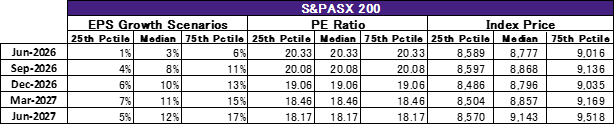
Equities