

Overview
Cabinet approves JPY 21.3trillion stimulus (JPY17.7trillion extra budget)
On 21 November, Japanese Prime Minister Sanae Takaichi’s Cabinet approved the largest stimulus package since the COVID-19 pandemic, totalling Japanese yen (JPY) 21.3 trillion. Of this, JPY 17.7 trillion is due to be funded via general account spending and an additional JPY 2.7 trillion will come from tax cuts. This is a clear increase from JPY 13.9 trillion in FY2024 and comes in above the expected range of JPY14–17 trillion.
The major spending components include:
- JPY11.7 trillion for price relief, covering subsidies for electricity and gas, a one-off child subsidy allowance and JPY2 trillion in regional support.
- JPY 1.7 trillion for defence and diplomacy
- JPY 7.2 trillion for crisis management investment
- JPY 700 billion for disaster and emergency reserve funds
Additional tax relief included an abolition or suspension of the gasoline tax (about JPY 1 trillion) and an increase in the minimum income tax threshold (JPY 1.2 trillion).
The rewards and the risks of betting on growth vs. fiscal prudence
Doubling down on growth: tax relief, handouts to households dominate
The lion’s share of the supplementary budget is dedicated to various types of relief for households, which have experienced the impact of rising costs of living as core inflation has remained above the Bank of Japan (BOJ)’s target of 2% for the last three years. These measures are expected to feed back into the economy (via consumption, for example) and contribute to GDP growth. That said, given Japan’s relatively low marginal propensity to consume, a portion of these funds is likely to be used to shore up savings. Hence, stimulus may help keep growth alive in Japan’s recovering economy, but it is unlikely to be associated with a high fiscal multiplier. Meanwhile, a smaller share is dedicated toward “diplomacy and defence”, which is likely to offer some near-term GDP support but its ability to shore up lasting growth remains in question.
Abandoning a key fiscal discipline: the single-year primary balance target
With the new supplementary budget, PM Takaichi’s administration proposes to do away with one measurable and transparent indicator of fiscal responsibility—the single-year primary balance target, which was previously set for FY2025. For many years, Japan ran primary balance deficits, which were aggravated by its “lost decades” of deflation. However, more recently, positive nominal growth has allowed Japan to successfully reduce its debt burden by harnessing inflationary growth dynamics. The mechanism behind the improvement was the difference between tax receipts and non-interest expenditures—the primary balance. By replacing this target in favour of “stabilising” the net debt-to-GDP ratio at pre-pandemic levels (a less operationally accountable measure) the government will now depend on sustained increases in tax receipts to demonstrate fiscal sustainability, which it may garner mainly through growth in domestic incomes and spending.
Risk of political pressure on the BOJ
Former Bank of Japan (BOJ) board member Goushi Kataoka, now serving on PM Takaichi’s growth panel, was instrumental in managing public expectations for a JPY 20 trillion-plus package. Moreover, Kataoka suggested that a hike could come “as soon as March,” but used conditional language to imply that the timing could depend on “whether fiscal stimulus boosts demand”, which some market participants may have interpreted to mean that the Bank of Japan’s move should be contingent on demand responding to fiscal stimulus.
Whether the BOJ aligns with this guidance remains uncertain. Any perceived linkage between fiscal expansion and monetary policy timing could raise concerns about the central bank’s independence (and therefore undermine its credibility in fighting inflation), if the BOJ is perceived to be caving to political pressure by delays in raising rates.
PM Takaichi’s contradictory fiscal aims
PM Takaichi aims for “responsible and expansionary” finance, but in sum, this is a paradox given recent bond and currency market reactions. The Takaichi administration’s version of expansionary policy risks:
- Undermining BOJ’s inflation-fighting autonomy
- Reversing recent fiscal prudence (abandoning annual primary balance goals and delivering a larger-than-expected supplementary budget vs. 2024), adding term premia to long-dated JGBs
- Sustainability hinges on growth-driven tax revenues outpacing expenditures to contain debt ratios.
Market response
Equities moving to the beat of hyperscalers rather than stimulus
Although Japanese equities had posted a rally after PM Takaichi took office on anticipation of accommodative policy, they appear to be influenced more by the dynamics driving global equity markets—the surge of investment surrounding AI data centres and other suppliers to the AI boom. While some sectors have experienced pressure due to ongoing China-Japan diplomatic tensions, this development also appears to have been overshadowed by the surge in technology-related investment. Additional fiscal stimulus poses no reason for equity markets to fret today, but it could possibly pose hurdles for the implementation of counter-cyclical stimulus in the future in a less buoyant market. The bond market appears to have reflected these concerns.
JGBs are responding to fears of additional supply
Japanese government bond (JGB) 40-year yields have hit record highs; 10-year JGB yields have also risen significantly, but in nominal terms, remain below the BOJ’s 2% inflation target for now (around 1.8% at the time of writing). Recently, the November 20-year JGB auction reflected relatively weak investor demand; although the bid-to-cover ratio remained in line with the 12-month average, the “tail” (the difference between the average and lowest accepted price) widened moderately. Life insurers, traditionally the anchor investors in the long end of the JGB curve, have generally scaled back purchases of superlong debt in 2025, reflecting broader ALM and hedging considerations. Expectations of even more duration supply are likely to maintain pressure on the superlong part of the yield curve. A succession of upcoming JGB auctions, such as the 10- and 30-year offerings in December, will be watched closely as the market tries to gauge investor appetite for government debt with issuance set to increase further.
Why are fiscal shocks feeding into the long end of the JGB curve?
With the BOJ’s yield curve control now removed, the recent rise in 20- to 40-year JGB yields reflects a higher term premium rather than a shift in near-term rate expectations. The anticipated scale of the supplementary budget has been a key driver, as markets price in increased supply and fiscal risk at the long end of the curve. These factors steepen the curve even if near-term rate expectations remain relatively stable.
Implications for the yen and inflation
The markets interpreted fiscal expansion—and resulting increase in JGB issuance—and the possibility for the BOJ to come under pressure to keep rates on hold going into 2026 as a reason to push the already cheap yen even lower. In this way, the larger-than-expected package could compound some of the existing inflationary pressures it purports to lessen by weakening the yen, which means Japan mechanically imports inflation. Keeping inflation in check remains the bailiwick of the central bank, and markets have started to question whether the government will truly respect the BOJ’s autonomous authority on inflation-fighting.
A larger supplementary budget: a history in charts
- Supplementary budgets have been shrinking since the pandemic. The gap between total general account expenditures (solid blue line) and the initial budget (dashed blue line) roughly represents annual special expenditures. This gap widened sharply during the pandemic but has since narrowed gradually. Although the new package does not create the most extreme divergence seen in 2020, it proposes to push net spending back toward elevated post-pandemic levels.
Chart 1: Japan’s government budget

Source: Macrobond, Japan Ministry of Finance (MOF)
- National debt as a share of tax revenues—a key fiscal sustainability indicator—has been declining since the pandemic. This trend signalled that Japan was successfully reducing its debt burden through inflation, in contrast to the US (it must be noted that the US was growing more rapidly).
Chart 2: National debt as share of tax revenues, US vs Japan

Source: Amova Asset Management, World Bank, St. Louis Fed - Japan has managed to reduce its debt burden through inflation and now finds itself close to its erstwhile medium-term target for the primary balance. As shown below, the country was just a stone’s throw from achieving a primary balance last year (with JPY 0 trillion on the Y-axis).
Chart 3: Japan’s general account primary balance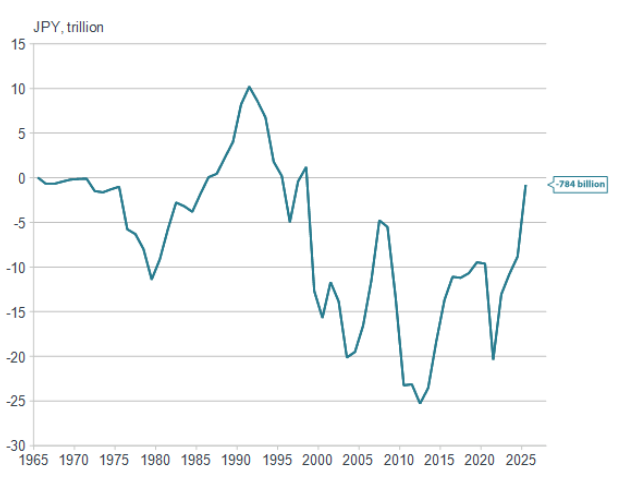
Source: Amova AM, MOF
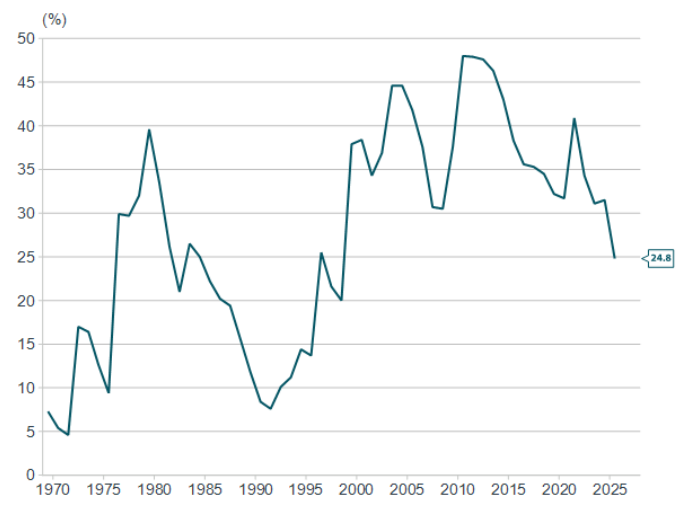
- Overall, the general government budget bond dependency ratio had declined to levels not seen since the early 2000s. This is a good signal, but it remains to be seen whether it will last. While tax receipts have risen more quickly than expected, the inexact goal of “fiscal discipline” does not equate to keeping bond issuance from rising, which is one reason markets have interpreted the new fiscal regime as a dilution of fiscal discipline.
Chart 4: Japan’s budget bond dependency ratio
Source: Amova AM, MOF