


Our outlook for 2026
We have a positive outlook for Asia in 2026, with the region seen to be supported by improving trade, contained inflation and supportive fundamentals, aided by the US–China trade truce and lower effective tariffs. Regional central banks are expected to manage interest rate cuts cautiously, in contrast to the Federal Reserve’s (Fed) continued easing. As monetary policies diverge, changing rate differentials could provide support to select regional currencies. We see fiscal policy playing a key role as the monetary space tightens; China is expected to advance its shift towards consumption and high-tech manufacturing under the 15th Five-Year Plan (FYP), despite lingering deflation risks. India, Indonesia and the Philippines offer attractive real yields and disciplined fiscal frameworks, while Singapore’s bond yields are seen tracking the decline in those of US Treasuries (USTs). Asian credit is expected to remain resilient, with returns to come mainly from carry as valuations stay tight—though global and policy risks warrant vigilance.
Asia local rates and FX: constructive backdrop with improving trade and policy support
Asia enters 2026 with a broadly constructive macro backdrop, underpinned by improving trade conditions, well-contained inflation and favourable macro fundamentals. The continuation of the US–China trade truce, alongside expanded exemptions for Asian exports to the US, implies that effective tariffs are now materially lower than headline rates suggest, easing external pressures and prompting upward revisions to regional growth forecasts. While the outlook for growth remains positive for now, we are attentive to the potential for renewed trans-shipment or sector-specific tariff threats.
Chart 1: Announced vs. effective US tariffs
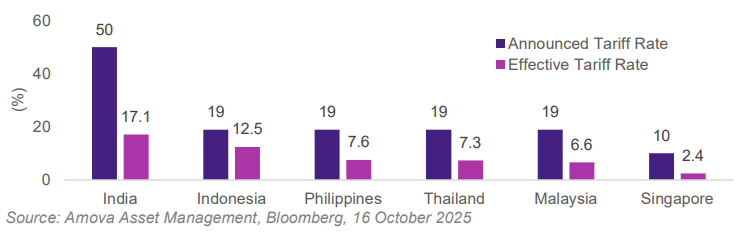
Meanwhile, inflation is expected to remain contained across most of the region, with well-anchored expectations and reduced effective trade tariffs.
Asian central banks are likely to preserve policy cushions and carefully manage the pace of any further rate cuts, in contrast to the Fed’s expected continued easing. With trade tensions contained and growth strengthening, changing interest rate differentials may support select Asian currencies as the dollar’s yield advantage diminishes and capital flows rebalance toward the region.
With monetary easing cycles largely concluding, fiscal policy is expected to take the lead in countering any growth slowdown, particularly in economies where monetary policy space is limited. That said, high-yielding markets with greater policy space may still deliver targeted monetary easing to support domestic activity.
China
China is expected to press ahead with its economic rebalancing efforts, with the 15th FYP outlining a continued shift toward a more domestically driven growth model. By prioritising measures to strengthen consumption and reduce reliance on the more volatile export sector, policymakers aim to foster a more resilient and sustainable economic structure over the longer term.
A core objective of the 15th FYP is to promote the economy’s technological self-reliance and facilitate its progression up the value chain into high-tech manufacturing. As China focuses resources on advanced sectors, production of lower-value goods is increasingly being relocated by Chinese firms to neighbouring economies, particularly within ASEAN. This trend is reinforced by geopolitical considerations, with firms diversifying supply chains and seeking to mitigate exposure to trade tariffs and external policy risks. As a result, China is poised to deepen economic partnerships and integration with neighbouring economies and key trade blocs.
These shifts bode well for China’s long-term growth and inflation dynamics. Higher productivity and a move toward higher value-added output may support more durable growth, while the dispersal of lower-cost manufacturing across the region could help contain overall production costs. Together, these developments also support a broader international role for the Chinese yuan in trade, investment and settlement, creating demand for the currency.
However, deflation remains a challenge. The government’s ongoing “anti-involution” campaign underscores its recognition of the problem. However, as progress on supply-side reforms has been measured, large-scale job losses and broader economic disruption can be avoided. These supply-side adjustments alone are insufficient, with sustained and meaningful demand-side support critical to easing deflationary pressures over the medium term.
Policy support is therefore expected to remain accommodative. Following a notable push in fiscal measures as growth slowed in the third quarter of 2025, we anticipate additional targeted fiscal stimulus in 2026, while monetary policy may play a more limited role due to the limited room for further easing.
Overall, with trade tensions relatively contained and growth prospects strengthened by supportive policy measures, Chinese government bond yields are likely to gradually edge higher from current levels.
India, Indonesia, Philippines: attractive real yields backed by policy support
As the Fed may pursue further monetary easing, investors are likely to look beyond the US in search of higher yields. In this environment, we believe that the government bonds of India, Indonesia and the Philippines are well positioned to outperform regional peers in 2026. Their appeal is supported by attractive real yields, inflation running below trend in their respective countries and stable debt dynamics underpinned by disciplined fiscal policies.
Chart 2: Real 10-year yields of Asian government bonds
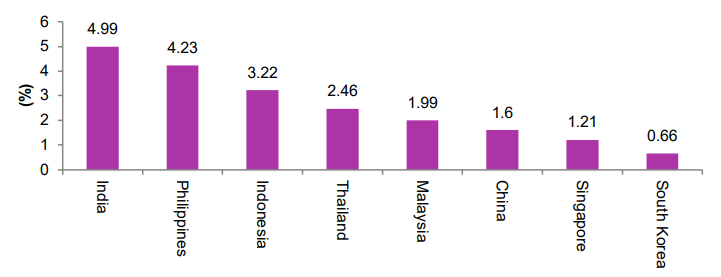
Source: Amova AM, Bloomberg as of 31 October 2025
India
The effects of India’s Goods and Services Tax (GST) reform are expected to begin filtering into consumer demand and inflation from late 2025. Together with the income tax cuts implemented earlier in 2025, these measures could help lift household spending and support broader domestic activities. Inflation remains subdued by historical standards and is likely to stay contained, aided in part by the GST rate adjustments. In response, the Reserve Bank of India has lowered its inflation forecast and acknowledged that “policy space for further supporting growth” has now opened up. This combination of contained inflation and greater policy flexibility is constructive for Indian government bonds.
External drivers are also becoming more favourable. Prospects for a bilateral trade agreement with the US have improved, which would bring India’s currently elevated tariffs closer to regional norms, enhancing export competitiveness and driving trade-driven growth. Meanwhile, rising foreign investment interest—underscored by Google’s recent USD 15 billion multi-year investment commitment, including its first AI hub in India—adds further confidence to the medium-term growth outlook. Together, these developments reinforce India’s growth momentum, support fiscal consolidation efforts, and benefit India’s rupee and government bonds.
Indonesia
In Indonesia, fiscal policy is expected to be the primary lever for supporting the economy in 2026, with markets also focused on the extent to which Bank Indonesia (BI) continues to support growth. The new administration is expected to pursue expansionary spending to stimulate investment and employment, while still keeping within the 3% fiscal deficit ceiling. Finance Minister Purbaya Yudhi Sadewa has emphasised spending efficiency rather than widening the deficit, suggesting targeted stimulus rather than broad-based expansion. With growth momentum yet to firm, we expect budget execution to accelerate over the course of the year, providing a measured boost to domestic demand.
Monetary policy is likely to play a complementary, rather than leading, role. BI retains some room to ease further, supported by subdued inflation and the Fed’s ongoing rate cuts, though the pace of BI’s easing is expected to be more measured than in 2025. A reduction in banks’ reserve requirement ratios is also possible, which would help to support credit growth. Meanwhile, any temporary inflation upticks in early 2026 are likely to reflect base effects rather than renewed price pressures and should not materially alter BI’s policy stance. Taken together, the combination of disciplined fiscal management and targeted monetary support provides a constructive backdrop for Indonesian government bonds as Jakarta maintains macro and currency stability heading into 2026.
Philippines
The Philippines offers one of the most attractive real yields in the region, in our view. The Bangko Sentral ng Pilipinas has already delivered 175 bps of rate cuts since August 2024, and with year-to-date inflation averaging 1.7% (as of October 2025) and expected to rise only gradually in the first half of 2026, there remains scope for additional easing should growth conditions soften. The combination of high real yields, anchored inflation expectations, and the government’s commitment to medium-term fiscal consolidation collectively provide a supportive backdrop for Philippine government bonds. Investor demand may be further strengthened by the Philippines’ potential inclusion in J.P. Morgan’s EM Government Bond Index, which would attract structural foreign inflows, improve market liquidity, and reduce borrowing costs over time.
At the same time, President Ferdinand Marcos Jr.’s recent crackdown on corruption in public works has prompted cost-cutting directives across government agencies, which may slow budget execution and public investment in the near term. While this presents some downside risk to growth if underspending persists, credible progress on governance and transparency reforms is ultimately supportive for investor confidence and can provide a tailwind for more sustained capital inflows over the medium term.
Singapore bonds
SGS yields to decline in tandem with those of USTs
MAS expects economic growth to ease back to a more sustainable, near-trend pace in 2026, with global growth seen cooling with earlier front-loaded demand fading and labour markets softening. With Singapore’s output gap projected to narrow toward zero, the economy is seen operating closer to its long-run potential.
On inflation, MAS anticipates core inflation to gradually pick up from its 2025 trough, supported by a modest rebound in regional price pressures and higher services unit labour costs as productivity growth normalises. Headline inflation, however, is likely to stay broadly unchanged from 2025 levels, with softer rental prices helping to offset firmer core inflation. Against this backdrop—moderating growth but slightly higher underlying inflation—we expect MAS to shift toward a less restrictive policy stance in the first half of 2026.
After the strong performance in 2025, SGS yields are expected to continue trending lower in 2026, albeit more gradually. This would be broadly in line with an expected decline in UST yields, as the Fed may follow a “shallow” interest rate cutting path—at least through the remainder of Chair Jerome Powell’s term, which concludes in May 2026. Demand for SGS is likely to remain firm even amid a modest increase in issuance, given Singapore’s commitment to maintaining a balanced budget and its limited reliance on government bond financing. Meanwhile, the supply of sovereign and statutory board green bonds is expected to rise as Singapore advances its 2050 net-zero transition agenda.
SGD credit returns to be driven by coupon carry and modestly lower yields
Looking ahead, we expect primary supply to remain broadly in line with 2025, with around Singapore dollar (SGD) 26 billion of bonds maturing or reaching first call. Additional supply is likely from opportunistic borrowers, including foreign banks, attracted by cost savings from currency conversions. We expect this supply to be readily absorbed as investors rotate from short-dated bills, for which yields are declining, into higher-yielding credit bonds.
Credit returns in 2026 are likely to be driven mainly by coupon carry and modestly lower yields as interest rates gradually decline. We remain constructive on SGD credit given strong issuer fundamentals, which should help limit spread widening. Steady demand from local buy-and-hold investors focused on all-in yields, together with Singapore’s safe-haven appeal, is also expected to support the asset class.
Along the credit curve, we prefer the BBB segment for its higher spread buffer and income carry. Our approach is to balance yield pick-up over government bonds with disciplined issuer selection, prioritising issuers with solid fundamentals that are better positioned to withstand a slower growth environment. Within the high-yield space, we have a favourable view of subordinated corporate perpetuals and bank capital instruments issued by investment grade names with strong fundamentals.
Asian credits
Valuations at all time tights, supported by resilient fundamentals and technicals; returns to be driven by carry
We maintain a cautiously constructive view on Asian credit in 2026. Fundamentals and technicals are likely to soften from recent highs but remain strong enough to sustain valuations at their currently tight levels. Nevertheless, given the overall tightening that has taken place, room for further spread compression is likely to be limited, leaving carry as the primary driver of returns in 2026.
Asian economies have demonstrated an impressive degree of resilience throughout 2025, despite unprecedented trade and tariff policy pressures from the US. As the front-loading activity fades, exports and production growth will likely trend lower in 2026. However, developments in 2025 also underscored the critical role that Asian economies play in global supply chains—particularly in semiconductors, cutting-edge AI chips and other high-tech products—a role that is not easily replaceable nor replicable in the near-term. This strength should continue to underpin the region’s macro resilience, along with its remaining monetary and fiscal policy room to support domestic demand, as well as the continuation of the US-China trade truce. Additionally, the global funding environment remains conducive, bolstered by ongoing Fed rate cuts.
Despite a softer macroeconomic backdrop, we expect default rates across the region to stay low and corporate earnings to remain broadly steady. Certain sectors, such as petrochemicals and China real estate, will continue to face cyclical and structural headwinds, making near-term recovery challenging. However, this is balanced by resilient performance across other sectors, including Macau gaming, semiconductors, insurance and banks. Even in the more challenging sectors, affected companies are actively deleveraging and strengthening their balance sheets through asset disposals and the issuance of equity and hybrid capital instruments.
Market technicals are expected to soften but remain generally supportive. We anticipate higher gross supply in 2026 due to several factors, including the narrowing of funding costs between onshore and dollar-denominated debt as well as stronger issuance from certain sectors like India’s non-bank financial companies. However, net supply is expected to remain modest, especially relative to the US credit market. In addition, we expect demand to keep pace, reflecting still elevated all-in yields and continued investor confidence in the region.
While we stay cautiously constructive, we are also mindful of potential headwinds, as current spread levels do not leave much buffer. A shift in the expected path of US monetary policy—such as fewer rate cuts than anticipated occurring—could challenge the benign global risk sentiment and lead to some spread widening. Meanwhile, macroeconomic uncertainties, including renewed trade tensions, political developments and fiscal policy shifts in markets such as Indonesia and the Philippines, warrant close monitoring. Regional policymakers may also face constraints in responding to future shocks, having already deployed significant monetary easing in 2025. All these risk factors keep us vigilant even as we stay focused on the carry underpinning returns in 2026.
Charts 3 and 4: JACI composite yield to worst (left), JACI composite spread (right)
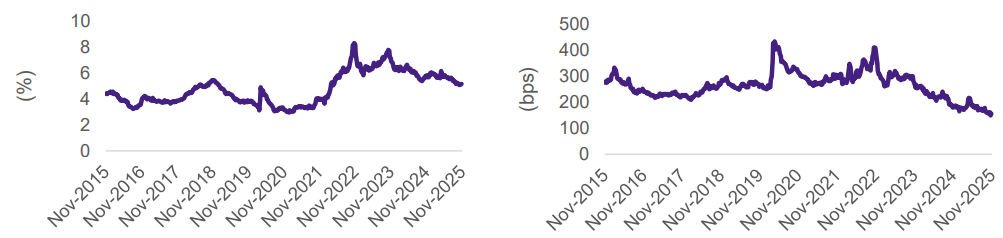
Source: Bloomberg as at 13 November 2025
Macau gaming and Asian insurance sectors favoured
The outlook for select sectors in Asia remains positive, particularly for Macau gaming and the region’s insurance industry. Macau’s gaming sector continues to benefit from strong performance, underpinned by resilient high-end consumer spending. This trend is expected to support further growth, with anticipated bond issuance likely to finance upcoming capital expenditures and refinance maturing debt. Meanwhile, the Asian insurance sector is also showing promise, supported by a favourable regulatory environment. Valuations in the sector remain attractive, and there are continued expectations for supply, which could present opportunities for investors seeking yield and diversification.
Cautious on sovereigns, quasi-sovereigns and Hong Kong real estate sector
On the other hand, given the tight valuations, a cautious stance is warranted for Asia sovereigns and quasi-sovereigns. While we do not see immediate macro fundamental concerns that would drive material spread widening, the historically tight spreads leave little buffer should policy leeway diminish further in response to external shocks in the year ahead. Similarly, the outlook for Hong Kong’s property sector remains subdued. While the residential segment shows signs of stabilisation, the commercial property sector continues to face headwinds with tight access to funding. Investors may need to remain selective and vigilant in these areas, as structural challenges and macroeconomic headwinds persist.
Conclusion
Asia’s macro outlook for 2026 remains broadly positive, supported by eased US-China trade tensions, broader tariff exemptions, and contained inflation. Fiscal policy will likely take the lead in countering any slowdown, except in high-yielding economies such as India, Indonesia and the Philippines, where monetary policy still has room for easing. With potential rate cuts, low inflation and ongoing fiscal consolidation, government bonds in these economies are well positioned to outperform.
In Singapore, growth is expected to moderate toward trend while core inflation rises modestly, allowing for a less restrictive MAS stance. SGS yields are likely to track those of USTs lower, with firm demand despite modestly higher issuance and expanding green bond supply.
With limited room for further spread compression, carry is expected to be the main driver of returns for Asian credits in 2026. We favour Macau gaming and Asian insurance, while remaining selective on sovereigns, quasi-sovereigns and the Hong Kong real estate sector. Narrow spread buffers, evolving US monetary policy, and localised risks highlight the need for selective positioning as the region navigates a more nuanced growth environment.