


For decades, Japanese companies have been known for the substantial amounts of cash on their balance sheets. However, such an approach to cash—once considered prudent during a prolonged period of deflation—is becoming obsolete amid Japan's changing economic and corporate environment.
Corporate governance reforms have encouraged companies to pay greater attention to capital efficiency. The return of inflation is changing long-established approaches to pricing, investment and balance-sheet management. Rather than simply accumulate cash, companies are being challenged to demonstrate how that capital can be used efficiently. From an investment perspective, we believe that the corporate shift in attitudes towards holding cash has important implications.
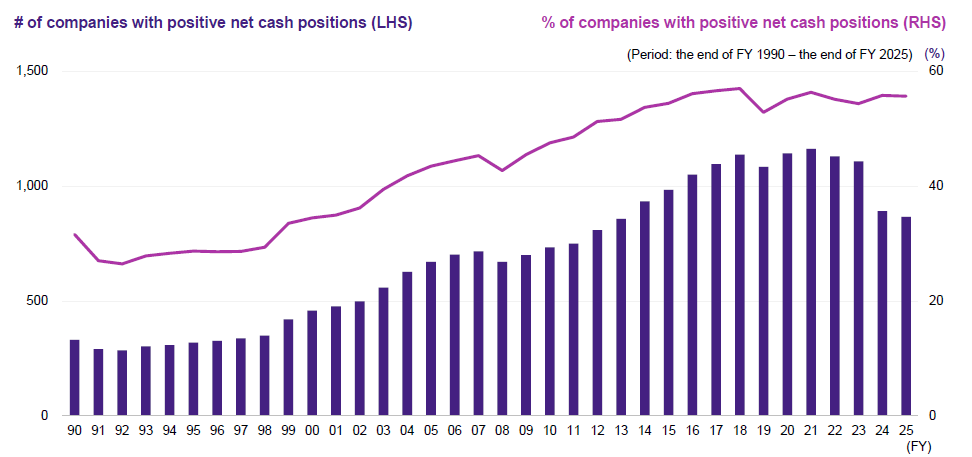
The change in Japan Inc.’s approach to cash, coupled with a steady increase in the investment universe (Chart 1) represents a significant opportunity for a cash-rich investment strategy. However, it is about much more than identifying companies with large cash balances. The real challenge is finding companies capable of putting underutilised capital to work in ways that can improve profitability, capital efficiency and, ultimately, greater shareholder value.
Chart 1: Japanese companies with positive net cash positions have increased steadily
Past data or any forecast is not necessarily indicative of future outcome.
Source: Amova Asset Management based on data from Nikkei, Inc., the Japan Company Handbook (FY2019 and onward) and Nomura Securities (FY2018 and previous).
From earnings to capital efficiency
One of the most important changes in corporate Japan has been a shift in management focus. Historically, many Japanese companies concentrated primarily on profit and loss. Management discussions frequently revolved around sales and earnings, but how capital was used to generate those earnings received less attention.
That mindset is changing, however, as return on equity and other measures of capital efficiency have become increasingly important considerations for corporate management. An important catalyst was the Tokyo Stock Exchange (TSE)'s 2023 initiative encouraging listed companies to pay greater attention to their cost of capital and share valuations. Pressure has also come from other quarters, including activist investors and shareholders. Collectively, these developments are encouraging companies to consider not only how much they earn, but also whether their balance sheets and capital allocation decisions are efficient.
This matters particularly for cash-rich companies. An accumulation of cash can provide financial resilience, but excessive cash can also represent inefficiently deployed capital. If companies can put that capital to productive use, whether through investment in the business or by returning excess capital to shareholders, they can improve the efficiency of their balance sheets. Improvements in capital efficiency can, in turn, provide a catalyst for improving valuations. The changing mindset among Japanese companies therefore represents a structural tailwind for cash rich investing.
Looking for change, not simply cheap stocks
It is worth explaining the subtle difference between cash rich investing and conventional value investing. Traditional value strategies often begin with valuation measures such as the price-to-earnings or price-to-book ratio and seek stocks that appear inexpensive on those measures. Certain sectors, including financials and resource-related companies, can consequently feature prominently in traditional value portfolios.
The cash rich approach takes a different route. Companies are first screened according to both the strength of their balance sheets and valuation. Out of the roughly 4,000 listed Japanese companies, approximately 2,000 currently meet the strategy's definition of cash rich. An additional screen removes those considered expensive, leaving a significantly smaller universe for fundamental research.
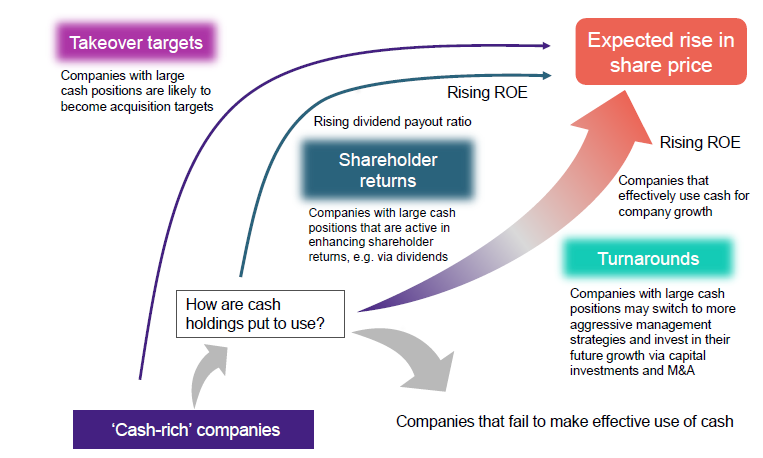
The quantitative screening is only the beginning. The key question is not whether a company looks inexpensive today: it is what the company might look like several years from now if management deploys its capital more effectively. A company might, for example, use excess cash to expand a promising business, invest in new production capacity or strengthen an existing competitive advantage. Alternatively, where attractive investment opportunities do not exist, returning capital to shareholders may be the more efficient option.
This makes change particularly important to the investment process. A company that does not appear exceptionally cheap can still be considered attractive if it appears to have the potential to improve its earnings and capital efficiency, making its valuation substantially more compelling several years later. In that sense, cash rich investing is not simply about buying cheap companies but identifying businesses where the way capital is used has the potential to change for the better.
Exhibit 1: Three different scenarios for effective use of cash holdings
Source: Amova AM. For illustrative purposes only.
Cash alone is not enough
This distinction is critical because having excess cash does not, in itself, make a company an attractive investment. Companies need to demonstrate that capital can be deployed in ways that improve capital efficiency and create value. Assessing management's intentions is therefore an important part of the investment process.
Quantitative screening can identify companies with strong balance sheets and attractive valuations, but it cannot determine how effectively management will allocate that capital. Fundamental analysis and dialogue with company management therefore play an important role in separating businesses that simply accumulate cash from those in which excess capital could become a source of future value creation.
As part of this process, we conduct roughly 100 company interviews each year. Demanding that every cash-rich company immediately begin returning money to shareholders is not our objective. Rather, we aim to understand management's priorities, the investment opportunities available to the business and whether capital allocation is likely to improve future returns. Being able to make that distinction has become more valuable as corporate Japan increasingly diverges between companies embracing change and those that continue to leave capital largely idle.
Inflation is revealing which companies can put capital to productive use
Japan's emergence from decades of deflation adds another dimension to this investment process. As inflation raises input and labour costs, companies' ability to protect profitability through factors such as pricing is becoming an increasingly important indication of that underlying ability to generate earnings.
In this sense, inflation is widening the gap between companies. Those with strong franchises may be able to pass higher costs on to customers and protect profitability. Others may struggle to do so. For an investor, identifying that difference is key to assessing whether today's excess capital can be converted into higher earnings and improved capital efficiency.
Saizeriya provides an interesting example. The restaurant chain, which operates roughly 1,000 eateries across Japan, had long been associated with deflation due to its affordable menu of Italian-inspired cuisine offered at rock-bottom prices—such as 100-yen glasses of wine. Saizeriya became known for its refusal to raise prices, even as Japan exited deflation and higher input costs weighed on margins in its domestic business. Yet we believed such an approach could eventually change as Saizeriya appeared to have something that many other companies lack. It had pricing power supported by strong customer loyalty. The strength of customer demand was visible, with diners often queuing for tables at its restaurants.
This loyalty proved resilient when Saizeriya ultimately raised prices in October, its first comprehensive hike since 1998. When a company that has historically resisted price increases eventually begins raising prices, the potential positive impact on profitability can be more significant than at a company that has increased them incrementally over time. If higher prices can be absorbed without significantly weakening demand, that change can potentially translate into stronger margins and earnings.
When rising costs create opportunity
The cash rich universe tends to have limited exposure to resource companies and greater exposure to businesses further downstream. When oil or commodity prices increase, these companies can initially suffer due to higher costs and lower margins. While market reaction to the rise in the cost of inputs can be very quick, the ability of companies to offset those pressures through higher prices may take six months or a year to become visible.
This time lag can create opportunities. If a company has a strong brand, attractive products and sufficient pricing power, higher input costs do not need to result in permanently lower profitability. After an initial margin squeeze, price increases can allow profitability to recover. If the share price has already fallen substantially on concerns about higher costs, the gap between short-term market expectations and longer-term earnings potential can become attractive.
Unicharm Corporation, a leading Japanese manufacturer of disposable hygiene products, household cleaning items and pet care goods, provides another example of how underlying business quality matters when assessing whether a company's financial strength can ultimately translate into sustainable returns. Higher raw material costs squeezed profit margins and put significant pressure on the company’s share price, prompting it to raise prices across its product range. Yet viewed through a longer-term lens, the company's global brand and product competitiveness provides us with a reason to believe that the pressure on margins does not need to be permanent. Rather, as pricing adjusts, there is potential for profitability to normalise over time.
For a cash-rich company, the durability of such competitiveness is particularly important. Simply having capital available to invest does not create value. The strength of a company's franchise and its ability to navigate an inflationary environment therefore form an important part of judging its longer-term potential.
For a strategy focused on change, periods when investors concentrate heavily on immediate cost pressures can therefore offer opportunities to invest several steps ahead of a potential improvement.
Beyond buybacks: putting cash to work for growth
There is another important misconception about investing in cash-rich Japanese companies. Since the TSE's 2023 reforms, much attention has understandably focused on dividends and share buybacks. Cash-rich companies can consequently be viewed primarily as candidates for shareholder returns, sometimes through pressure from activist investors.
However, we believe that is only one part of the story. Returning excess capital to shareholders can certainly be an appropriate decision when a company does not have sufficiently attractive investment opportunities. But productive investment in future growth can be an even more powerful use of capital.
The most compelling outcome is often for a company to deploy surplus cash into businesses where it can generate attractive returns and increase future earnings. Capital expenditure, investment in new growth areas and other forms of productive deployment can improve both earnings and capital efficiency when executed successfully.
The emerging debate around more detailed disclosure of cash allocation may reinforce this trend by encouraging management teams to explain more clearly how cash will be used over a period of several years. For investors, that places an even greater premium on distinguishing between companies that merely hold cash and companies capable of putting it to work.
A long-term approach to a fundamental investment question
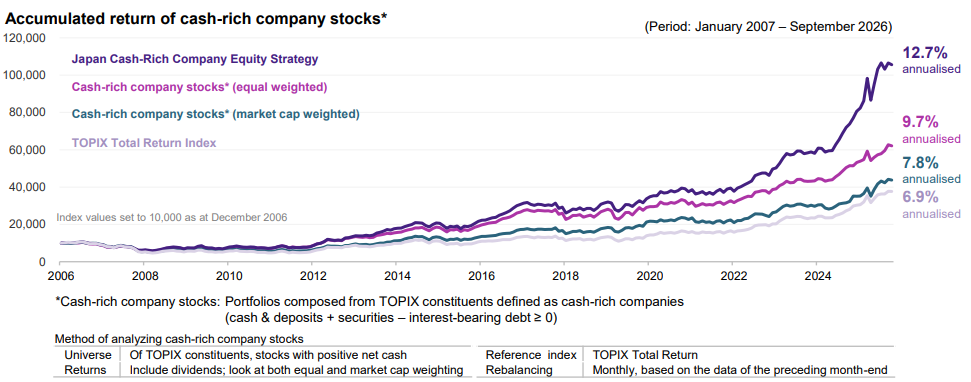
Cash rich investing has attracted greater attention as Japan's governance reforms have accelerated, but the fundamental investment principle is not new. The strategy has a track record that goes back more than two decades (Chart 2), well before the TSE's recent reforms brought greater attention to the efficiency of corporate balance sheets.
Chart 2: Long-term outperformance of cash-rich company stocks
Past data or any forecast is not necessarily indicative of future outcome.
Source: Amova AM based on data deemed reliable; TOPIX Total Return Index data from JPX Market Innovation & Research, Inc.
What has changed is the environment surrounding our cash-rich investment philosophy. Ultimately, the question is a basic one: how effectively does a company use the capital entrusted to it? The question has grown in importance as Japan transitions away from deflation, the focus on return on equity sharpens and emphasis on productive investment is renewed. These changes are also widening the gap between companies willing and able to change and those that remain slow to adapt.
The divergence can be fertile ground for active investors. In our view, opportunity can be found by applying a longstanding investment approach to a corporate environment that is becoming increasingly open to change. Cash may be where the investment process begins, but the potential for change is where the opportunity lies.
References
Reference to any particular security or sector is purely for illustrative purposes only and does not constitute a recommendation, nor to be relied upon as financial advice in any way. There can be no assurance that any performance will be achieved in any given market condition or cycle. Past performance or any prediction, projection or forecast is not indicative of future performance. They do not indicate or guarantee the current or future holdings, purchases or sales of any fund or strategy managed by Amova Asset Management.