

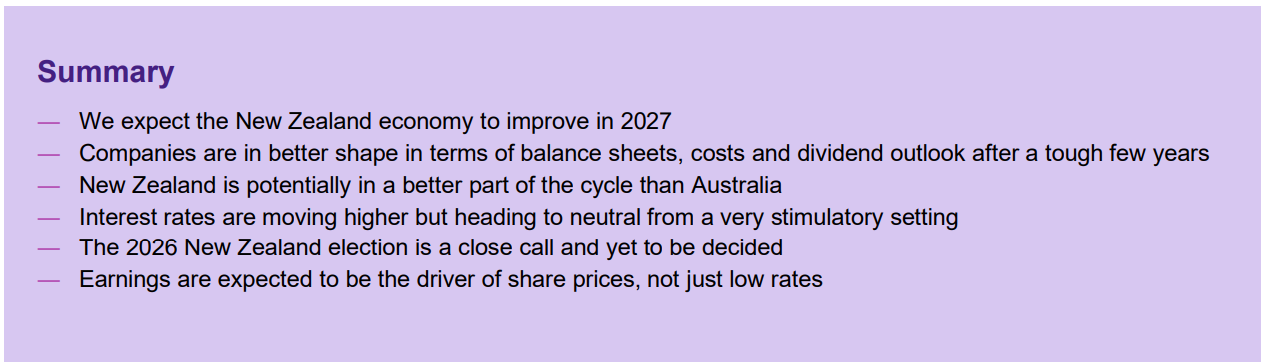
After several false starts, we expect the New Zealand economy to begin a slow cyclical recovery in 2027. We see companies entering the recovery in better shape than the economy itself.
A year ago, I expected 2026 to be the year lower interest rates would finally begin to flow through to New Zealand households and companies. However, they did not get the chance. A war in the Middle East pushed up fuel prices, lifted inflation and interrupted the recovery before it had properly gathered momentum. The Reserve Bank of New Zealand (RBNZ) responded by reversing course and raising the Official Cash Rate (OCR).
How my 2026 calls held up
I was right on exporters. The New Zealand dollar has stayed weak, and the export-facing parts of the economy are the ones benefiting from strong commodity prices and more tourists. I was too early on retail: I expected an uptick as mortgages refixed lower, but higher fuel costs have left households with less to spend. I also had the RBNZ waiting until late in 2026 before lifting the OCR, and it moved in July. The conflict in the Middle East was the swing factor I did not see coming, and it accounts for both the retail and the OCR misses.
The year ahead
The recovery has been delayed, rather than abandoned. Our central view is that economic activity will improve through 2027, although the upturn is likely to be slower and less evenly distributed than in a normal cycle. The corporate sector is generally in better shape as we move into 2027. New Zealand companies have spent several difficult years reducing costs, selling non-core assets and strengthening their balance sheets. As demand returns, even gradually, many should be capable of converting modest revenue growth into stronger earnings and cash flow.
Interest rates are moving towards neutral
The OCR is currently at 2.75%. The RBNZ expects inflation to return to its 1–3% target band during the first half of 2027, before settling close to 2%. However, with inflation still elevated and the economy recovering, monetary policy is likely to move towards a neutral setting rather than return to the very low rates of the past decade. We will get an update from the RBNZ in December.
We do not expect the OCR increases required to reach neutral to derail the recovery, but neither can investors rely on falling interest rates to lift the market. Returns in 2027 will need to be earned through higher profits, stronger cash generation and, eventually, growing dividends.
The move towards neutral interest rates is also consistent with a gradual rise in the New Zealand dollar. A stronger currency would reduce some of the support exporters have enjoyed, but it should also lower imported inflation and improve household purchasing power. We expect the appreciation to be modest, which should keep export-facing companies and tourism-exposed businesses competitive.
Companies have done the hard work
The starting point for the corporate sector is stronger than it has been for some time.
Fletcher Building provides a clear example. The company has simplified its portfolio, sold its construction division and other non-core assets, and used the proceeds to reduce debt. Management has also focused on costs, capital discipline and operational performance.
SkyCity has similarly been selling assets, lowering debt and reducing its cost base. The company has also been preparing for two significant infrastructure developments: the opening and ramp-up of the New Zealand International Convention Centre, and the opening of the City Rail Link, which will have a station on the doorstep of its Auckland property.
Spark is working through a substantial reset of its operating model and cost structure. The company has been pursuing a leaner cost base and lower capital intensity against a difficult operating backdrop.
Other companies are taking comparable steps. Ryman Healthcare has raised capital, reduced development spending and placed greater emphasis on releasing cash from its existing portfolio. Kathmandu Brands has been rationalising costs and inventory following weak consumer demand. The Warehouse Group has been simplifying operations and addressing underperforming formats. None of this guarantees a rapid earnings recovery, but these steps may increase operating leverage if revenue conditions improve.
The pattern is important. Companies have not waited for the economy to rescue them. They have restructured during the downturn.
Dividends can return, but cash flow comes first
Improving balance sheets have also brought companies’ dividend policies back into focus.
Like a number of others, Fletcher Building paid no FY26 dividend and has said its dividend policy will be reset once the company is generating positive free cash flow and net debt is in the lower half of its target range. This places cash generation and balance sheet strength at the centre of the company’s stated approach to future distributions.
SkyCity has similarly focused on debt reduction and completion of its major investment programme. These steps reflect management’s emphasis on improving its capacity to restore distributions.
At Ryman, the immediate priorities have been debt reduction, cash release and improving returns on development capital.
The common theme across these companies is less about the timing of their first dividend and more about management teams’ emphasis on normalising free cash flow before becoming comfortable returning capital to shareholders again.
New Zealand is moving ahead of Australia
The relative economic position of New Zealand and Australia could become an increasingly important theme.
New Zealand entered the downturn earlier and monetary policy began adjusting earlier. Although the domestic recovery is slow, the economy should increasingly benefit from improving household incomes, recovering construction activity and unemployment moving in the right direction.
Meanwhile, Australia continues to battle inflation and the Reserve Bank of Australia lifted its cash rate to 4.85% earlier this month, its fifth increase this year. Capital city home values have fallen about 8% since March, and unemployment has risen to 4.7%.
This points to a period in which New Zealand growth could improve while Australian growth slows. That narrowing gap could also affect migration. Better employment prospects in New Zealand and softer conditions in Australia could make staying or returning home more attractive, and a low New Zealand dollar makes an Australian move more expensive. As a result, the net outflow of New Zealanders could slow. That would support housing demand, consumption and business confidence, although the timing remains uncertain.
The election leaves some uncertainty
The 7 November 2026 New Zealand election produced an exceptionally close preliminary result. On preliminary numbers, National, ACT and New Zealand First together hold 67 of the enlarged Parliament’s 131 seats, just above the 66 required for a majority.
A National-led coalition therefore appears the most likely outcome, but the final result is not yet known as special votes remain to be counted. Official results are due on 27 November, and coalition negotiations may extend into 2027, although hopefully an agreement can be reached before the New Year.
For markets, the composition of the government may matter more than the headline result. Energy policy, infrastructure investment, regulation and fiscal discipline could all be influenced by coalition negotiations. The uncertainty may delay some investment decisions, but we do not expect it to change the underlying direction of the economic cycle.
Conclusion: earnings could decide the year
Our conclusion is cautiously constructive.
New Zealand is approaching the recovery with companies carrying less debt, lower costs and more disciplined investment plans. The move towards neutral interest rates, rather than deeply restrictive territory, may allow activity to improve without recreating the excesses of the previous cycle.
The recovery will not lift every company equally. We favour businesses with strong balance sheets, clear operating leverage and management teams that have already completed the difficult restructuring work. We are more cautious on companies that require a rapid consumer rebound, materially lower long-term interest rates or generous valuation multiples to justify their share prices.
After several years in which the recovery was repeatedly forecast but derailed by external events, we expect 2027 to be the year it begins to appear in company earnings. The opportunity is not simply to own the market. It is to identify which companies are genuinely ready for it.