


US midterms not expected to signal a fundamental shift for Japanese equities
The global markets watched the US midterm elections closely and Japan was no exception. Despite the hype, the elections’ longer-term impact on Japan’s economy and equities may be limited. Many of the Trump administration’s trade and tariff measures related to Japan have been conducted through executive authority rather than via Congress. As a result, the Republicans losing the congressional majority may not alter the general direction of US trade policy.
The same applies to fiscal and monetary policy. Political division in Washington could discourage major fiscal initiatives, while the president could opt to veto changes initiated by Congress. The elections, therefore, may not result in fiscal expansion large enough to strongly impact US long-term yields. Similarly, Federal Reserve (Fed) policy is not expected to change significantly after the midterms. Fed Chair Kevin Warsh has seemingly held his ground on policy direction so far and he may not be swayed easily by Democratic policy initiatives. The relatively muted response by dollar/yen following the elections would appear consistent with such a view.
A more immediate concern for Japanese equities is AI and semiconductor-related regulation. Expectations that Democratic policymakers could favour tighter restrictions on data-centre development or AI applications contributed to some initial volatility in Japanese technology stocks. However, any restrictions the Democrats may try to enact can be viewed as another potential constraint, alongside current shortages in electricity and of cables, cooling systems and other materials needed to build data centres, rather than a threat to the underlying AI growth story.
While restrictions and political changes in Washington may have some impact, the growth narrative driven by AI agents and physical AI is expected to remain intact. Restrictions in individual US states may slow data-centre construction, but in the long run, investment could move to other states more receptive to development. The more important challenges facing AI-related companies remain intensifying competition, capacity constraints and rising debt levels. Short-term political uncertainty may amplify those concerns. However, once it becomes clear that innovations such as AI agents and physical AI can translate into sustainable profits, political developments will have less of an impact. Overall, the midterms may create political noise and bouts of market volatility, but they are unlikely to fundamentally alter Japan’s economic outlook.
The 2% target and the question of whether Japan has overcome deflation
The Bank of Japan (BOJ)’s recent assessment that underlying inflation is now broadly consistent with its 2% price stability target represented an important milestone. From the BOJ’s perspective, we can say that its price objective has effectively been achieved. In our view, however, that should not be understood as a declaration by the central bank that deflation has been overcome.
This is because Japan will only leave deflation behind if consumers begin to spend more. Much of the country’s recent inflation has been driven by higher food, utility, gasoline and imported-goods prices rather than robust consumer spending. Although wage growth has recently begun to exceed inflation, households have yet to fully experience improvements in purchasing power to change their spending behaviour.
A genuine exit from deflation would therefore require the virtuous cycle of rising wages and inflation to become further entrenched. Persistent labour shortages should encourage companies to invest in machinery and productivity improvements, allowing wages to rise faster than prices. Higher real incomes would then need to translate into stronger consumption, whether through greater spending on travel and dining or major purchases such as housing. Only when households begin to feel that their living standards are improving would a declaration of victory over deflation become convincing.
For equities, the next issue is the appropriate pace of monetary normalisation. Lower interest rates are not necessarily better for stocks. If the BOJ tightens too slowly and allows inflation run rampant, it could hurt its credibility and that would be damaging for the overall market. Conversely, tightening that is too aggressive could constrain economic activity. The most constructive scenario is therefore a gradual normalisation in line with sustainable inflation.
The Japanese equity market is currently being led by AI- and semiconductor-related companies. These companies are relatively unaffected by higher interest rates, because their profits are driven by strong earnings growth and investment. Meanwhile, higher interest rates could improve earnings opportunities for banks and other financial institutions, providing another source of support for the broader market.
If inflation stabilises sustainably at around 2%, investors may eventually have to become comfortable with a terminal policy rate above 2%. The policy rate is currently at 1.25% and such normalisation still has some distance to go. And it may take a while before the government makes a formal declaration that deflation has ended. The government has its own agenda. It is about to cut the consumption tax rate on food and beverages and a likely scenario is for the government to declare victory over deflation when its initiative results in stronger consumer spending.
Japanese stocks fall in October amid concerns over inflation and AI
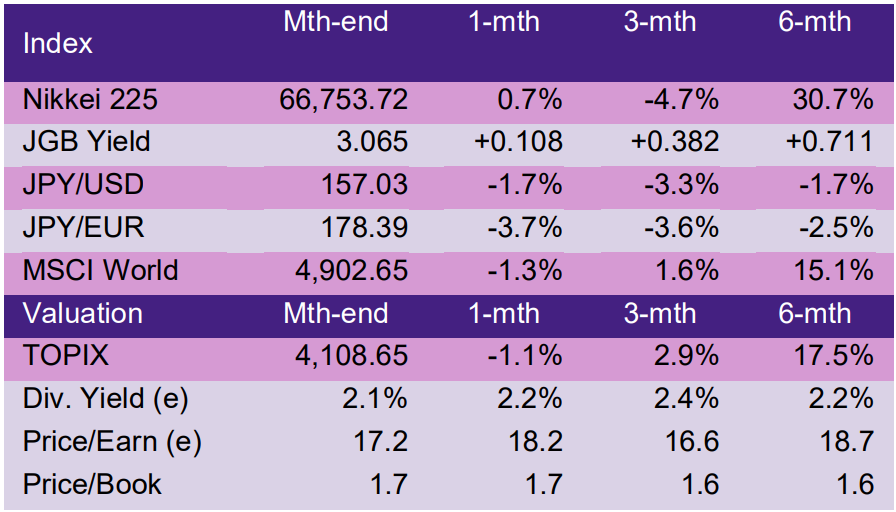
The Japanese equity market ended October lower, with the TOPIX Total Return Gross Index falling 3.48% on-month and the Nikkei Stock Average (Nikkei 225) Total Return down 5.18% (both in JPY terms). While the market was supported by a decline in companies’ overall inflation expectations in the BOJ’s Tankan survey compared with the previous survey, which reduced expectations for an early additional rate hike by the central bank, as well as investors flocking to defensive stocks such as pharmaceuticals during periods of yen appreciation, these positive factors were outweighed by renewed inflation concerns amid higher crude oil prices resulting from escalating tensions in the Middle East. Investor sentiment was also dampened by growing uncertainty over the sustainability of AI investment following credit concerns surrounding an emerging US AI-related company.
Of the 33 Tokyo Stock Exchange sectors, 17 sectors rose, with Services, Mining, and Pharmaceuticals posting the strongest gains. In contrast, 16 sectors declined, including Nonferrous Metals, Machinery, and Banks.
Exhibit 1: Major indices
Source: Bloomberg, 30 October 2026
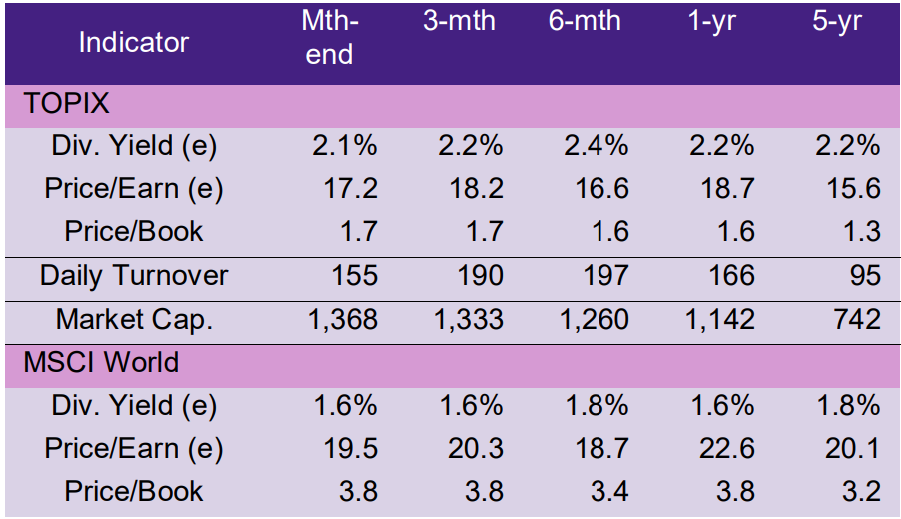
Exhibit 2: Valuation and indicators
Source: Bloomberg, 30 October 2026