


Global growth: where will tomorrow’s return on investment come from?
The US remains the principal global growth engine, supported by corporate investment and earnings. However, growth remains uneven across firms, sectors and households. Continued inflation pressures and monetary policy normalisation create a more demanding environment for returns. That said, recent evidence on labour productivity and unit labour costs complicates an exclusively inflationary interpretation. At the same time, stronger labour productivity does not necessarily establish a durable improvement in total factor productivity (TFP), which is the long-term growth driver.
In the meantime, economic growth and market valuations appear increasingly reliant on the assumption that the robust returns realised to date will continue, with most of these returns having been achieved amid a large capital investment boom. Another way to look at it is that strong investment can contribute to economic growth today without guaranteeing sufficient future returns. The central question for 2027 and beyond is: where will the economic returns on today’s investment emerge, and what are the conditions necessary to sustain them?
The implications for 2027 depend on whether productivity improvements can broaden enough to support real income growth, and this is not yet a foregone conclusion. The central scenario remains one of resilience, but with increasing sensitivity to financing conditions, inflation persistence and the risk of corporate earnings not meeting lofty expectations.
Technology and productivity: the road from investment to diffusion
AI infrastructure investment remains a substantial source of economic activity and corporate earnings, particularly in the US. This is also true in many pockets of emerging markets; volatility and rotation among a handful of Asian technology stocks (especially those related to semiconductors and AI-adjacent supply chains) have been particularly visible in recent sessions. According to Bloomberg, technology hardware represented 49% of the MSCI AC Asia ex-Japan Index. However, the earnings story is even more concentrated: emerging market Asia earnings are projected to rise more than 220% in 2026, with most of the gains attributable to just two Asian technology firms. Recent corrections in technology stocks have reminded us that the AI sell-off risk is real. However, subsequent rebounds also remind us how deep-seated global investors’ risk tolerance is, and how important expectations have been in sustaining the investment phase of the technology boom.
The investment process has started with healthy spending and contractual commitments, which has resulted in a build-up in installed productive capacity. However, recent earnings announcements have clearly shown that one firm’s capex is another’s revenue, underscoring the market’s reliance on continued investment.[1] Even in massive innovation booms, however, the investment phase will end. Eventually, realised productivity gains and financial returns on these investments will have to materialise. Between these two phases, however, there can be a significant period of disruption, during which incumbent innovators may face challenges (Chart 1). Beneficiaries need not be the original capital providers.
Chart 1: Technological innovation cycles and total factor productivity growth2
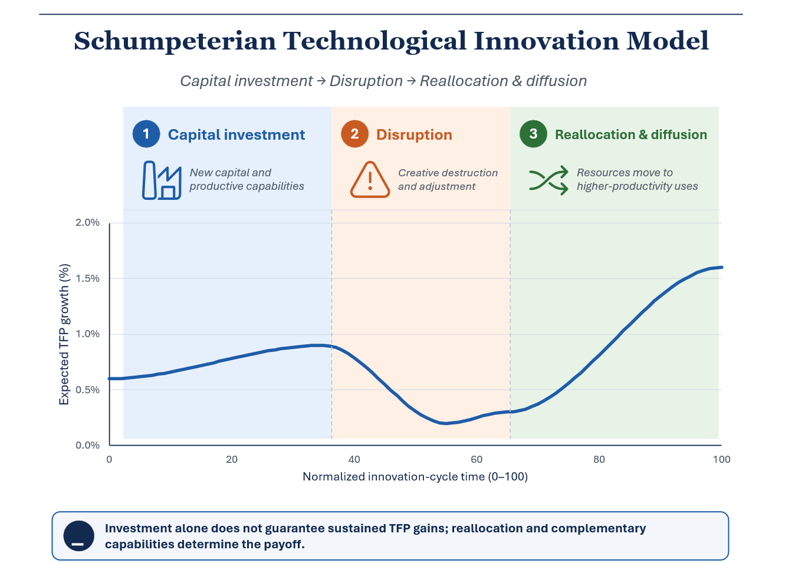
Stylised expectation and not an empirical estimate, historical calibration or forecast. The sequence and timing are illustrative.
Illustrated by the author
Spending and contractual commitments may bode well for growth, but it will be important to monitor installed productive capacity against these commitments, and any signal of realised productivity gains from those making the capital investments. On the other hand, it will be increasingly important to explore the economic implications of rapid technological obsolescence. As we elaborated in our September 2026 Global Investment Strategy Committee (GISC) Outlook, falling prices for frontier computing capabilities do not necessarily mean that economic user costs will decline when migration, reintegration and shortening capital lifecycles are considered. The option value for waiting for newer technologies may delay complementary investment in workflows, organisational structures and human capital, even when underlying AI capabilities are advancing rapidly. If capital expenditure slows as productivity stutters, it is possible that we will begin to see the start of the disruption phase, which typically precedes eventual reallocation and diffusion.
As a result, firm-level capabilities and complementary capital may become increasingly important sources of differentiation. Commoditisation of AI could shift economic rents toward businesses with organisational, human or complementary productive assets that are scarce in the wider economy. In our view, therefore, it is worthwhile diversifying into firms with robust balance sheets, steady business processes and strong corporate governance. Meanwhile, company-specific shocks may remain localised but could become macroeconomically important if they affect financing, capital expenditure or broader earnings expectations.
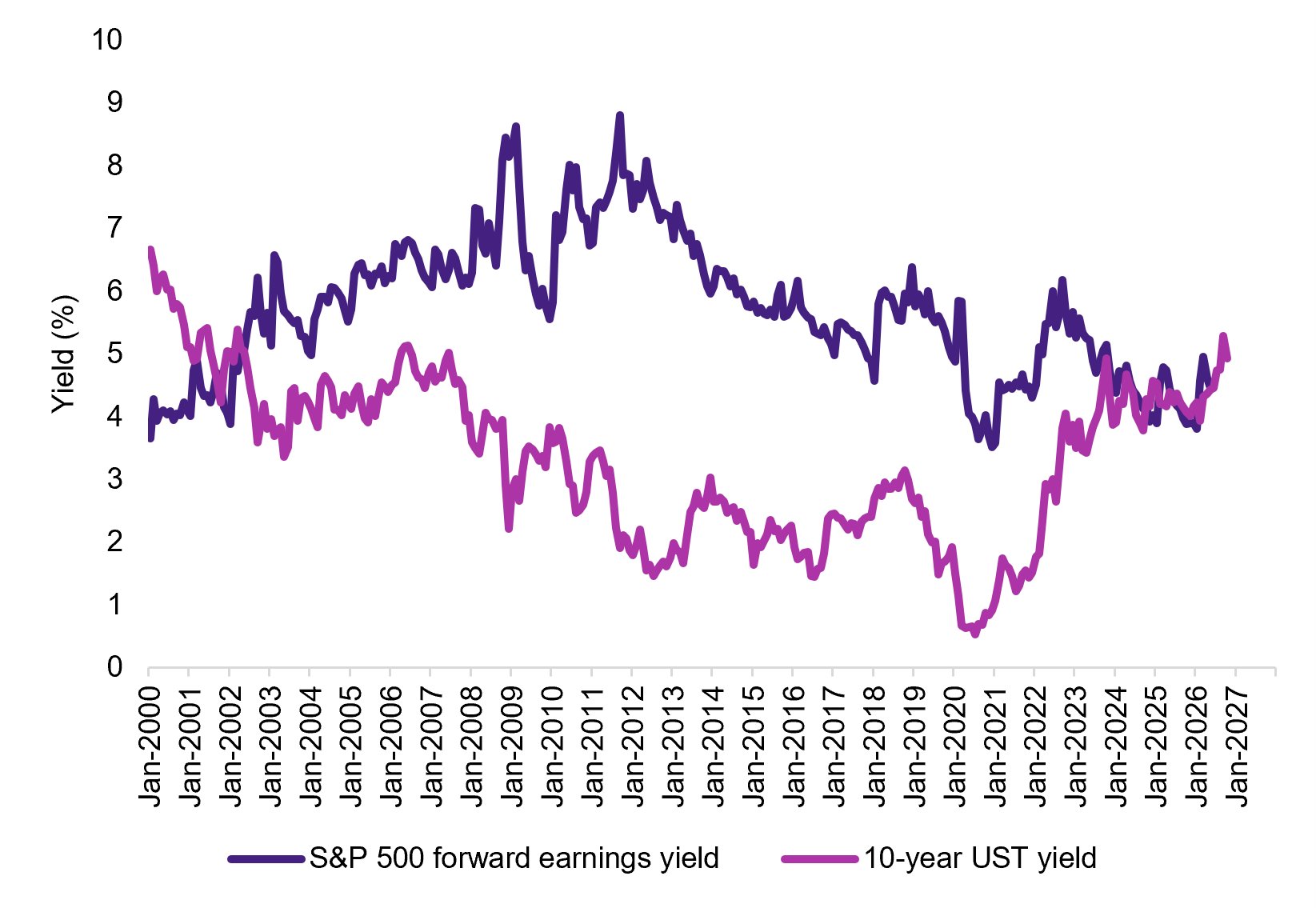
Chart 2: Rising rates are eating into the forward earnings yield premium
Source: Bloomberg, author’s calculations
Financing growth: fiscal policy, long-term interest rates and capital allocation
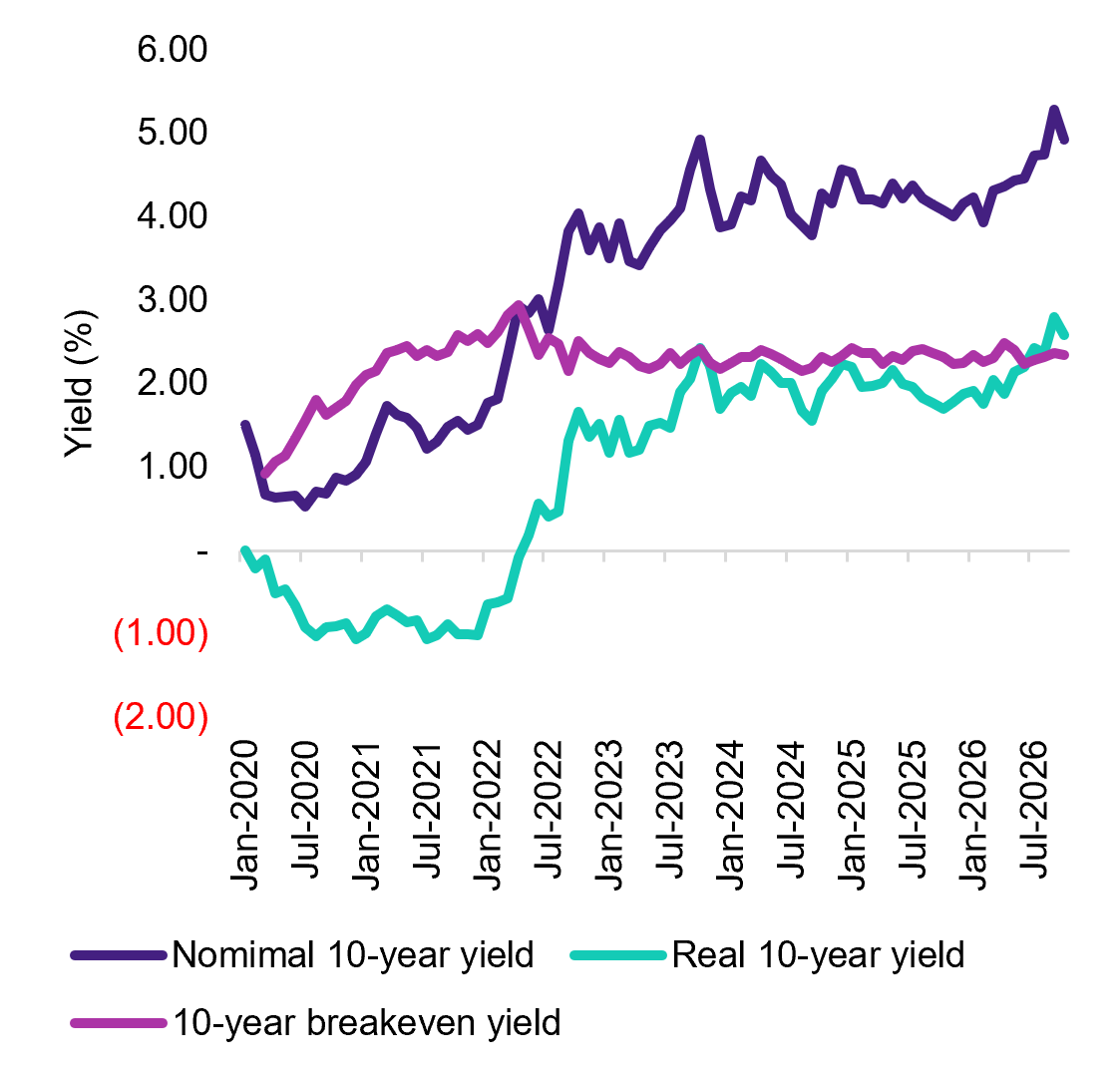
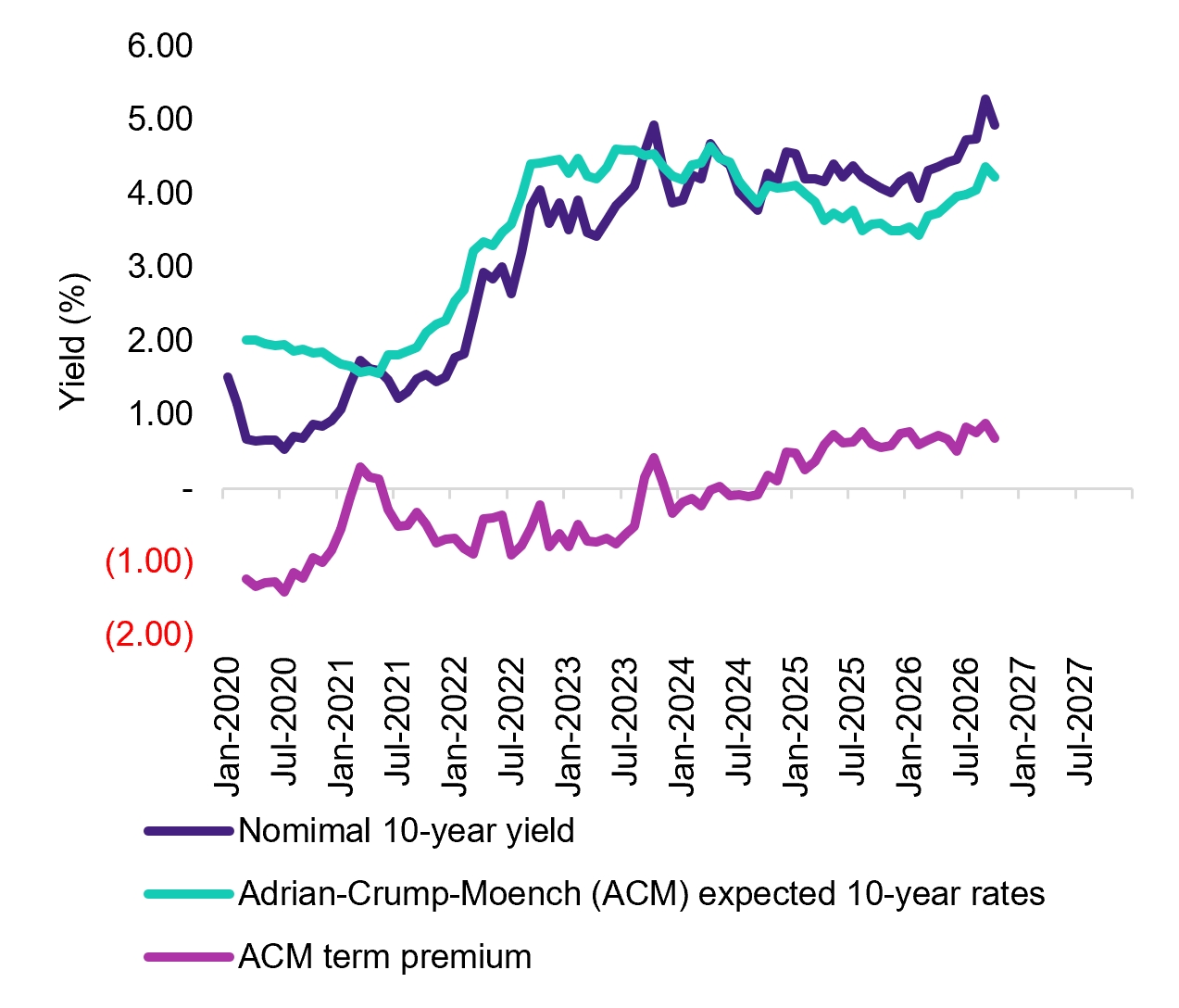
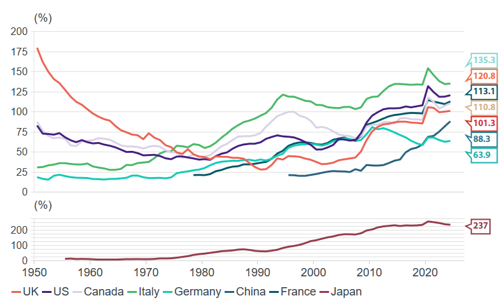
Competition for capital is increasing between sovereign and private-sector borrowers. The latter cohort remains dominated by the financing needs of the ongoing innovation-related investment boom, but growing demand for long-duration financing more broadly may alter the conditions supporting both public and private investment. Expectations for ongoing withdrawal of monetary stimulus persist; the long end of the US yield curve now prices a “higher-for-longer” expectation for the Federal Reserve (Fed), and other yield curves (such as Japan’s) have started to price in more hawkish central bank policy as well. In the absence of a slowdown in growth, ongoing withdrawal of global stimulus is likely to continue and, albeit at a lag, to tighten financial conditions. Near-record developed country indebtedness is also keeping pressure on the longer end of global bond curves, and at the same time, potentially limiting developed economy fiscal largesse.
Chart 3: US real rates and risk-neutral interest rates consistent with “higher for longer” Fed expectations
Source: Bloomberg, author’s calculations
For now, global capital flows, currencies and energy costs transmit changes in US growth and financial conditions around the world. However, the potential for tighter conditions going forward may mean that the expansion has limited room to run in the absence of a productivity payoff on investments made to date. Policy credibility, meanwhile, becomes increasingly important as investors differentiate productive investment from fiscal expansion that fails to generate adequate economic returns.
Chart 4: Indebtedness of large economies (percent of GDP)
Source: Amova AM, IMF, Macrobond
Regional opportunities and constraints: finding diversification
In October 2026, the IMF forecast global growth of 3.4% for 2027, with the US growing by more than 2% and the euro area by slightly more than 1%. It expects Japan to grow by less than 1%, which is still above the country’s potential growth rate of around 0.5% as estimated by the Bank of Japan (BOJ). The IMF foresees emerging markets growing at diverse rates, with China’s growth slowing to 4%. Although Amova Asset Management’s GISC December-on-December forecast is not yet available for 2027, the committee’s outlook is largely in line with the IMF’s for most of the coming year.
US: investment-led resilience versus concentration and financing constraints
In the US, investment and earnings have supported resilience; global risk-tolerance sentiment and nominal growth has maintained this balance. However, the narrowness of leadership in the stock market, elevated valuations and reliance on benign financing conditions raise questions about sustainability. The gap between real-economy investment and anticipated financial returns, meanwhile, has been somewhat obscured by the “circular economy” of the ongoing investment boom, with purchasing commitments, leases and off-balance sheet transactions occupying a greater proportion of the investment boom’s accumulating assets (as elaborated in the Q4 GISC Outlook).
The key forward-looking issue is whether investment-led growth can broaden into productivity improvements and real economic returns. The danger is consumption, still a stalwart of US economic growth, may not underpin economic growth indefinitely, with the investment boom giving way to disruptions before the value of investments is realised in productivity terms.
Japan: corporate transformation, monetary normalisation and domestic demand challenges
In Japan, domestic investment, ongoing corporate reform and labour scarcity have supported capital renewal. However, the test is whether investment and wage increases can lift productivity, real household income and consumption. With global investors’ eyes firmly on corporate balance sheets, we believe that stronger investment alone will be insufficient for Japan to achieve a self-sustaining recovery. Consumption and earnings breadth will be expected to follow through, and the key is whether wage growth, productive investment and capital reallocation can generate sufficiently broad income gains.
The signals remain positive, supporting the BOJ’s decision to declare in October 2026 that underlying inflation is consistent with its 2% target. At the same time, BOJ Governor Kazuo Ueda cautioned against confusing meeting the target with achieving a sustainable recovery. Inflation persistence remains a challenge, and we expect the BOJ to stay on a rate hike trajectory. Fiscal credibility remains another challenge and may limit the scope for further fiscal expansion. In our view, Japan’s opportunity increasingly lies in productive private-sector capital allocation rather than reliance on fiscal expansion or currency depreciation.
China: Still feeling growing pains in strategic investment transition
Weak property and household demand coexist in China with strength in manufacturing, strategic sectors and exports. The central test is the execution of already-authorised projects and their transmission into spending, cash flows and household demand. A significant proportion of authorised local government expenditure has not yet been spent, which may buoy growth towards the end of 2026. The transition away from property-led expansion towards infrastructure, technology, advanced manufacturing and other strategic sectors remains a defining structural adjustment. It is worth noting that lofty budgets for China’s “six networks” program (which includes pivotal projects such as enhancing the country’s electricity grid) still imply trillions of yuan of planned investment by 2030.[2] Therefore, we expect below-target periods of growth to be followed by catch-up in public spending.
The key question for 2027 is whether fiscal support, infrastructure approvals and financial intermediation translate into actual expenditure, productive activity, corporate cash flows, and, ultimately, stronger household demand. Currency flexibility, external imbalances and China’s evolving capital allocation may meanwhile carry significant implications for global inflation, trade and reserve diversification.
Europe: Investment, institutional reform and fiscal crediblity
The euro area is seen showing modest growth against an energy-triggered inflationary backdrop, with investment needs in energy, defence and infrastructure. Uneven national performance may be seen on one hand as a reason for financial fragmentation but on the other as a measure of natural diversification within the region. While markets continue to test the euro area’s fiscal credibility, yield spreads (e.g., French OATs vs. German Bunds) have been contained relative to the levels seen during the euro crisis in the early 2010s. Expectations for eventual regulatory reform, improved capital allocation and deeper fiscal and financial integration offer slow but promising opportunities to strengthen productivity and investment efficiency. Institutional credibility and the capacity to finance collective investment will remain central to Europe’s prospects.
What could change the outlook?
The upside growth scenario remains tied to the realisation of investment efficiency rather than simply continued growth in investment volumes. Technological diffusion may accelerate and productive investment may broaden beyond infrastructure providers. However, the timing remains the greatest unknown. Firms may need more time than markets anticipate to deploy complementary capital successfully and to improve productivity and real incomes. Signals of broadening may include less concentrated earnings growth and broader productivity gains that help limit cost pressures. For now, however, there are few clear signals that such broadening is taking place.
Meanwhile, on the downside, AI investment commitments are running neck-and-neck with monetisation, leaving the ongoing investment boom vulnerable to a sudden shift in financing conditions, which for now remain very accommodative. Although inflation expectations show no signs of becoming unmoored, they remain persistently above target in many economies. Political, geopolitical, trade or energy shocks have meanwhile remained largely in the background but could feed through over time into price expectations; the impact of such shocks is generally inflationary.
Greater tail risks, such as regional policy failures, including insufficient transmission to domestic demand in China or fiscal credibility pressures in Japan, Europe, or even in the US, do not form our central scenario but remain low-probability, high-impact risks to watch.
Conclusion: high-conviction, high-quality investments plus diversification
There remains significant upside to investing in firms with the potential to drive the productivity-enhancing reallocation phase of the innovation cycle. However, between the investment phase and the reallocation and diffusion of its benefits lies, most likely, a period of disruption. Markets remain confident that the investment phase will continue in the short term. However, it may be optimal to position for the longer-term, pairing high-conviction risk asset investments with those that can help protect against near-term liabilities. For liability-matching investors, including those in Japan, China or Europe’s surplus-holding economies, high-quality fixed income assets denominated in the local currency may provide a natural complement to high-quality, high-conviction risk asset investments.
References
[1] Damodaran, Aswath (2026). “Stock Prices, Earnings and Cashflows: The AI Effect Plays Through!” Musings on Markets, 8 October 2026. Slides available on MktandAI2026
[2] This is an illustration of expected TFP growth over an innovation cycle, rather than an empirical forecast.
[3] Sources: China NDRC (in Chinese) stated that China expects to invest more than Chinese yuan (CNY) 5 trillion in new power grids during the 15th Five-Year Plan (2026-2030), and separately projected approximately CNY 5 trillion of investment in underground utility networks. Both belong to the broader Six Networksinitiative. Separately, Xinhua (in Chinese) announced in January that fixed asset investment is expected to reach CNY 4 trillion over the 15th Five-Year Plan.