


Introduction
If 2025 was dominated by US president Donald Trump’s tariffs and their impact on global growth, 2026 will be defined by the Iran conflict. The war’s significance goes beyond its effect on oil prices and inflation: it also played a pivotal role in the Democratic Party’s “blue wave” victory in the US midterms, which has left Trump with a much weaker hand. Looking to 2027, the big question is whether the year will bring an end to geopolitical conflicts that have delivered an energy shock and dampened global growth.
At the beginning of 2026, things looked very different. The US Federal Reserve (Fed) appeared close to accomplishing its mission of taming inflation, and a series of interest rate cuts was expected amid a largely disinflationary environment. The Iran war changed that, severely dislocating oil supply and making the Strait of Hormuz the most famous shipping channel in the world. Optimism over an end to the blockade turned to pessimism during the summer. Inflation fears spiked, with options markets pricing in three to five rate hikes[1] and 10-year US Treasury yields reaching a 24-year high of 5.34%.[2] But as we near the end of 2026, the US has regained control over oil transit through the Strait and oil markets have returned to a surplus. Increased crude oil production outside of the Middle East has helped, although refinery production remains more heavily disrupted. Oil prices have moved lower from their recent peaks, giving more stability to headline prices. However, once higher insurance premiums and transportation costs are added, we are still looking at a year-on-year rise in prices.
Is a resolution to the Iran war getting closer? There are reasons to be hopeful. Senate oversight of the Trump administration should significantly reduce the president’s ability to remain aggressive towards Iran, increasing the likelihood of a negotiated outcome and the reopening of the Strait. And at the time of writing, Ukraine, the US and Russia have just completed two days of peace talks in Abu Dhabi, the first tripartite meeting since the beginning of 2026. While no peace deal was reached, the announcement of a prisoner exchange was an important step in building trust, and both Russia and Ukraine confirmed that negotiations would continue. Natural gas prices are responding positively to easing political tensions and have declined almost 20% from their peak a couple of weeks ago.[3]
If a rapprochement is reached in both conflicts, today’s slight oversupply in oil could turn into a glut which, coupled with a return to pre-conflict refining levels, could resolve the energy supply shock. That would be disinflationary if it were to occur.
Central bank policy could change course quickly
As of this writing, we expect the Fed to hike once more in December 2026, taking the Fed Funds rate above 4.0%. Markets are also pricing two more increases by mid-to-late 2027.[4] However, we think expectations could shift dramatically if the US and Iran reach a negotiated agreement. Central banks could stay on hold, describe headline inflation as transitory, and concentrate on underlying inflation, which has been relatively modest so far. The market could reprice rapidly, with expectations moving back towards rate cuts.
Even if US foreign policy becomes more conciliatory, we expect domestic politics to be increasingly hostile. It is hard not to foresee a US budget fight, with a possible government shutdown as early as December 2026 that could carry into 2027. The US political climate has parallels with 2018, when the Democrats regained the House of Representatives, and long-dated yields fell into late 2018 and into 2019. Trump still has some powerful tools at his disposal, including executive orders and veto powers, but gridlock looks likely to persist for the remainder of his term and up to the presidential election in 2028.
One other potential benefit of a more circumspect president could be the preservation of central bank independence. In our outlook for 2026, we flagged concerns over the Fed’s leadership while Jerome Powell was still its chair. Powell’s successor, Kevin Warsh, has managed to escape criticism of partisanship and presided over a rate hike in September 2026. After Trump failed to oust Fed Governor Lisa Cook, we expect he will be severely limited in terms of who he can fire or hire.
Presidential election in France likely to be Europe’s next big test
France has been in a febrile state since the student protests that spread across several cities. In response, the French 10-year yield recently broke through 5% to its highest level since 2002. Meanwhile, French government bond spreads over German Bunds widened to 174 basis points in late October 2026, the widest since the eurozone sovereign debt crisis in 2011[5]. Amid concerns of a downgrade, Moody’s then held France’s sovereign debt rating steady at Aa3, albeit with a negative outlook.[6] It is not the overall stock of debt that is the main issue, but the deficit and the deficit projections. The question is whether the spike was fuelled entirely by the pressure on the country’s public finances, or by hedge funds taking on excessive leverage. Our main concern is that the election will not take place until April 2027, so we do not see France’s ability to govern improving much before then.
While French President Emmanuel Macron appears to have lost his mandate to govern, it remains to be seen whether National Rally frontrunner Marine Le Pen can become the outright victor, as Polymarket and the polls currently project. As we have seen in some elections, such as Brazil, voter sentiment can turn sharply. The prospect of far-left candidate Jean-Luc Mélenchon, who has talked about outright debt cancellation, seizing power is probably the main investor concern. If Mélenchon continues to gain traction in the polls, that would justify wider spreads beyond hedge fund deleveraging. Our expectation is that if Le Pen does assume the presidency and can present a more fiscally responsible budget plan, spreads will settle quite dramatically once she takes office.
Pressure on the BOJ to curb inflation intensifies
Is the monetary policy of the Bank of Japan (BOJ) out of step with Japan’s economy? The BOJ raised its policy rate to a 31-year high of 1.25% in September 2026[7], but interest rates remain low compared with inflation, which rose to 2.1% year-on-year in September, above the BOJ’s target.[8] Moreover, a BOJ-adjusted inflation measure that excludes the effects of energy subsidies for petrol, electricity and gas reached 3.2% in September, indicating that underlying price pressures are considerably higher than the headline figures suggest.[9] With one interest rate hike expected in December 2026, and another likely around mid-2027, we expect the BOJ to stay on a gradual tightening path. Growth momentum is strong by Japan’s historical standards, and wage increases of 4% to 5% at some companies have no recent precedent. In practice, Japan’s bond market is setting yields regardless of the BOJ. With the 30-year Japanese government bond yield close to 4%, Japan is returning to levels not seen in decades.
For the Japanese yen, real yields are likely to stay negative even after 100 basis points of hikes. That points to continued weakness rather than a rebound, unless markets sell off sharply. The yen no longer behaves as a reliable safe haven, and the Swiss franc and the dollar now play that role more convincingly. When bond yields fell during the recent risk-off episode, the yen did not strengthen. Japanese demand for foreign bonds has also fallen, turning negative in some months. However, because much of that money was hedged, the effect on the currency has been limited. At most, repatriation may stop the yen weakening further rather than drive it higher.
Emerging markets expected to enter 2027 in good shape
Emerging markets (EM) continue to benefit from above-trend global growth, resilient domestic demand and credible policy frameworks. While growth is no longer accelerating, it remains firm enough to support earnings, fiscal revenues and risk appetite, particularly in markets offering attractive real yields. Energy concerns have also eased as crude flows recover towards pre-war levels, pointing to softer oil prices, lower inflation risk premia and a more supportive environment for EM rates and currencies.
The current El Niño is nearing historically strong levels and is expected to persist into early 2027, with the main consumer-price impact likely to emerge in the first quarter of 2027. Pressure is already visible in Peru, India, Thailand, Indonesia, Chile and Nigeria. Colombia and Ecuador remain exposed, while South Africa faces upside risk from reduced maize planting. Mexico, Australia, New Zealand and the Philippines could see greater pressure in the coming months. This may slow EM disinflation and keep policy rates higher for longer, although the impact will vary considerably by country.
We favour EM currencies, particularly high-carry markets with credible policy frameworks, positive real rates and strong external balances. Carry continues to provide a meaningful cushion against moderate currency volatility, although exposure may remain concentrated where domestic fundamentals are strongest.
Questions over the AI trade persist
S&P Global estimates that the total volume of credit issuance funding the buildout of AI capabilities could total USD 400 billion in 2026.[10],[11] Sell-side forecasts point to funding increasing to USD 600 billion in 2027.
That could prove difficult given that the market has started to push back aggressively, albeit selectively, on supply. CoreWeave, which has accumulated more than USD 50 billion in debt and obligations to fund data centres, has found itself shut out of the high-yield market, with spreads on its credit default swaps (CDS) in distressed territory and spiking as high as 1,200 to 1,300 basis points.[12] Oracle, another AI financing bellwether, has had its own issues with spreads, but it can still tap the market and recently completed a USD 20 billion financing.[13]
One other aspect of the Democratic Party’s ascendancy relates to the AI trade and data centres. Voter antipathy towards data centres was cited in exit polls as one of the reasons many governorships changed hands, particularly in Texas. The governor-elect there has been constructive in terms of honouring existing data centre building commitments through to 2028-29, but more restrictive in terms of taxing data centres for power consumption and limiting new construction beyond existing commitments. That said, in the face of more determined US-based opposition, hyperscalers are likely to turn to international markets to diversify their data centre commitments. In November 2026, Alphabet and Meta sold euro-denominated bonds, albeit at a significant discount.[14] The evidence suggests that hyperscalers can still tap the market but that investors, if not growing cold on the AI trade, are demanding more for their money. Given the amount of supply to come, these issuers are likely to keep driving their own spreads wider. The AI topic is going to remain very relevant in 2027 and 2028.
Credit markets: IG looks strong, but HY and private credit under pressure
In credit markets, the year saw a degree of spread widening not seen for some time, driven by heavy issuance from the hyperscalers and fears about the AI trade. Investment grade (IG) credit continues to attract inflows, although these have moderated from previous years, partly reflecting increased interest rate volatility. Technical conditions remain supportive, but are less favourable than previously, contributing to the widening of credit spreads.
Within IG, credit fundamentals remain strong, supported by another positive earnings season. Corporate earnings were strong, and credit upgrades continue to outnumber downgrades, with no visible signs of deterioration in credit quality. Technology is the one sector where leverage is clearly rising, which has been priced into spreads.
Sector allocation has been a key driver of performance in 2026 and is likely to remain so in 2027. Underweighting technology and taking a cautious approach to hyperscaler issuance have proved beneficial. Our preference has been for companies enabling the growth of AI, particularly utilities, rather than the hyperscalers themselves. We expect this positioning to continue into 2027.
Outside of the AI theme, we have maintained a favourable view of banks for the past four years. The sector has delivered relatively stable earnings across different economic cycles and interest rate environments, with large US money centre banks proving particularly resilient.
Within the high yield (HY) and leveraged loan markets, the picture looks rather different, particularly for CCC-rated debt and private credit, where there has been considerable underperformance. Pain is particularly evident in the leveraged loan market, where lending to software companies has come under pressure. This is feeding through to the collateralised loan obligation (CLO) market, where declining loan valuations are putting pressure on overcollateralisation levels.
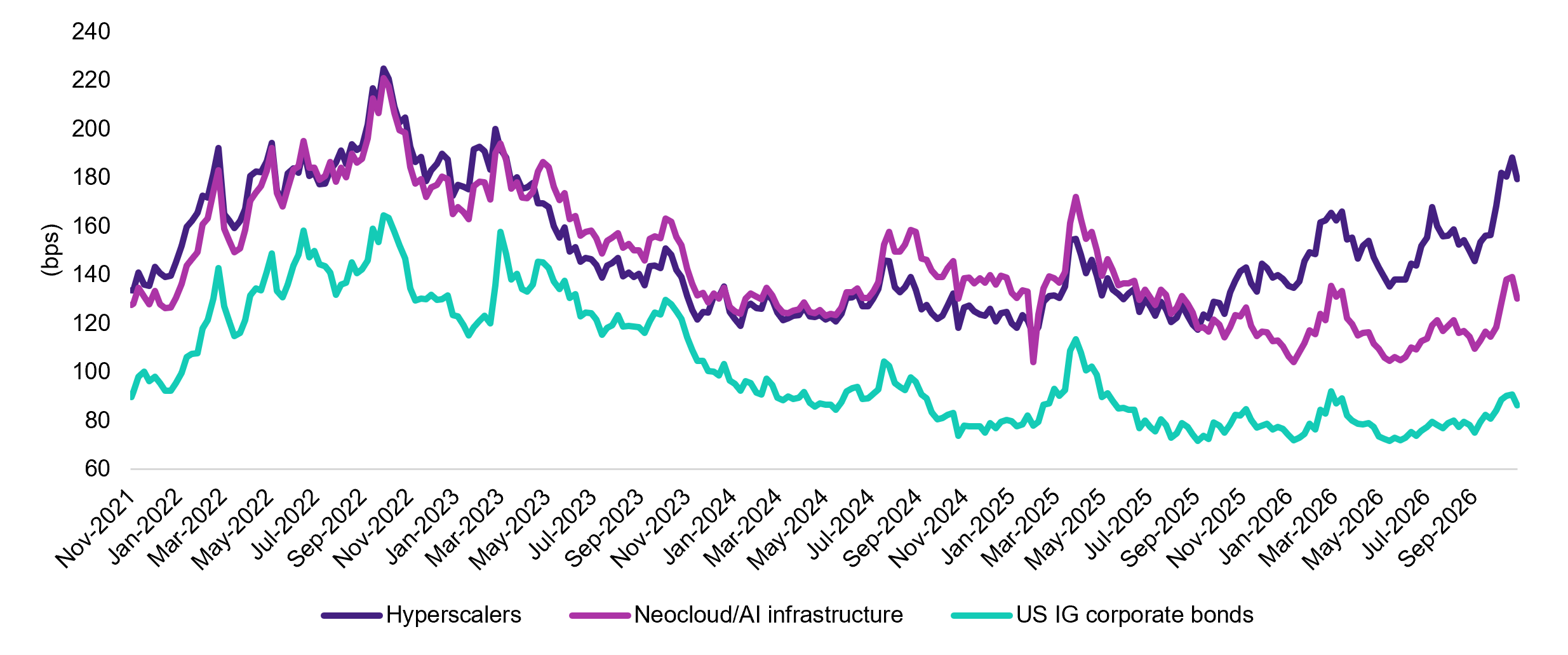
Hyperscalers have very clearly underperformed as a group, even though they are classified in different sectors, with Alphabet in media and Amazon in retail, for example. Having issued mainly in long-dated dollar bonds, the hyperscalers are now making more use of the euro market and issuing at shorter maturities. We expect the trend to continue through 2027. We also expect hyperscalers to increasingly turn to other funding sources, including private credit and securitised debt. This could help ease supply pressures in the US dollar-denominated IG market, where investor inflows have moderated. This underperformance is evident in the widening of hyperscaler credit spreads relative to the broader US IG corporate bond market.
Chart 1: Hyperscalers and neocloud AI Infrastructure vs. US IG corporate bonds, weekly weighted-average OAS (bps)
Source: Bloomberg as of November 2026
Sustainable fixed income as a useful diversifier
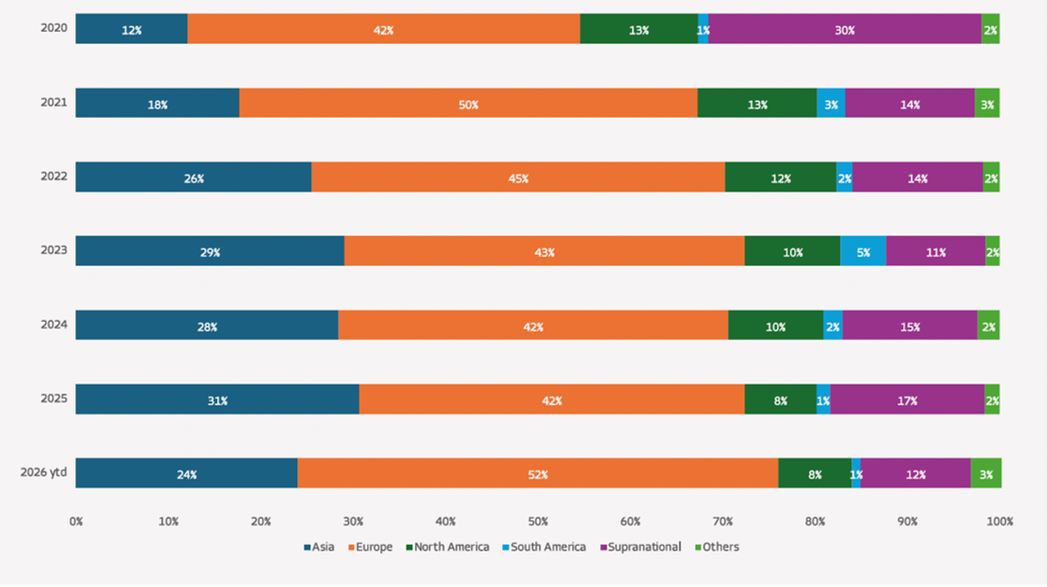
In 2025 we discussed green bonds as something of a hedge against the AI trade. That view still holds, more so than ever. According to the International Capital Market Association, global sustainable bond issuance reached USD 867 billion at the end of September 2026, an increase of 18% over the same period in 2025.[15] On a regional basis, Europe continues to dominate issuance, representing 52% of the total market, with Asia at 24%. There may be a gradual return of US issuers to the labelled green space, given that the political environment will be less hostile, but we do not expect US appetite for sustainable bonds to grow significantly any time soon. We expect that to be especially true of utility issuance focused on financing green energy build-out. The US still lacks a taxonomy that meets the EU criteria, and issuers will continue to be reluctant to issue labelled bonds that are subject to an EU regulatory regime.
Chart 2: Sustainable bond issuance breakdown by region (%)
Source: ICMA based on LGX and Bloomberg data as at 17 September 2026
Country to watch: Australia
We see an attractive medium-to-long-term opportunity in Australian government bonds, particularly through duration exposure, with the potential for additional returns from the currency in a favourable market environment. The Reserve Bank of Australia (RBA) has delivered five interest rate increases in 2026, taking the policy rate to 4.85% in November, its highest level in 18 years. It appears the central bank has paused for now, and markets are starting to price in rate cuts in 2027.
The economic effects of higher interest rates are becoming more apparent. Household consumption has weakened, house prices have fallen and unemployment has started to rise. The RBA expects economic growth to remain below its potential through 2027, with spare capacity emerging as higher borrowing costs continue to weigh on activity.
Against this backdrop, we believe Australian government bonds offer an attractive combination of income and potential capital appreciation. We see scope for expectations to shift towards monetary easing as inflation moderates and the economic slowdown becomes more pronounced. That would support a decline in bond yields, benefiting longer-duration positions. The Australian dollar could provide an additional source of return. Relatively high interest rates and Australia's exposure to global commodity demand could support the currency if economic conditions stabilise and investor risk appetite improves.
Summary
We expect 2027 to be shaped by whether the conflicts in Iran and Ukraine are resolved, and how the US administration responds to being constrained by a Democratic Congress. While much of the policy tightening by G10 central banks has already happened, short-term interest rate curves are still pricing in hikes in 2027. We see pricing less as a forecast of what central banks will deliver and more as a risk premium embedded in market pricing while geopolitical conflicts remain uncertain.
Bonds have continued to show they have diversifying properties. When risk sentiment soured in October 2026, government bond yields fell. Investors may view the current landscape as an opportunity. All-in yields remain at multi-decade highs, providing a strong starting point for income. And if geopolitical tensions ease and oil prices fall further, inflation risk should also diminish. This would give central banks in developed markets licence to pause and look through headline inflation, perhaps even paving the way for future rate cuts.
As always, selectivity matters more than broad exposure. In credit, we continue to favour AI enablers such as utilities over the hyperscalers, alongside our long-held favourable view on banks. In emerging markets, carry remains the main return driver, with exposure concentrated where policy is credible and real rates are positive. For a country to watch, we pick Australia, where we see value in both duration and the currency.
References
[2] https://www.reuters.com/world/10-year-us-treasury-yield-hits-highest-since-2002-2026-10-01/
[3] https://ng.investing.com/commodities/ice-dutch-ttf-gas-c1-futures-historical-data
[6] https://events.moodys.com/2026-mie30883-sovereign-credit-today
[8] https://www.stat.go.jp/english/index.html
[14] https://www.ft.com/content/5f08f1fb-4948-4420-8fe4-3c8c8cc492ef?syn-25a6b1a6=1