


Our outlook for 2027
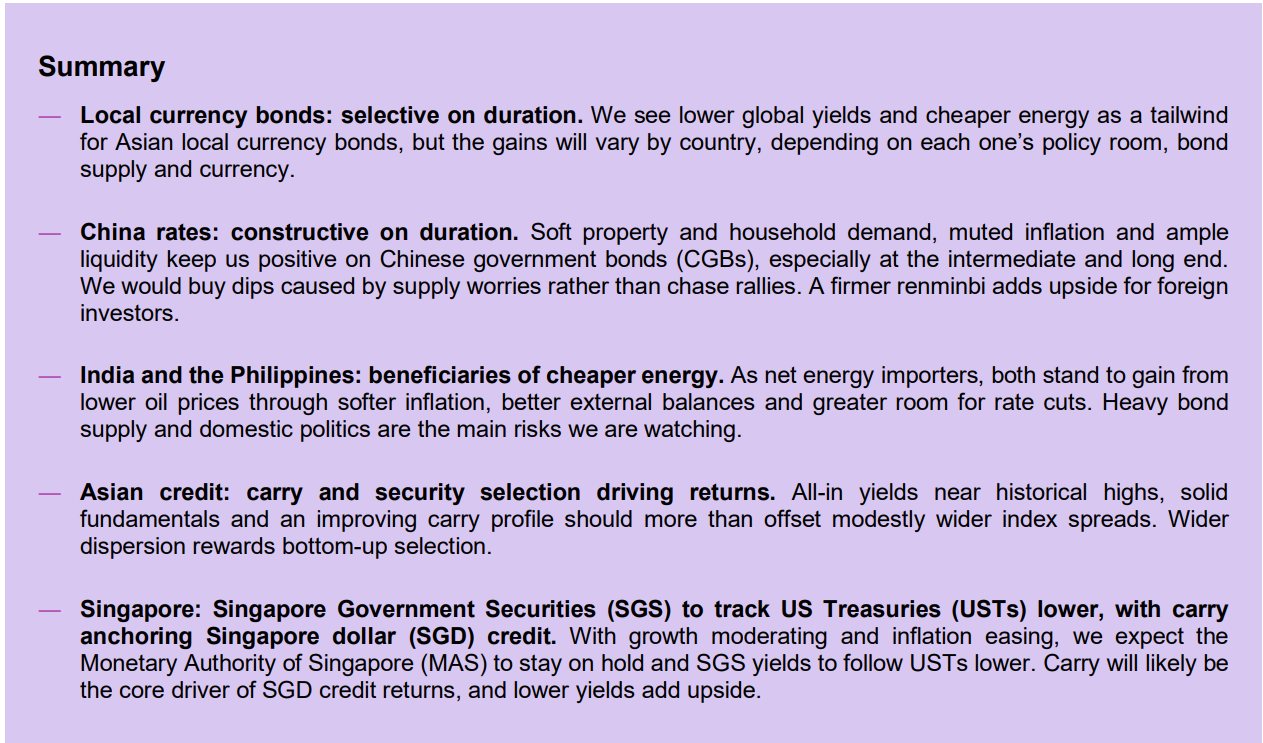
Asian fixed income markets enter 2027 well placed to deliver gains. Our base case assumes a gradual easing of geopolitical tensions in the Middle East and the Russia–Ukraine conflict, lower commodity prices, softer global growth and moderating inflation, which together could push global bond yields lower. However, with gains likely to vary across the region, we favour a selective approach.
Within local currency bonds, we remain constructive on CGB duration, as subdued domestic demand, limited inflationary pressures and ample liquidity should keep government bonds supported. India and the Philippines stand to benefit from lower energy prices, which may help moderate inflation and create greater scope for monetary easing, while the Philippines’ expected inclusion in the J.P. Morgan GBI-EM index could provide an additional catalyst. Indonesia offers attractive carry, although currency, fiscal and MSCI reclassification risks warrant a cautious approach to duration. We could become more constructive as currency pressures ease, fiscal credibility strengthens and foreign flows recover, providing a firmer foundation for lower bond yields.
In Asian credit, we expect carry and security selection to underpin returns. Resilient fundamentals, historically high all-in yields and an improving carry profile are seen more than offsetting modestly wider spreads at the index level. Supply technicals are expected to remain broadly neutral, with a small positive net supply after several years of contraction, while demand should keep pace. Greater dispersion may also increase opportunities for bottom-up security selection. We favour Asian insurers, Indian financials and selected energy and basic materials credits, while remaining cautious on Chinese real estate.
In Singapore, moderating growth and easing inflation from mid-2027 support a steady MAS policy stance, with SGS yields expected to broadly track USTs, albeit with relatively less volatility. In SGD credit, coupon carry should anchor returns, with lower yields providing an additional source of upside. Along the credit curve, we favour the BBB segment.
Local currency bonds: favouring selective duration and carry
Asian local currency bond markets enter 2027 in a potentially more supportive global environment for duration. Our base case assumes a gradual easing of geopolitical tensions in the Middle East and the Russia–Ukraine conflict through protracted negotiations. We expect this to allow energy and shipping flows to normalise, helping to lower global commodity prices. Meanwhile, political constraints on the Trump administration following the US midterm elections, coupled with tighter regulatory scrutiny of AI and technology-related investment, could weigh on global capital expenditure and growth. Together, these developments could ease inflationary pressures and push global bond yields lower, creating a more favourable backdrop for Asian local currency bonds.
Such a backdrop, in our view, offers opportunities to capture both capital gains from falling bond yields and income from holding bonds (carry). However, the benefits are unlikely to be evenly distributed across the region. Scope for monetary easing, domestic inflation trends and government borrowing needs will determine how much individual markets stand to gain from lower global yields. Currency performance will be equally important, as depreciation could erode returns for foreign investors even when local bond markets perform well. We therefore favour a selective approach, focusing on markets where attractive yields are underpinned by improving fundamentals, credible policy frameworks and greater currency stability.
Chart 1: 10-year government bond yields (left), real yields (right)
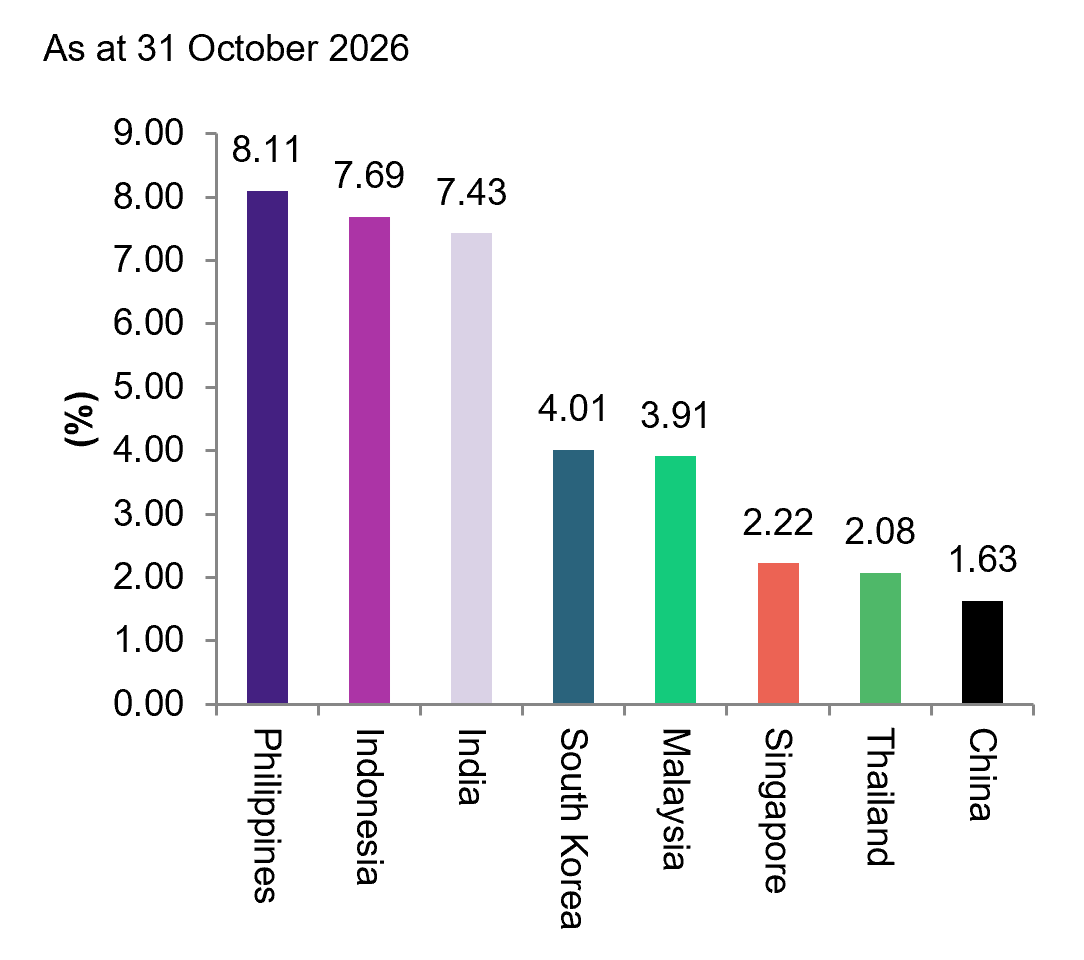
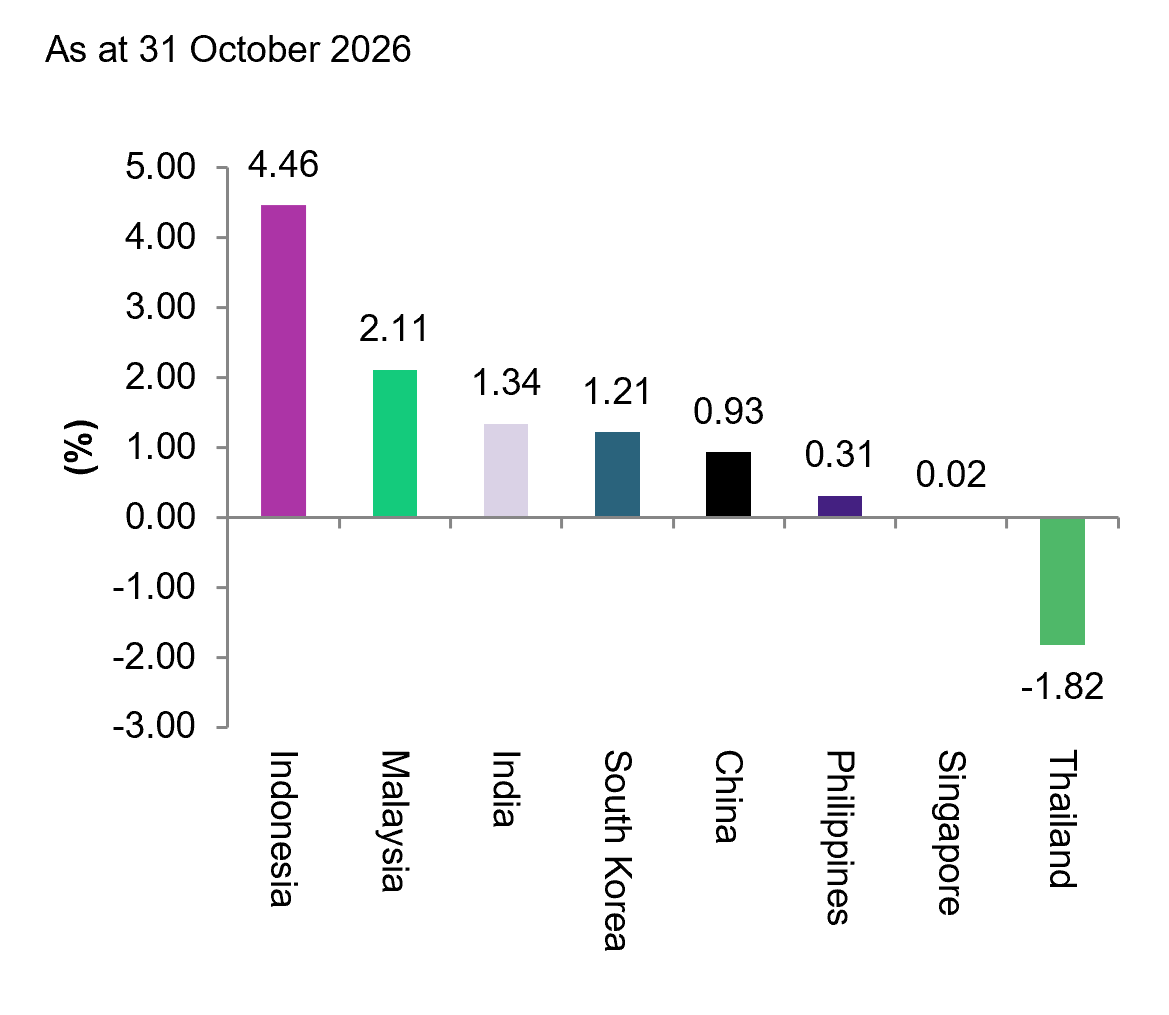
* Malaysia and Singapore CPI data as atSeptember 2026
Source: Amova Asset Management, Bloomberg
China: constructive on duration
We remain constructive on CGB duration, as subdued economic activity and limited inflationary pressures may allow monetary conditions to remain accommodative. Prolonged weakness in the property sector, soft private-sector demand and cautious household spending are likely to continue weighing on domestic activity and limit pricing power. Meanwhile, a potential slowdown in global technology investment could moderate export and manufacturing momentum, adding to disinflationary pressures. A gradual easing of geopolitical tensions should provide further relief through lower energy and commodity prices, helping to contain imported inflation.
We expect ample liquidity and expectations of further policy support to underpin demand for CGBs, particularly in the intermediate and longer end of the curve. Nevertheless, for yields, the path is unlikely to be one-way. Heavier government bond issuance to fund fiscal stimulus could put upwards pressure on longer-dated yields and steepen the curve. A stronger-than-expected recovery in the property market could also lift growth expectations and prompt some repricing of monetary policy. We would view temporary sell-offs in CGBs driven by supply concerns or shifts in sentiment as opportunities to add duration rather than chase rallies. In addition, gradual renminbi appreciation, supported by a potentially softer US dollar and improving external conditions, could provide a further source of returns for foreign investors.
India: lower commodity prices offer meaningful relief
India stands to benefit significantly from lower global oil and fertiliser prices, given its reliance on imports. Cheaper energy should help moderate domestic inflation, reduce the import bill and improve the current account balance. Lower fertiliser prices could also ease input costs for farmers and reduce the government’s subsidy burden. Together, we expect these developments to provide some support to the rupee and give the Reserve Bank of India (RBI) greater room to ease monetary policy, creating a more favourable environment for government bonds.
However, sticky food inflation could complicate the RBI’s easing path, while heavy government bond issuance may limit the extent of yield declines. Political uncertainty, including growing student-led protests against the Bharatiya Janata Party government, could further weigh on investor sentiment. The rupee may also remain vulnerable if the RBI prioritises rebuilding foreign exchange reserves. Nevertheless, a sustained decline in commodity prices could strengthen the case for monetary easing and support duration.
Indonesia: attractive carry, but conviction hinges on rupiah stability
Indonesian government bonds (IndoGBs) offer attractive carry, although we expect to begin 2027 with a neutral duration stance as currency and policy uncertainties cloud the country’s outlook. Lower global yields and a softer US dollar may improve the appeal of emerging-market assets and encourage demand for IndoGBs. However, weaker oil and commodity prices could weigh on export receipts and narrow the trade surplus, limiting support for the rupiah.
A more compelling investment case would require greater confidence in rupiah stability, fiscal credibility and a recovery in foreign inflows. Progress on capital-market reforms, particularly in improving transparency and accessibility, could help rebuild investor confidence. However, uncertainty surrounding a potential market reclassification by MSCI remains a key downside risk. Any downgrade of Indonesia’s equity market status could trigger portfolio outflows, putting further pressure on the rupiah and raising the country’s risk premium. This could, in turn, constrain Bank Indonesia’s ability to ease monetary policy, as currency weakness limits its room to cut rates.
We therefore favour a cautious approach to duration while recognising the carry appeal of IndoGBs. We could become more constructive as currency pressures ease, fiscal credibility strengthens and foreign inflows recover. These improvements could provide a firmer foundation for lower bond yields and more sustainable total returns.
Philippines: attractive potential for a duration recovery
The Philippines could emerge as one of the more attractive duration opportunities in 2027, supported by an improving inflation outlook and the prospect of a less restrictive monetary policy stance. Lower global oil prices, together with easing food and freight costs, are expected to help moderate domestic inflation and reduce imported price pressures. A lower energy import bill could also improve the external balance, providing some support for the peso. As inflation moderates, the Bangko Sentral ng Pilipinas (BSP) should have greater room to ease monetary policy, creating scope for government bond yields to decline.
Relatively high starting yields provide an attractive carry cushion, while monetary easing could generate capital appreciation as yields fall. Expected inclusion in the J.P. Morgan GBI-EM index from January 2027 could provide an additional catalyst by attracting benchmark-driven foreign inflows and broadening demand for Philippine government bonds. However, domestic political uncertainty could undermine foreign investor confidence and weigh on the peso. Heavy government bond issuance is another concern, as additional supply may limit the extent of yield declines, particularly at the longer end of the curve. We expect to begin 2027 with a tactically neutral stance on duration, while maintaining a modestly constructive bias. Clearer evidence of moderating inflation, greater visibility on the BSP’s easing path and sustained foreign inflows are seen strengthening the case for increasing duration exposure.
Asian credits: resilient fundamentals, attractive all-in yields, and fertile ground for bottom-up selection underpin returns
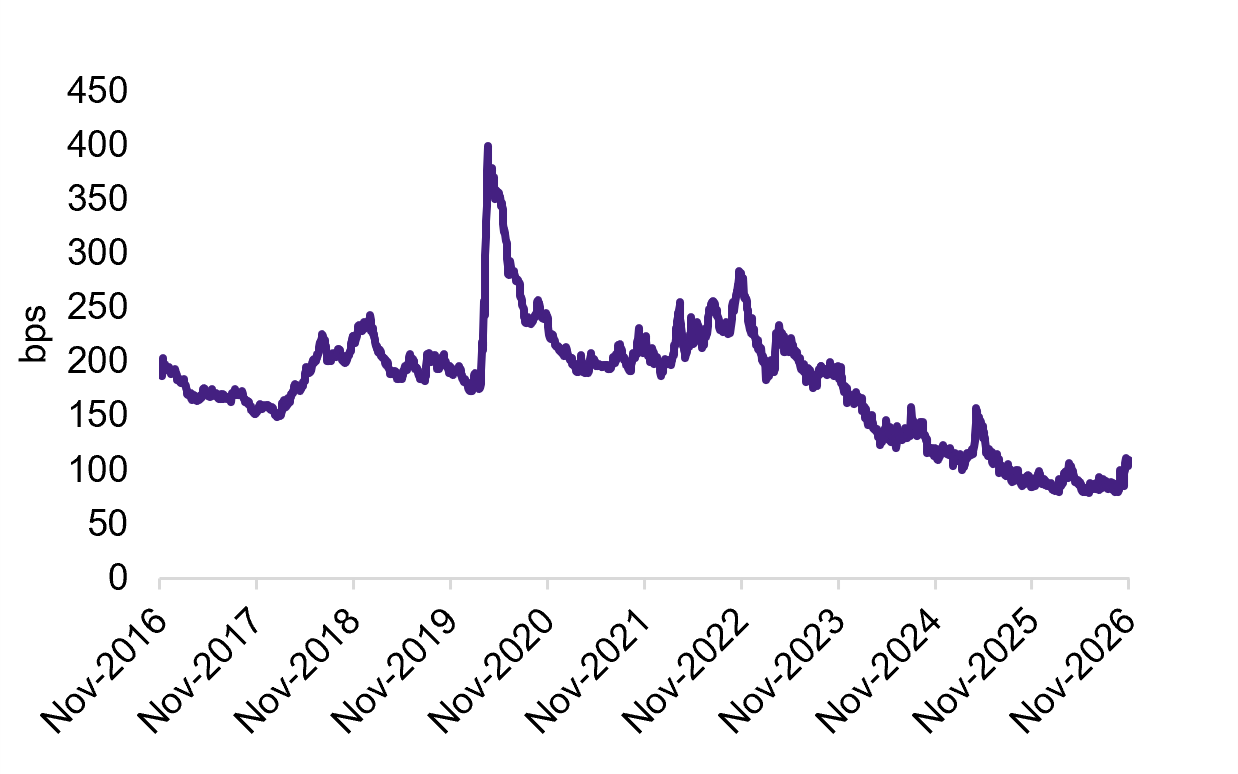
For Asia credit, 2026 has been a testing year, and many of the challenges, especially those emanating from global developments, look set to persist into 2027. However, with spread valuations having adjusted somewhat, all-in yields near historical highs and with fundamentals for most Asian countries and corporates likely to stay resilient, Asia credit enters 2027 in a better position. We expect modestly wider spreads at the index level, which could be more than offset by an improving carry profile. Importantly, dispersion and dislocations amid the broader market volatility have created attractive opportunities to generate alpha through bottom-up security selection—a welcome change from recent years, when technicals drove broad-based spread compression.
Asian economies weathered significant external supply shocks in 2026, mostly brought about by developments in the Middle East. Net energy importing countries such as the Philippines and India experienced macro pressures, especially on the external balance front, while Indonesia faced further investor scrutiny over policy consistency and credibility. Yet gross domestic product (GDP) growth remained firm across most countries, with India a standout performer driven by robust domestic demand.
Additionally, strong demand for semiconductors and other equipment needed to power the unprecedented global AI buildout has driven exceptional export growth in South Korea, Taiwan, China, Malaysia and Singapore. With the US-China trade truce holding and US tariff headwinds fading, export-oriented Asian economies have benefitted strongly from the technology super-cycle, offsetting pressures from geopolitical and energy shocks. We expect this divergence in macro fundamentals to continue at least in the early part of 2027, although a gradual easing of geopolitical tensions and a normalisation of energy and shipping flows should allow some convergence in the second half.
Despite the more uncertain macro backdrop, we expect Asian financials and non-financial corporates to continue delivering steady earnings and robust credit metrics. On fundamentals, we are particularly constructive on Asian insurance, Indian financials and the energy and basic materials sectors, while remaining cautious on China real estate. We also like credits where a combination of cyclical improvement and asset disposals have supported deleveraging, such as Thai oil and gas. Some of these credits have seen spreads widen amid the broader market volatility experienced in October 2026, presenting attractive value opportunities. We expect the positive ratings trend in Asia credit seen in 2026 to continue into 2027. The biggest downside risk is the negative outlooks on the Philippines’ and Indonesia’s sovereign ratings resulting in downgrades, with potential knock-on effects extending to banks and government-related entities from those two countries. The default rate for Asia credit is expected to remain low, given manageable maturities and the better credit quality of most Asia high-yield credits.
Supply technicals are expected to remain broadly neutral, with greater dispersion across sectors. Some sectors, such as telecommunications, media and technology in China, are likely to see greater supply given heavy capital expenditure needs, while others, such as Indian banks, may see issuance decrease from 2026. After several years of contraction, we expect a small positive net supply for Asia credit in 2027. Importantly, we anticipate demand to keep pace, reflecting historically high all-in yields and steady demand from regional investors.
Overall, we continue to see a compelling case for Asia credit, underpinned by resilient fundamentals, attractive all-in yields, an improving carry profile and fertile ground for bottom-up security selection. Many challenges and downside risks remain, including the evolution of the Middle East conflict, global monetary policy and financial conditions, and the sustainability of the global AI cycle. We believe that staying invested while remaining nimble in response to these risks will be key to delivering robust performance in 2027.
Chart 2: JACI composite spread (left), Asia lifers vs. JACI IG (right)
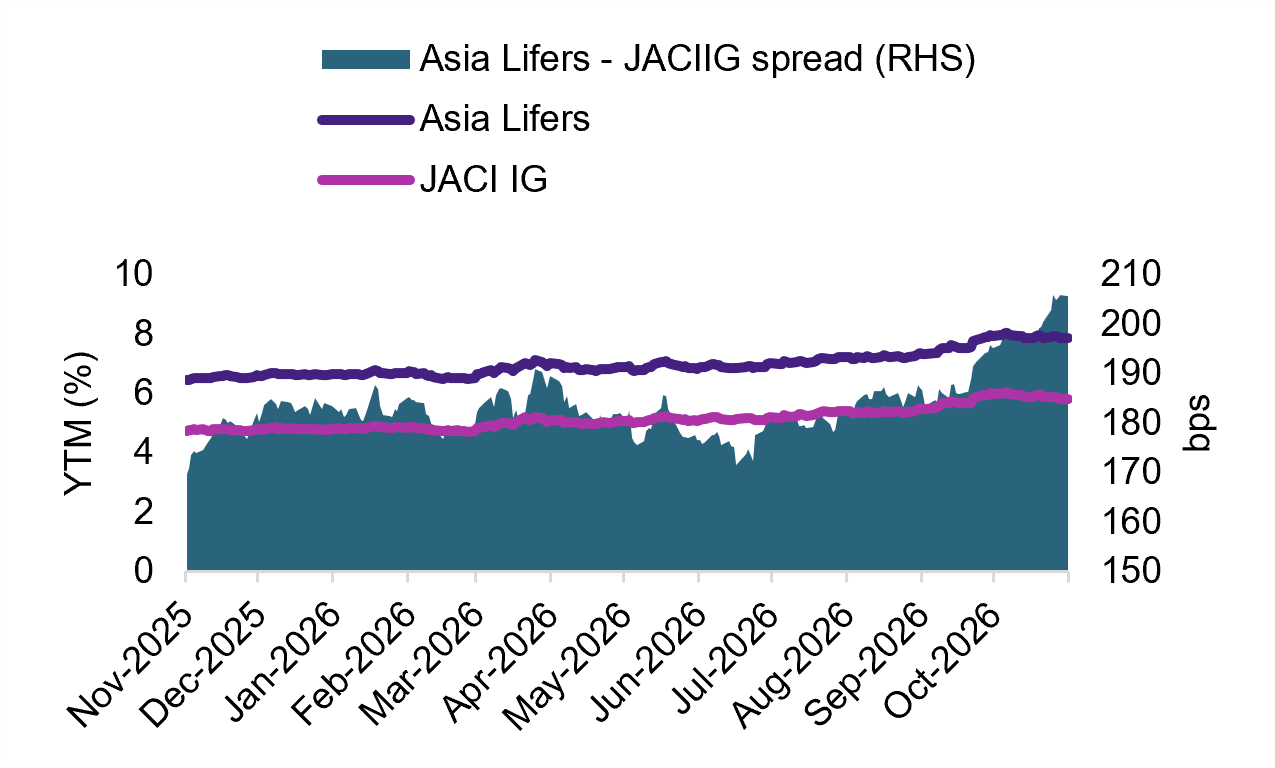
Source: Bloomberg, Amova AM
Source: Bloomberg, Amova AM
*Average of selected Asian insurer bonds
Constructive on Asian insurers and Indian non-bank financial institutions (NBFIs)
Asian insurers have become increasingly active issuers in the bond market, a trend we expect to continue, providing high-quality additions to the Asian bond universe. These issuers are typically well-established franchises with entrenched market positions and growing incentives to diversify their funding and capital sources. Capital instruments from the sector can also offer attractive valuations relative to their underlying credit fundamentals. We remain similarly constructive on Indian NBFIs, where strong business growth and rising financing needs have driven increased bond issuance alongside the expansion of the industry. Strategic investments and capital infusions from high-quality sponsors have strengthened capital bases and credit profiles while supporting further growth. Looking ahead, continued earnings expansion, improving capitalisation and strong sponsor support could drive further rating upgrades and create additional rising-star opportunities across the sector.
Hyperscalers to drive bond supply growth
US hyperscalers have dominated primary market headlines in 2026 with several jumbo-sized bond issues. In 2027, we expect issuance from Asian data centre operators and Chinese hyperscalers to pick up, becoming a more meaningful source of Asian bond supply. Continued investment in data centres and AI-related infrastructure is driving elevated capital expenditure and funding requirements. While most hyperscalers have strong balance sheets and sufficient financial flexibility to support these investments, we remain cautious on technicals. With committed capital expenditure continuing to rise, increased funding needs and heavier bond issuance could create a supply overhang, weighing on market technicals and putting pressure on spreads.
Energy and basic materials benefit amid supply constraints
Demand from EVs, renewables and AI infrastructure investment continues to support commodities such as copper and aluminium. Companies across the supply chain are benefiting from robust demand and elevated commodity prices, which are strengthening earnings and cash flow generation and enabling many issuers to reduce leverage and improve their credit profiles. We expect these supportive conditions to persist, providing scope for further rating upgrades across the sector. In energy, supply disruptions arising from the Middle East conflict have supported oil prices, benefiting Asian upstream oil and gas producers, while downstream refiners have also enjoyed strong refining margins. However, should geopolitical tensions ease, energy prices and refining margins could moderate from current levels, although we expect them to remain relatively elevated as inventories and strategic reserves take time to rebuild.
Singapore bonds
SGS yields seen trending lower alongside USTs, albeit along an uneven path
MAS expects economic growth to moderate in 2027 from the strong, “above trend” pace seen in 2026, as the AI-driven technology upcycle moderates and global financial conditions tighten. Strong order books and capacity expansion should continue to underpin technology-related activity in the near term, before easing in the second half of 2027. Major infrastructure projects and financial services activity should remain supportive, while most other sectors are expected to expand at around their trend rates. Overall, the economy’s positive output gap is projected to narrow through 2027. The government raised its 2026 GDP growth forecast to around 6% from 4.5–5.5%, but expects growth to moderate to 2.5–4.5% in 2027, reflecting softer growth among key trading partners and a slower pace of expansion in AI-related investment.
On inflation, MAS projects both core inflation and CPI-All Items inflation to average 1.5–2.5% in 2027. Core inflation is likely to remain slightly elevated in the coming quarters before easing more discernibly from mid-2027 as imported cost pressures subside and domestic cost increases remain contained. Continued productivity gains may help limit services unit labour cost increases, while enhanced healthcare and education subsidies are expected to help temper services inflation. Nevertheless, the balance of inflation risks remain tilted to the upside, particularly if global energy and food prices resume their upward trajectory. Having pre-emptively tightened monetary policy in April and July 2026, MAS left its policy settings unchanged in October, maintaining the prevailing rate of appreciation of the Singapore dollar nominal effective exchange rate (S$NEER) policy band (estimated to be 1.25%) without adjusting its width or centre. We expect MAS to maintain its current currency settings, unless a renewed build-up in inflationary pressures warrants further tightening.
In 2027, we expect SGS yields to broadly track UST yields, albeit with relatively less volatility. The path is likely to be uneven, reflecting shifts in the US inflation outlook and monetary policy expectations. UST yields could stay elevated in the near term amid persistent inflation and fiscal pressures, before moving lower later in 2027 as inflation cools, economic growth moderates and expectations of Federal Reserve easing gain traction. We expect this to create a supportive backdrop for SGS. Domestically, demand for SGS is seen holding up well despite a modest increase in issuance, supported by Singapore’s commitment to maintaining a balanced budget and its limited reliance on government bond financing. Meanwhile, the supply of sovereign and statutory board green bonds is expected to increase as Singapore advances its 2050 net-zero transition agenda.
Carry to anchor SGD dollar credit returns, with lower yields providing upside
For 2027, we expect primary supply to remain broadly in line with 2026 levels (YTD: ~ SGD 35 billion), with around SGD 30 billion of bonds due to mature or callable. Additional issuance is likely to come from opportunistic borrowers, including foreign financial institutions and first-time AI-related issuers, such as hyperscalers and data-centre infrastructure providers, seeking to benefit from currency-conversion cost savings and diversify their funding channels. The entry of these new issuers would be a positive development for the SGD credit bond market, broadening sector representation and expanding the opportunity set for investors seeking greater portfolio diversification.
We remain constructive on SGD credits. Higher yields and wider spreads relative to the start of 2026 offer more attractive entry levels, while resilient credit fundamentals and favourable supply-demand technicals could help sustain investor demand. In our view, coupon carry will remain the primary anchor of SGD credit returns in 2027, with lower yields providing an additional source of upside.
Along the credit curve, we favour the BBB segment, given its higher spread buffer and income carry. Our approach is to capture additional yield over government bonds while staying disciplined in issuer selection, prioritising fundamentally resilient credits that are better positioned to navigate a slower growth environment. Within high yield, we see selective opportunities in corporate subordinated perpetuals and bank capital instruments issued by fundamentally strong, investment-grade issuers.
Conclusion
The backdrop for Asian fixed income in 2027 appears more supportive than it has been for some time. Easing geopolitical tensions, lower commodity prices and moderating global inflation could combine to bring bond yields lower, while starting yields across rates and credit offer a meaningful income cushion.
Nevertheless, returns are likely to diverge across the region, reinforcing the case for selective positioning. The scope for monetary easing, inflation trends, government borrowing needs and currency stability will determine which markets benefit most. CGB duration continues to look supported, while India and the Philippines could benefit as energy prices moderate and monetary easing gathers pace. In Indonesia, we intend to wait for greater confidence in rupiah stability and fiscal credibility before turning more constructive. In Asian and SGD credit, returns are likely to be driven less by broad-based spread compression and more by carry and disciplined issuer selection.
Downside risks remain, including the evolution of the Middle East conflict, the persistence of elevated UST yields, potential sovereign downgrades in the Philippines and Indonesia, and the sustainability of the global AI investment cycle, along with the supply overhang it could create. In our view, staying invested while remaining selective and nimble will be key to capturing the opportunities that 2027 presents.