


Blessing or misfortune? A lesson in perspective
An old Chinese tale, recorded over 2,000 years ago in the Huainanzi, a compilation of classic essays, tells of an old man living on the northern frontier. One day, his horse ran away. When his neighbours came to console him, he simply asked, “Who can say this is not a blessing?”
Months later, the old man’s horse returned with a herd of fine horses from the nomads beyond the border. The neighbours offered congratulations. “Who can say this is not a misfortune?” he replied. Soon after, his son fell from one of the new horses and broke his leg. A year later, war came to the frontier and most young men were called to fight. Few returned. The son, spared from war because of his injury, survived.
The story gave rise to the idiom sai weng shi ma, yan zhi fei fu (塞翁失马,焉知非福): the old man lost his horse, but who could say it was not a blessing? For investors, 2026 offered a similar lesson in perspective. An oil shock, a turn in the rate cycle and a sharp AI sell-off each appeared threatening, yet also created opportunities for those prepared to look beyond the headlines. This captures our philosophy of “Harnessing Change”: not predicting every turn, but maintaining discipline and recognising opportunities where others see only risk.
The 2027 backdrop: resilient growth, shifting winds
Looking back on 2026: solid gains, wider divergence
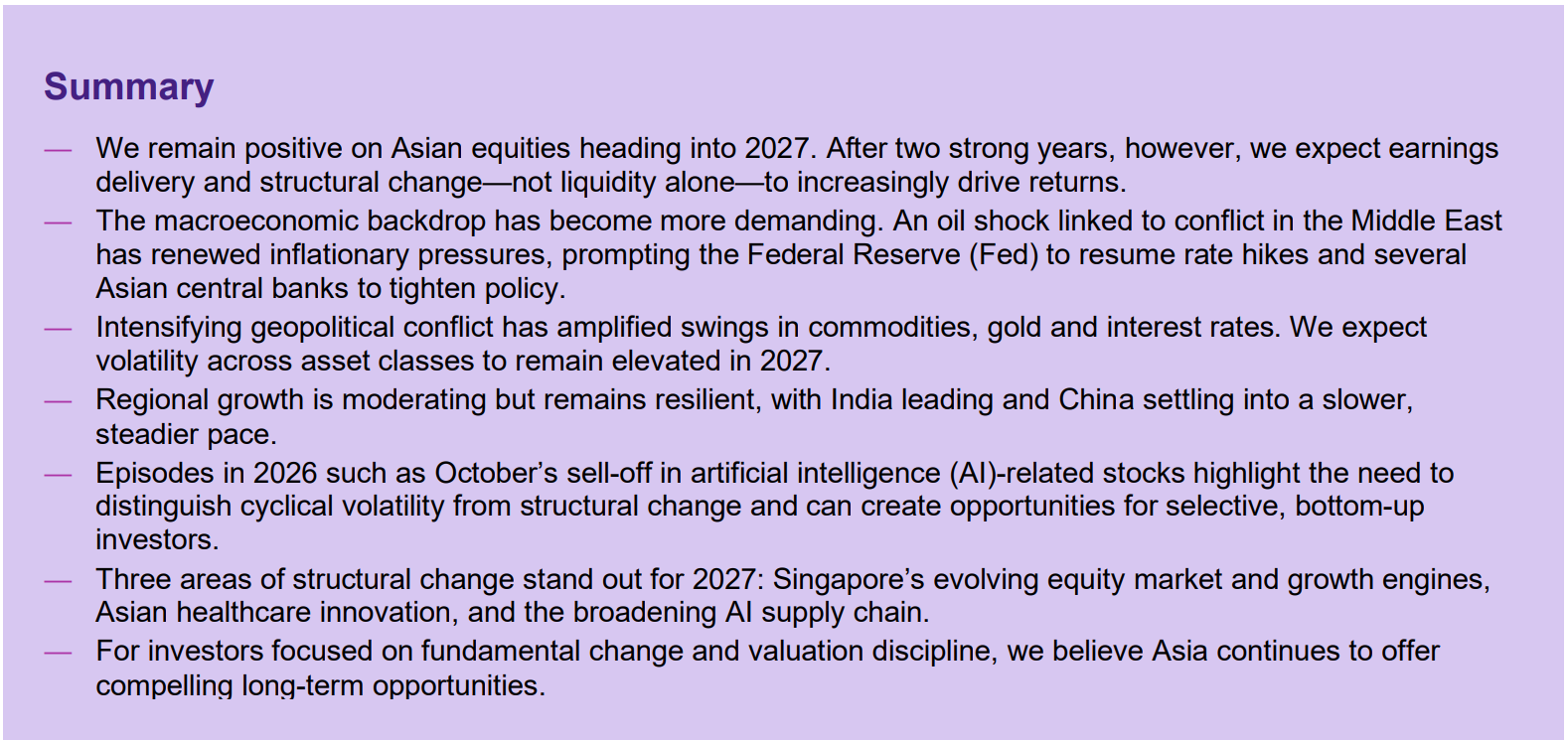
Asian equities extended their strong performance in 2026. The MSCI AC Asia ex-Japan Index returned 33% in US dollar (USD) terms in 2025, while a tracking exchange-traded fund (ETF) had gained around 19% year-to-date by late October 2026. Leadership was concentrated in AI hardware in South Korea and Taiwan for much of the year. October’s sharp correction underscored the distinction between market momentum and underlying fundamentals.
Geopolitics: a more volatile world for every asset class
Geopolitical conflict intensified and broadened in 2026, and we expect it to remain a defining feature of the investment landscape in 2027. The conflict involving Iran, which began in late February, has severely disrupted shipping through the Strait of Hormuz, a route that carries much of Asia’s imported crude oil and liquefied natural gas (LNG). The war in Ukraine is continuing, and several risk assessments now rate a crisis in the Taiwan Strait as a meaningful possibility.
The impact has extended well beyond equities:
- Commodities: Brent crude rose around 15% in October alone, reaching a six-month high above USD 110 per barrel, before pulling back in early November on hopes of diplomacy. Precious and industrial metals have also swung widely, with silver falling nearly a fifth in October.
- Gold: After reaching a record high of around USD 5,590 per ounce in January, gold had retreated roughly 27% by the end of October, as rising rate expectations outweighed safe-haven demand. Still, central bank buying remains an important support.
- Rates: The US 10-year Treasury yield climbed to 5.31% in early October, almost a percentage point higher than a year earlier, before easing to around 4.9% by the end of the month.
The effects on Asia are uneven. As a large net energy importer, the region faces pressure on trade balances, currencies and inflation, particularly in India, South Korea and Thailand. Yet greater volatility also creates dispersion. Energy security, grid investment, defence and supply-chain resilience are becoming durable investment themes. Markets with strong external balances and policy credibility, such as Singapore, continue to offer relative stability. We believe that for bottom-up investors, the priority is to identify companies with strong balance sheets and pricing power, and to use dislocations selectively where fundamentals are improving.
Monetary policy: a pause in the easing story
The year began with expectations of further monetary easing, but the path has changed. The oil shock has fed directly into inflation. US consumer price inflation rose to 3.7% in September, and the Fed raised rates in September for the first time since 2023 to a range of 3.75–4.00%. It held steady in October, but markets are pricing in a high probability of another hike in December.
For Asia, the broad liquidity tailwind seen in 2025 has faded. We expect returns in 2027 to depend less on multiple expansion and more on earnings delivery, balance-sheet strength and company-level improvements.
Growth across Asia: slower, yet holding firm
The International Monetary Fund (IMF) expects growth in Asia and the Pacific to moderate from 4.8% in 2026 to 4.4% in 2027. India remains the region’s growth leader, with the IMF forecasting 7.0% growth in both 2026 and 2027 (fiscal-year basis), supported by domestic demand, services and AI-related investment. China’s economy grew 4.5% year-on-year (YoY) in the third quarter of 2026, with the IMF projecting a growth rate of 4.0% in 2027; domestic demand remains soft and fiscal support measured.
Energy importers remain particularly exposed to higher oil prices. The Reserve Bank of India raised its policy rate in October for the first time in nearly four years. The Monetary Authority of Singapore (MAS), meanwhile, held policy steady and expects core inflation to ease from mid-2027. Fuel subsidy costs remain a pressure point for parts of ASEAN.
Market reform: progress that outlasts the cycle
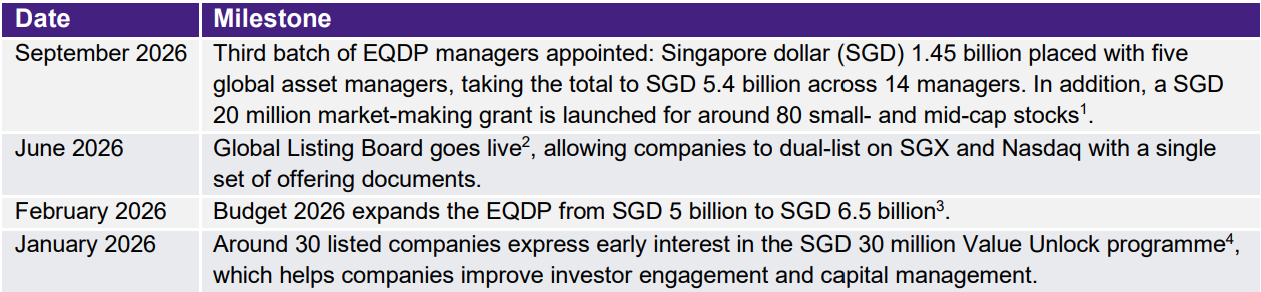
Market reform remains one of the region’s most durable sources of change. South Korea’s focus on corporate governance and shareholder returns continues, while in Singapore, the Equity Market Development Programme (EQDP) is helping broaden market participation beyond the largest stocks. As reform moves from liquidity support to value creation, we expect capital discipline, governance and earnings delivery to become increasingly important drivers of returns.
Why change is our compass
Change is a defining feature of Asian markets. In 2026, an energy shock, a turn in the interest rate cycle and a reassessment of AI expectations showed how quickly the investment landscape can shift. Our “Harnessing Change” philosophy focuses on identifying fundamental improvements at the company, industry and policy levels that can underpin sustainable returns.
When liquidity is abundant, many stocks rise together. When conditions tighten, differences in business quality and earnings resilience become more important. Distinguishing cyclical fluctuations from structural transformation is therefore central to our approach. We seek enduring improvements in growth or profitability that the market has yet to fully recognise.
Our bottom-up approach combines rigorous fundamental research with local market insight. While volatility can be unnerving in the short-term, it can create opportunities to invest in companies undergoing genuine transformation at more attractive valuations. Equally important is avoiding businesses whose share-price gains depend on sentiment rather than improving fundamentals.
Where we see change at work in 2027
We expect three themes to illustrate our approach in 2027. Each reflects a structural shift—in market development, science or technology—with the potential to outlast the macroeconomic cycle.
1. Singapore: from market reform to defensive growth
Singapore’s investment case is evolving. Its appeal as a relatively resilient, income-generating market now sits alongside structural growth opportunities in services, advanced manufacturing and digital infrastructure. After a substantial rerating, however, the next leg of performance may depend increasingly on earnings growth and value creation rather than further multiple expansion. For 2027, the question is not simply whether reform can attract capital, but whether companies can translate that capital into sustainable growth.
2026: reform moves into delivery
Source: Amova Asset Management, 1 Monetary Authority of Singapore, 2 Allen & Gledhill, 3 Caproasia, 4 The Business Times
The market has responded. In its financial year ended June 2026, the Singapore Exchange (SGX) recorded 21 initial public offerings (IPOs) raising around USD 3.2 billion, up from six IPOs raising USD 20 million a year earlier, and reported record revenue and earnings. The Straits Times Index (STI) reached a record high in September. Participation has also broadened, with the iEdge Singapore Next 50 Liquidity Weighted Index outperforming the STI over the first five months of the year. These developments point to a wider opportunity set, although stronger liquidity alone is not a substitute for earnings growth.
Singapore’s role as a wealth and capital hub reinforces this investment case. Its institutional strength, currency stability and policy predictability support its defensive appeal, while wealth management, financial services and insurance provide growth opportunities. Services exports, including transportation, logistics and information and communications technology, also broaden the economic base beyond goods trade.
The “New Singapore” extends beyond the index heavyweights. Semiconductor supply-chain companies, advanced manufacturing, digital infrastructure and energy-transition businesses offer exposure to structural growth. Many of these opportunities lie among small- and mid-cap companies, where improving liquidity can make previously under-researched businesses more accessible to investors.
2027: from liquidity to lasting value
We see four connected drivers of opportunity in 2027:
- From capital deployment to value creation. The EQDP has helped improve market participation. The next phase should increasingly reward companies that combine stronger governance with disciplined capital allocation and sustained shareholder returns. Further allocations could support this process, but their investment impact will depend on how effectively companies put that capital to work.
- Broader participation beyond blue chips. Market-making support and improving liquidity can reduce barriers to investment in smaller companies. The opportunity lies in identifying businesses where better access and investor engagement coincide with improving earnings and cash flow, rather than relying on rerating alone.
- New issuers and structural growth. A revived listings pipeline and the Global Listing Board could broaden access to digital infrastructure, specialised real estate and capital-market services. Alongside listed industrials and technology suppliers, these businesses could offer investors the opportunity to participate in Singapore’s evolving economy. The pace and quality of new listings remain important tests.
- Dividend growth, not yield alone. Banks and established national champions remain an important source of income. After the market’s rerating, however, we favour companies with the balance-sheet strength and cash flow resilience to sustain investment and grow distributions. Value Unlock initiatives should be assessed against tangible improvements in capital management and shareholder alignment.
We remain positive on Singapore equities, but selectivity matters more after the market’s rerating. Our focus centres on modern services, particularly financials; industrials and communication services linked to transport, data and infrastructure; and utilities and infrastructure businesses participating in the energy transition. Small- and mid-cap companies may offer more direct exposure to these growth themes, while established dividend payers provide income. The case for 2027 is therefore one of defensive growth: resilience combined with earnings delivery, cash-flow generation and the potential to build tomorrow’s blue chips. Geopolitical shocks, an AI investment slowdown and disappointing earnings remain key risks.
2. Healthcare: from supplier to innovator
Asia’s role in global healthcare is shifting from supplier to innovator. China’s innovative drug industry, which we highlighted in 2025, has become an increasingly important source of new therapies. According to PharmCube data reported by Reuters, overseas out-licensing deals by Greater China drug developers reached USD 137.7 billion in 2025, nearly ten times the 2021 level. By early October 2026, the reported total had already exceeded that record.
Chart 1: 2026 year-to-date out-licensing deals eclipse previous full-year record
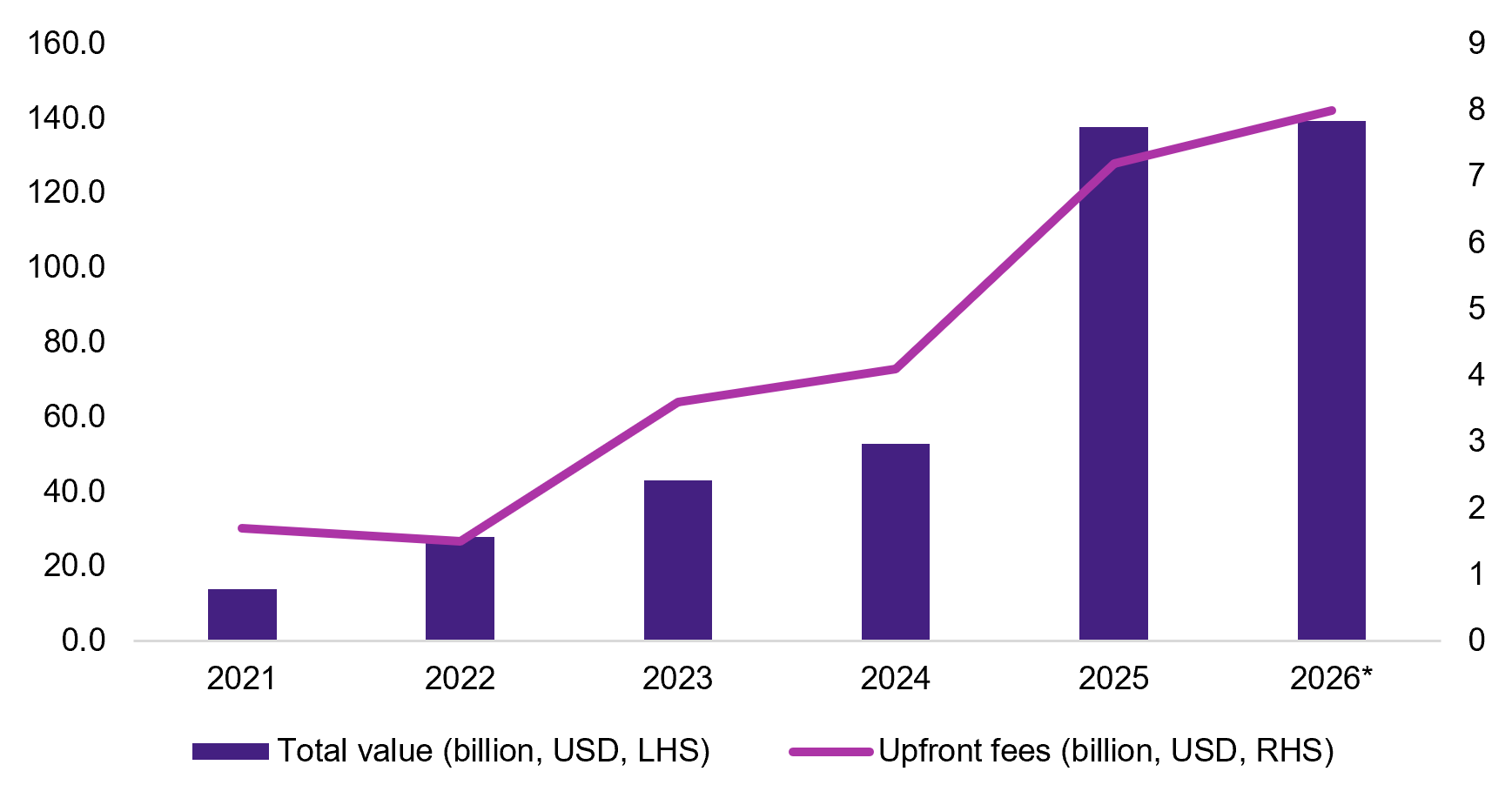
*2026 total value as of 8 October; upfront payments as of the first nine months of 2026.
Deal quality is improving alongside volume. Average upfront payments in early 2026 were roughly double the 2025 level, suggesting that global partners are placing greater value on differentiated science. Agreements have broadened beyond oncology into obesity, metabolic disorders and liver diseases, with AstraZeneca and AbbVie among the multinationals signing multi-billion-dollar deals with Chinese developers. As major products approach patent expiry, global pharmaceutical companies increasingly view China as a source of innovation for their research and development (R&D) pipelines.
Access to treatment is evolving too. In March 2026, the core patent for semaglutide, the active ingredient in leading GLP-1 obesity and diabetes drugs, expired in India and several other markets. Indian manufacturers launched generic versions within a day at a fraction of the originator’s price, with dozens of brands expected to enter the market. This creates a new growth category at home and an opportunity to build capabilities for other markets as patents expire.
Policy is another catalyst. The US BIOSECURE Act, signed into law in December 2025, is prompting global drug developers to reassess their reliance on certain Chinese contract research and manufacturing providers. Implementation details remain uncertain, but supply-chain diversification could benefit well-positioned contract development and manufacturing organisations (CDMOs) elsewhere in Asia.
US drug-pricing policy, geopolitical restrictions and clinical setbacks remain material risks. Even so, the combination of scientific expertise, cost-efficient trials and large patient populations supports a compelling structural opportunity. Selectivity remains essential: innovation must translate into clinical progress and commercial value.
3. AI supply chain: looking beyond volatility to lasting demand
Asia sits at the heart of the global AI build-out. The region manufactures the leading-edge logic chips, high-bandwidth memory (HBM), advanced packaging, servers and much of the networking and power equipment that AI data centres require. In 2026, this translated into exceptional earnings. Taiwanese semiconductor foundry TSMC’s third-quarter revenue rose 41% YoY to USD 46.7 billion, with high-performance computing accounting for 68% of sales, and the company raised its full-year growth expectation to around 44%. South Korea-based SK hynix, which holds a majority share of global HBM revenue, completed a US listing in July that ranks among the largest equity offerings by a foreign company.
Yet the October sell-off was a reminder that expectations can run ahead of fundamentals. South Korea’s KOSPI, which had surpassed 9,000 in June, fell more than 16% in a month, including a 7.6% drop on 15 October that triggered a market-wide circuit breaker. The catalysts were concerns over the financing of data-centre expansion and future chip supply, rather than a collapse in end demand.
We believe the underlying growth driver remains structural. Large US technology companies are expected to spend over USD 700 billion on capital expenditure (capex) in 2026, and several have signalled further increases in 2027. Supply of leading-edge wafers, advanced packaging and HBM remains tight, and TSMC expects capacity for its 2-nanometre (N2) family to more than double in 2027. Industry leaders expect memory supply to trail demand for years, reinforcing the pricing power of established suppliers.
Opportunities are also broadening across the value chain and the region, as highlighted below:
- From training to inference, as AI moves into everyday applications and drives demand for custom chips and edge devices.
- From chips to systems, including power management, thermal solutions, optical networking and printed circuit boards, where Asian suppliers hold strong positions.
- From North Asia to the wider region, as supply chain diversification accelerates assembly, testing and component manufacturing across ASEAN and India.
- From imported to domestic technology in China, as domestic chip and memory makers advance and gain share at home.
Risks include a pause in capex as investors scrutinise returns, tighter financing conditions, export controls and elevated valuations in parts of the sector. We focus on companies that address critical technological bottlenecks, retain pricing power and possess the balance-sheet strength to invest through the cycle. Structural demand alone does not justify paying any price.
Final thoughts: turning change into long-term value
Asian equities enter 2027 against a more demanding backdrop. Higher energy prices, renewed monetary tightening and a reassessment of AI expectations make a repeat of broad-based gains less assured. Yet resilient growth, market reforms and company-level innovation continue to create opportunities across the region.
In this environment, our “Harnessing Change” philosophy provides a consistent investment framework. We look for companies where fundamental change can deliver lasting improvements in growth, profitability and cash flow—and where valuations do not yet fully reflect that potential. Our team’s on-the-ground insights and bottom-up research help us distinguish durable progress from short-lived momentum.
Singapore’s combination of resilience and new growth engines, Asia’s expanding healthcare innovation and the broadening AI supply chain demonstrate the range of opportunities. The common thread is not change for its own sake, but its capacity to create sustainable shareholder value. For patient, selective investors, that remains a compelling reason to allocate to Asian equities.
References
Any reference to a particular security is purely for illustrative purposes only and does not constitute a recommendation to buy, sell or hold any security. Nor should it be relied upon as financial advice in any way.