


The Democratic Party is projected to take control of the US Congress following the 2026 midterm elections, prompting renewed scrutiny of US data centre investment plans. Yet the elections’ economic implications must be considered against a much broader macroeconomic backdrop that political change alone may do little to alter.
Market priors: a Democratic House victory was anticipated
Bloomberg research, citing prediction markets, had already estimated a high probability of a Democratic takeover of the House of Representatives prior to the elections, suggesting that markets had already priced in such an outcome beforehand. On the other hand, a Democratic Senate victory, while not entirely unanticipated, may have been less certain. At the time of writing, Democrats are reported to have won 54 of 100 seats in the Senate, including two independents caucusing with the party, and are projected to secure a majority in the House.
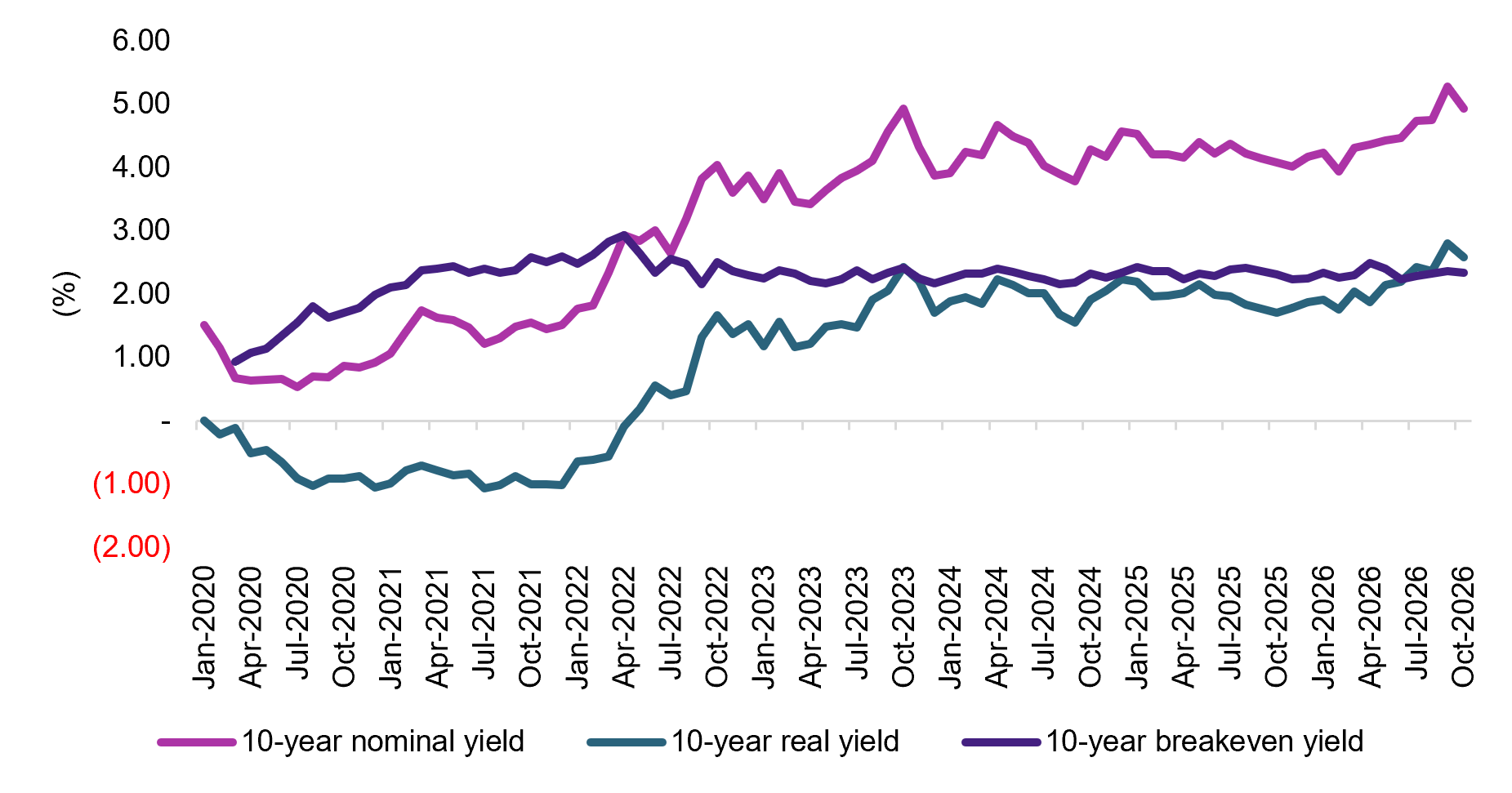
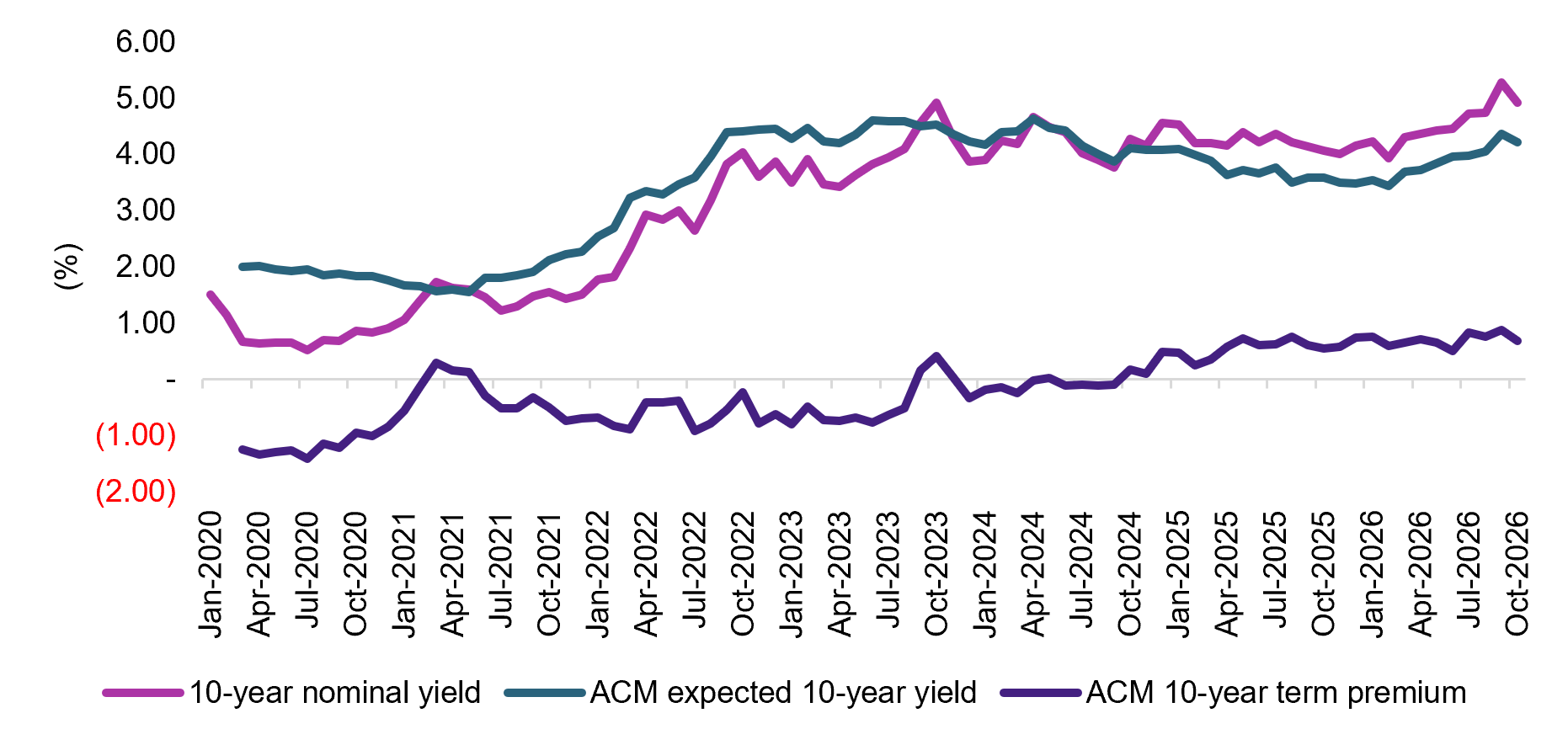
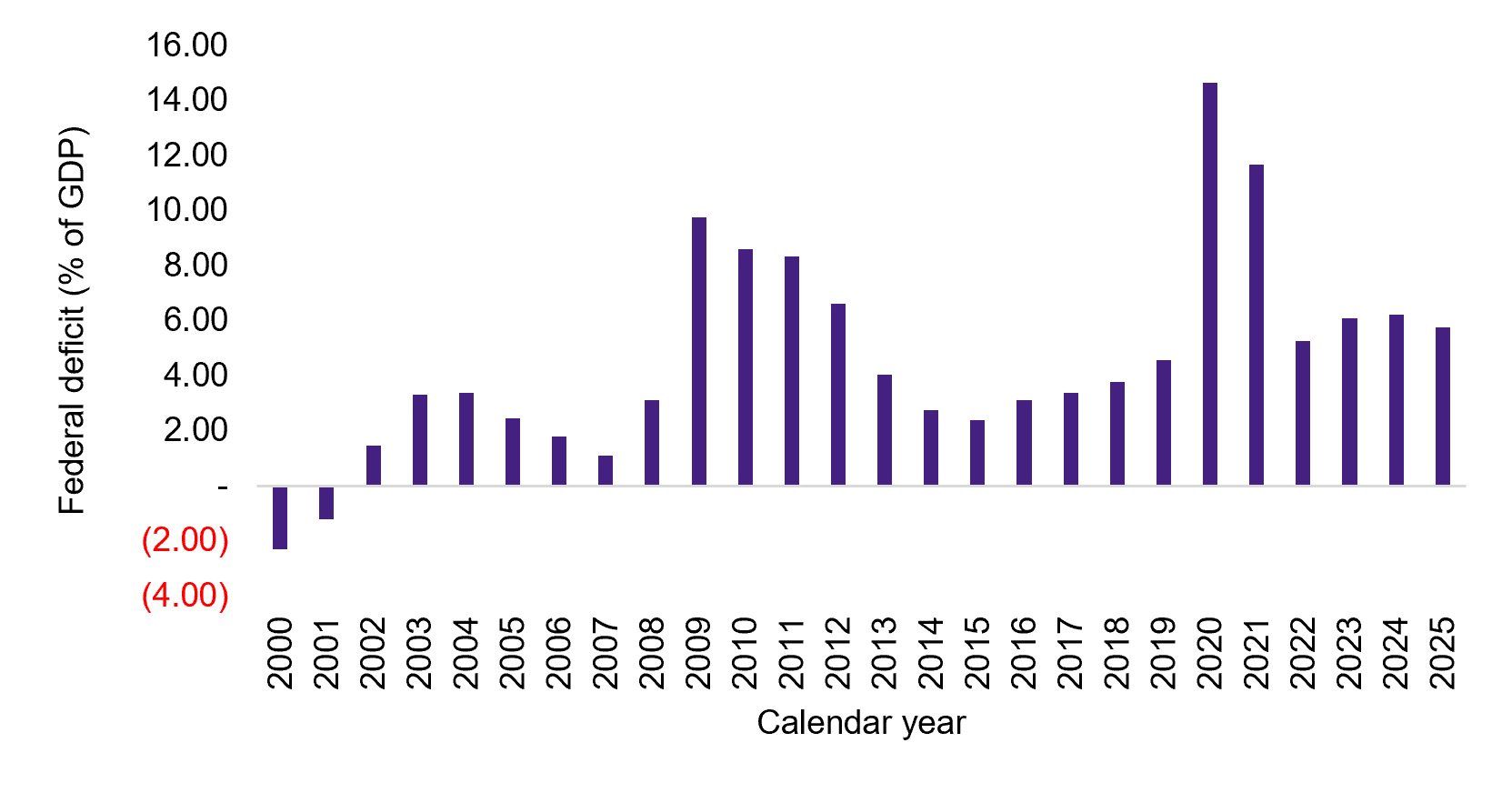
Also influencing market behaviour, however, were persistent fiscal deficits of around 6% of US GDP, substantial Treasury issuance and continued fiscal sustainability concerns irrespective of congressional control. The US 10-year Treasury yield continues to hover near 5%, reflecting elevated real yields and inflation compensation with term-premium pressures an additional concern (see Charts 1 and 2). Meanwhile, markets anticipated continued inflation pressures and restrictive Federal Reserve (Fed) policy.
Chart 1: US 10-year nominal, real and breakeven yields
Source: Bloomberg
Chart 2: US 10-year nominal yield and Adrian-Crump-Moench (ACM) components
Source: Bloomberg
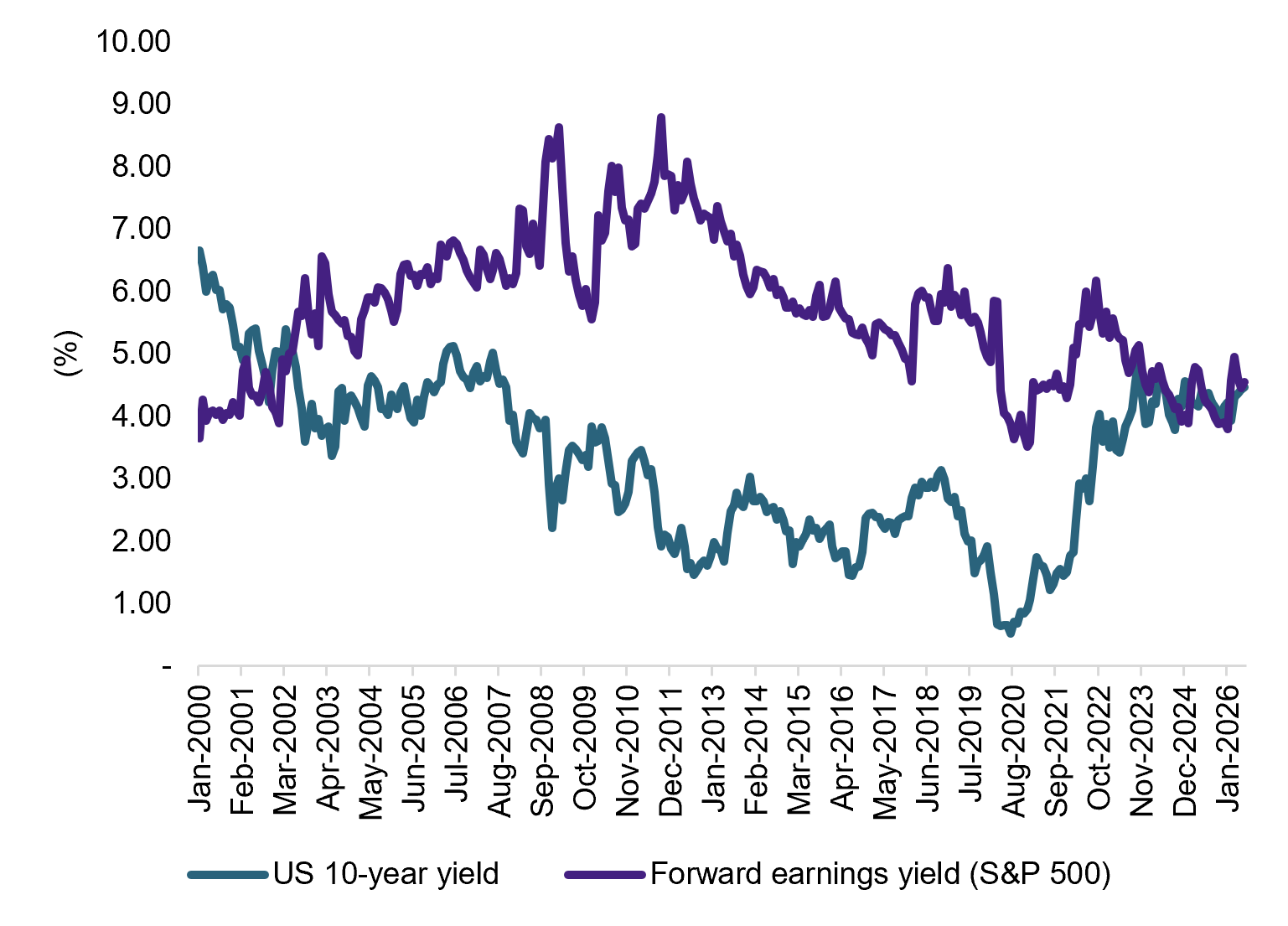
As we had already flagged in the Q4 GISC Outlook, strong AI-related earnings expectations, elevated valuations and concentration, alongside relatively tight credit spreads and continued risk tolerance, have remained narrowly supportive of US equities, though we also noted that the balance has become increasingly delicate. For weeks, equities have been showing a narrowing earnings-yield advantage relative to Treasuries, the implications being that equities may not offer sufficient remuneration to offset a trend rise in long-term yields without assuming additional risk elsewhere (e.g. credit, currency or liquidity). At the same time, confidence over the sustainability of AI-driven capital expenditure and earnings had already begun to waver in instances where technology sector earnings results failed to live up to optimistic assumptions.
Chart 3: Forward earnings yield (S&P 500) and the US 10-year yield
Source: Bloomberg
Political outcomes: direction versus magnitude
History strongly favours the opposition in US midterm elections. Between 1934 and 2022, the president’s party lost House seats in 20 of 23 midterms and Senate seats in 15 of 23. Electoral setbacks for the ruling party are the norm and not necessarily evidence of exceptional political change.
However, the meaningful information lies in seat changes relative to historical experience, pre-election expectations and whether congressional control or legislative margins change. Moreover, the implications for democratic institutions may have long-term consequences for procedural continuity and future capacity for legislation and oversight. Institutional credibility, however, is difficult to infer from electoral outcomes alone and may require the completion of vote counting and certification, as well as the resolution of any potential material disputes over the results. Meanwhile, the administration retains substantial executive discretion over trade, tariffs, regulation and foreign policy, subject to applicable legal constraints. A shift in congressional power may affect new legislation more than it limits the administration’s capacity to influence economic conditions through existing executive powers.
Financial market reactions do not necessarily signal the “right answer”
In early Asian trading on 4 November, Treasury yields and the dollar declined, while US equity futures came under pressure. This would be in line with the tendency of financial markets to flatten electoral results into binary “good for X; bad for Y” outcomes. Some may argue that the results could reduce the upside risk of further fiscal expansion while increasing the risks associated with legislative deadlock and policy uncertainty. However, it is also possible to present a counter-argument. Thanks to existing government indebtedness and the vigilance of bond investors, the Administration already faced significant fiscal and market constraints on further expansion.
Chart 4: US federal deficit remains elevated relative to GDP
Source: Bloomberg
Still open questions: growth, productivity and earnings
The elections provide little new evidence concerning underlying productivity trends, including the realisation of AI-related improvements in productivity, particularly durable gains in total factor productivity (TFP) or the sustainability of projected earnings.
AI-related capital expenditure has already generated substantial revenues for infrastructure and technology suppliers, supporting current earnings expectations. However, these revenues largely reflect investment in productive capacity, while the broader productivity gains—and ultimately the returns needed to justify that investment—remain less firmly established.
Admittedly, greater political scrutiny of AI investment could affect the allocation and financing of capital. However, the underlying questions surrounding investment returns, the sustainability of earnings expectations and path from building productive capacity to new capabilities remain unresolved.
Risk distribution: possible fiscal, legislative constraints
On the one hand, the midterm results may place limits on further fiscal expansion, while potentially increasing risks associated with legislative deadlock and policy uncertainty. On the other hand, they do not materially resolve existing inflation pressures, fiscal sustainability challenges or vulnerabilities in the financing-and-confidence equilibrium.
Conclusion: elections cannot resolve the productivity question
What we have is a substantial realised expansion in productive capacity, but the question of its economic impact remains unanswered. The elections may alter the government’s capacity to formulate and implement policy, but they do not provide a satisfactory answer to the primary question at hand: whether the economy can deliver productivity growth and earnings performance already anticipated by markets. Political developments may provide a catalyst for market reassessment, but underlying vulnerabilities—and the economic adjustments required to resolve them—predate the elections. Perhaps the Fed’s 16 November field hearing of its Productivity and Jobs Task Force will provide further clues.