


One of the quotes attributed to Warren Buffett captures the current moment well: “Long-term investing is hard, because nobody wants to get rich slow”. For the last few years, the technology supercycle driven by the artificial intelligence (AI) boom has been the party everyone wanted to be invited to. At the same time, quality growth companies—those displaying the traditional virtues of robust balance sheets, steady cash flows and sustainable profitability—have looked dull and slow by comparison, with their party invitation seemingly lost in the post.
And while the party is still going, we may have reached a point where simply assuming that the extraordinary growth of AI investment and earnings will continue is becoming increasingly dangerous. We have no doubt that AI has the capacity to transform the global economy, but we do question whether the levels of investment made to date can generate the returns needed to justify them. Therefore, rather than extrapolating recent trends into the future, investors may need to start anticipating what happens if those trends begin to change.
Retail investing and reflexive momentum
The prospect of the AI bubble beginning to deflate has been the elephant in the room for a while, and comparisons have been made between the current situation and the dot-com era. But there is a key distinction to be made. This time, the bubble is not in the price, and it is perhaps more evident in the earnings. The share price reactions we have seen so far appear rational, in that they are supported by earnings and cash flow. However, what we have experienced is rampant speculation, with volatility among individual US stocks reaching levels not seen since the dot-com boom.
At the same time, global equity indices have become unusually concentrated, and the number of stocks that are outperforming—beating the market cap-weighted index—has fallen to historic lows. A handful of companies have been doing the lion’s share of the work, which doesn’t feel sustainable in the longer term.
For an example of investor overexuberance leading to a painful reckoning, we can look at South Korea, where concentration has reached extreme levels this year. High levels of retail investor participation and speculation, easy access to leverage, and the popularity of single-stock exchange-traded funds (ETFs) are not likely to be the foundations for sustainable, long-term returns. The consequences of this overexuberance can be severe. In July, Reuters reported that more than 1.2 million trading accounts, owned by 3.4% of Korea’s adult population, received a margin call on their investments[1]. To put that into perspective, it is hard to imagine 3% of the UK population even knowing what a margin call is, let alone receiving one.
AI capex has become the dominant growth theme
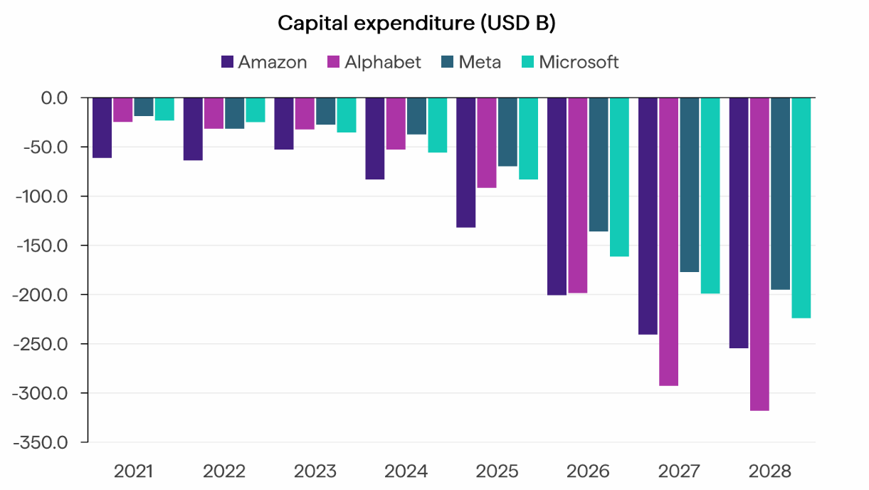
Arguably the biggest surprise so far this year has been the scale of AI capital expenditure, which has exceeded expectations by around US dollar (USD) 300 billion[2]. When that much money is concentrated in one particular industry, the effect is akin to squeezing an elephant into a jam jar. The companies supplying the investment suddenly gain enormous pricing power, driving growth in cash flow and profits. That is exactly what we have seen.
However, so far most of the spending has been supported by capital raised by Anthropic and OpenAI. When the scale of that capex sits at around USD 500 billion to 600 billion, raising a few hundred billion dollars has been sufficient to support ongoing investment. The question on everyone’s minds, however, is what happens next. As we move into the next wave of spending in 2027 and 2028, the funding requirement could run into the trillions. Both Anthropic and OpenAI will need to generate significantly more revenue or return to the markets for huge amounts of additional funding. This raises serious questions over just how sustainable, or how substantial, that funding is going to be.
Chart 1: AI capital expenditures (in USD billions)–are we in a bubble?
Source: Company reports, Bloomberg July 2026 data. Past data or any forecast is not necessarily indicative of future outcome.
Contractual commitments into the trillions
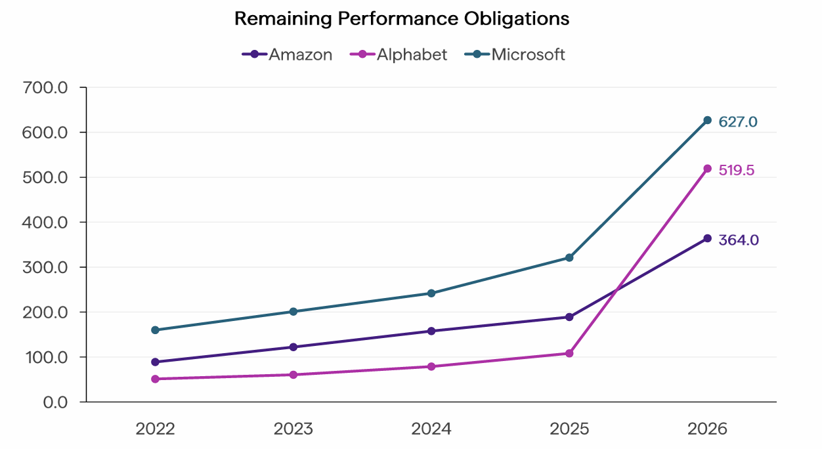
There is another reason for questioning whether future capital raising requirements can continue: the enormous growth in remaining performance obligations (RPOs) among the major cloud providers. RPOs represent contracted future revenues for services that have not yet been delivered. For the three main hyperscalers, Alphabet, Amazon and Microsoft, these commitments now stand at more than USD 1.5 trillion[3].
OpenAI and Anthropic account for a significant amount of that expected demand. The hyperscalers generate substantial cash flow, but the large language model (LLM) companies are in a far trickier position. They will need significant financing and substantial revenue growth over the next few years to support the scale of investment being planned. According to Goldman Sachs research, revenues may need to reach USD 1 trillion—an extremely ambitious assumption.
Chart 2: RPOs–hyperscaler contractual commitments to add future capacity (USD bln)
Source: Company reports, Bloomberg July 2026 data.
Investors should therefore be wary of assuming that the current pace of AI infrastructure investment can continue indefinitely. We may already be approaching the peak in capex assumptions. This all matters because the RPOs are helping to underpin earnings expectations across the AI hardware supply chain. OpenAI represents a material credit-risk consideration within the AI investment cycle.
The key question is whether AI investment can ultimately be monetised at a scale that justifies the capital being deployed. For investors, the next phase of the AI story may therefore be less about infrastructure spending and more about commercial adoption. Recent developments at Meta provide an early test of that thesis.
The next test: monetising AI
Meta’s new AI agent may help justify some of its recently elevated AI capex and help keep investors bullish on the AI use case. The long-awaited Muse is an AI “personal assistant” app, capable of doing everything from booking a restaurant to selling a car. The app has been successfully launched in North America, with a free basic version and subscription models for heavier users.[4]
The company is targeting significant take-up among its consumer user base, but the larger opportunity may lie with the estimated 250 million small businesses that use its platform worldwide. If it can convert enough of them into paying enhanced subscriptions for additional business support tools and access to more agentic e-commerce transactions, its AI investments could support strong returns on the capital deployed. However, trust in agentic AI, particularly with personal and financial information, is still an obstacle to broader user take-up, and the success of Muse may depend on how many users grant it access to that information, as well as how reliably its agents perform once access is granted.
What’s going to drive the next cycle?
As quality growth investors focused on Future Quality companies, extrapolating forward what was considered quality in the last cycle is probably not the appropriate strategy. The definition of quality could look quite different in the next investment cycle. It may have more of an infrastructure theme, with greater exposure to hard assets and industrial businesses.
In the past, we have tended to look for digital businesses and asset-light companies that could generate high returns on capital and stable growth without the need for significant investment. However, we are moving into a more asset-intensive world, driven by areas such as AI infrastructure, data centres, energy and industrial investment. We expect companies such as Hitachi, Keyence, SMC, Epiroc and Sandvik to be capex beneficiaries. The growing need for energy infrastructure and greater energy security across Europe could create further opportunities, including among energy services companies. Healthcare, for so long the graveyard of the quality-seeking investor, has started to turn around, as demonstrated by the strength of the US biotech sector this year. As new drug development accelerates and research and development becomes more productive, companies providing the tools and equipment needed to bring these drugs to market could benefit significantly. And while traditional defensive companies, including consumer staples and utilities, may be considered unexciting, they may offer strong potential to compound capital over time.
Patience is still a virtue
We are still bullish about AI technology—we are just less bullish about the business model and the funding requirements that go with it. We expect it to be a game changer in many industries, but we believe this will still take a long time to play out, and for many investors, patience is a rare commodity.
As Warren Buffett knows better than most, getting rich slow is about preserving and compounding capital, avoiding overexuberance or overleverage, and paying attention when the warning signs start to flash. We believe that Future Quality companies with strong balance sheets and sensible valuations, many of which have been overlooked or have fallen out of favour over the last five years, will have a crucial role to play in portfolios. When the party stops, you still need a designated driver to get you home.
References
[2] Company reports of the hyperscalers, Bloomberg July 2026 data
[3] Company reports of the hyperscalers, Bloomberg July 2026 data
Reference to any particular security or sector is purely for illustrative purposes only and does not constitute a recommendation, nor to be relied upon as financial advice in any way. There can be no assurance that any performance will be achieved in any given market condition or cycle. Past performance or any prediction, projection or forecast is not indicative of future performance.