

Fed Chair Warsh’s 28 August speech at the Jackson Hole Economic Policy Symposium attracted significant attention. Although the conference generally sits somewhere between a research symposium and a communication event for major central banks, the speech served to shape expectations for communications under a new Fed Chair. At the same time, we are aware that the Chair does not single-handedly determine Fed policy, but also needs to coordinate and engage with the full Federal Open Market Committee (FOMC).
Aiming to reconcile these two focal points of market interest, we approached our analysis of the content of the speech from a slightly different perspective than usual. We established a Bayesian designed to calibrate the market’s pre-Jackson Hole assumptions and then update these assumptions, but only to the extent that the speech contained genuinely new, clear and institutionally representative information.
Seven prior assumptions: what the market was expecting
We developed prior assumptions based on market expectations around seven underlying characteristics that the market reportedly prioritised (using Bloomberg news and data), and established guidelines for updating these priors based on the content of the speech. We then calibrated a prior mean and dispersion factor for each characteristic. These calibrations are presented in the Appendix.
Based on this framework, the market’s seven major prior expectations were:
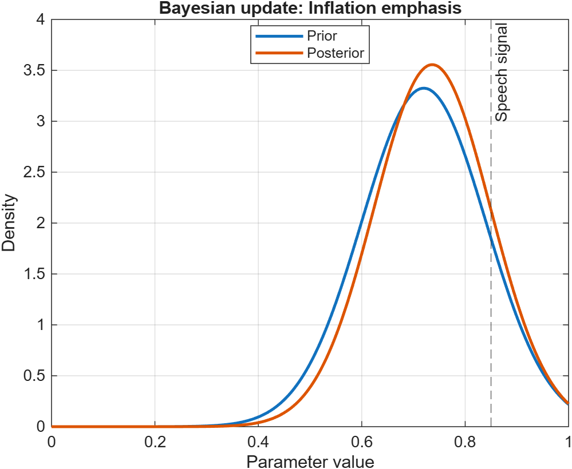
1. Inflation emphasis: We started with a fairly strong prior that inflation remains the Fed’s dominant near-term constraint, consistent with pre-speech expectations that Warsh would reaffirm the 2% target and express concerns about persistent inflation. Prior to the speech, 10-year breakevens of around 2.33% suggested that inflation expectations were elevated relative to target but anchored rather than destabilised.
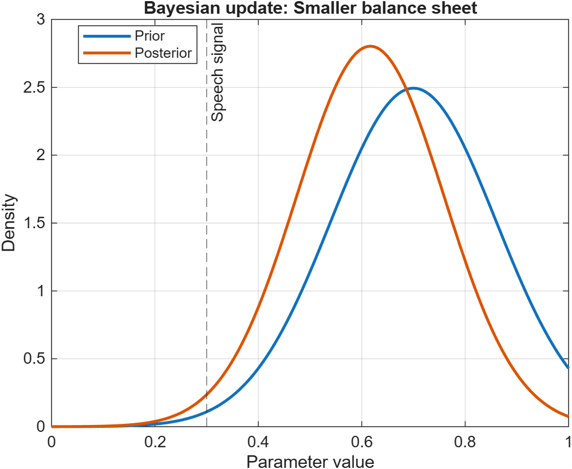
2. Smaller balance sheet: Markets also held a reasonably strong prior that Warsh favours reducing the Fed’s balance sheet footprint. However, confidence was lower than for forward guidance because a Chair’s personal preference and actual FOMC implementation are different propositions.
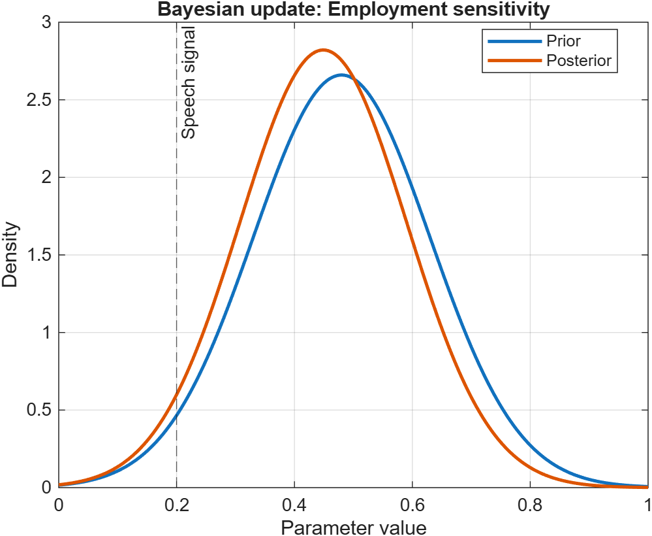
3. Employment sensitivity: Here, we put the market prior closer to neutral. The recent weak payroll data had raised the relevance of employment risk, but policymakers showed disagreement over whether current rates were restrictive enough. The relative weighting of the two sides of the Fed’s mandate remained an open question going into Jackson Hole.
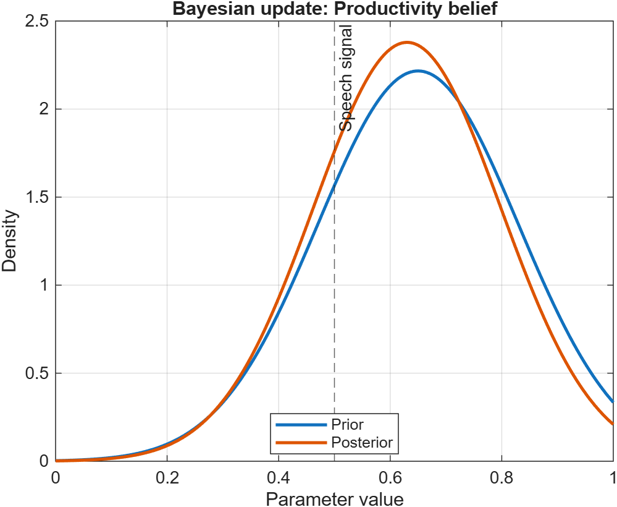
4. Productivity belief: The prior was based on an assumption that markets associate Warsh with a constructive view of AI and productivity. However, the wider standard deviation reflected uncertainty over both the magnitude of any productivity acceleration and, crucially, whether Warsh’s personal supply-side view is shared among committee members to the extent that it affects policy. Pre-speech commentary on Bloomberg expected AI/productivity to feature in the address.
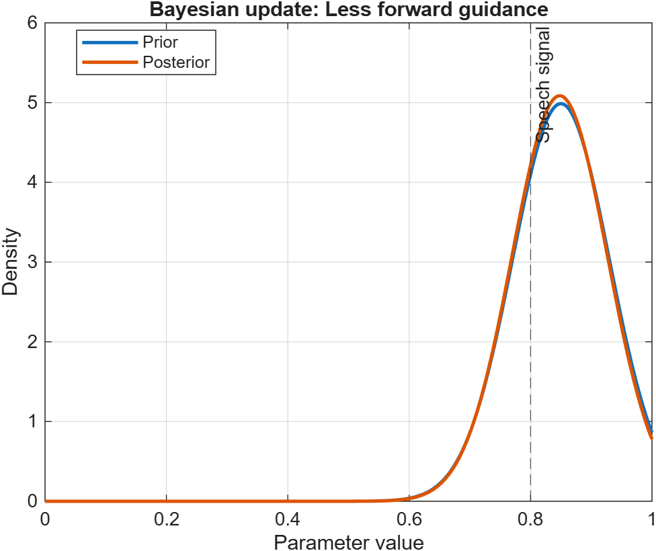
5. Less forward guidance: This was intentionally the strongest and tightest prior. Warsh’s desire to reduce forward guidance is already well known. Simply repeating it would contain no Bayesian surprise.
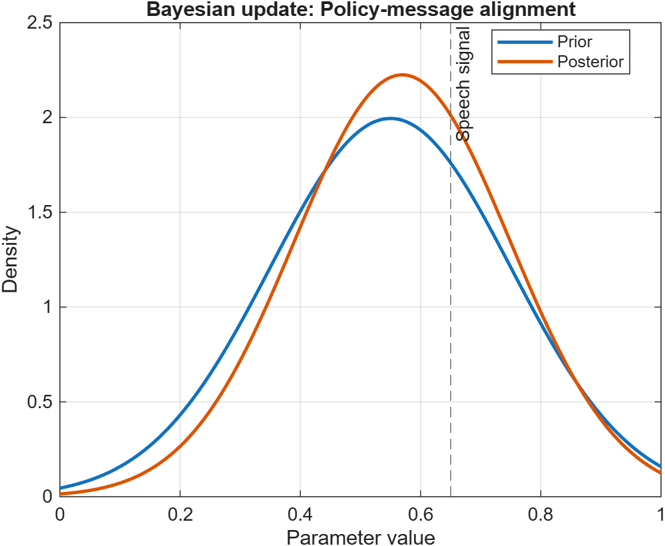
6. Policy message alignment: This was deliberately one of the weakest priors. We know considerably more about Warsh’s preferences than about whether those views represent the Committee’s effective reaction function. Accordingly, Jackson Hole provided an opportunity for information to be gained on this question.
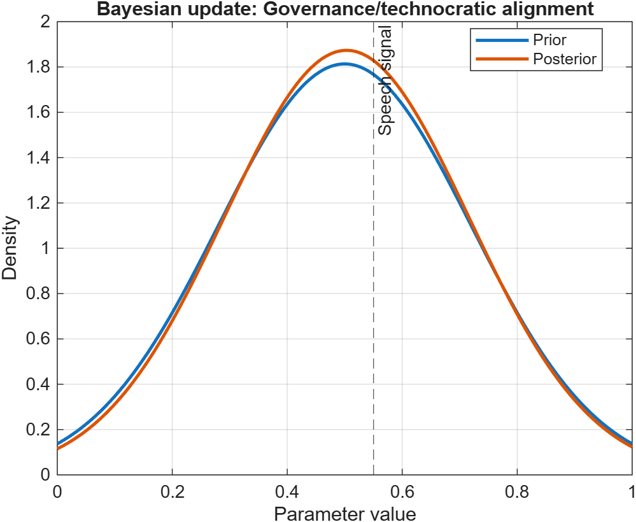
7. Governance/technocratic alignment: This was the most agnostic prior and carried the greatest underlying uncertainty. With Jerome Powell, the previous Fed Chair, the market gained observations over time on whether he synthesised staff analysis and Committee preferences (technocratic alignment) or placed greater weight on his own conviction. Note that the model also imposes an additional noise penalty on this parameter because one speech cannot credibly establish a Chair’s governance style.
What we learned: inflation reinforced, balance sheet downgraded
Now that the speech has been delivered, our framework allows us to visualise the gaps and overlaps between market expectations and what was delivered by the speech. We summarise the findings as follows:
1. Inflation conviction strengthened, but only moderately
The emphasis on inflation increased, as did the conviction evident in the language. The speech was clearly hawkish, but this mostly reconfirmed the prior although it remains Chair-specific in tone and framing. The relative downgrading of other factors, however, brought inflation into sharper relief as the policy focal point.
Source: Amova Asset Management
2. Balance sheet: the dog that did not bark
The biggest information event, according to our model, was the notable absence of any aggressive rhetoric on shrinking the Fed’s balance sheet. The speech provided less support than expected for the balance sheet prior.
Source: Amova AM
3. Employment sensitivity fell
Warsh emphasised the health of the labour market, interpreting some soft hiring data partly in terms of demographics, while placing less weight on wage moderation as a disinflation signal. The explicit subordination of employment to inflation as the operative policy constraint was new, but the signal remains noisier than others, particularly given divergent views among FOMC members regarding the labour market and wages.
Source: Amova AM
4. Productivity optimism modestly marked down
Given that innovation was central to the theme of the symposium, market expectations for Warsh to reiterate his optimism over productivity were modestly disappointed. Although Warsh treated AI as potentially transformative, he also framed the productivity payoff as an open question rather than an established fact.[1]
Source: Amova AM
5. Forward guidance: mostly confirmation
The posterior was virtually unchanged from the prior as Warsh confirmed his personal preference for less forward guidance, without specifying new preferences for communication to the market regarding the Fed’s reaction function. The posterior almost completely overlaps the prior.
Source: Amova AM
6. Policy message alignment: higher, mildly more hawkish
The speech brought Warsh somewhat closer to the hawkish wing of the FOMC but did not establish a new Committee consensus. This meant the posterior moved modestly higher and narrowed.
Source: Amova AM
7. Governance style: too early to tell
The FOMC’s governance style under Warsh remains unresolved. This is not due to any loss of credibility but because one speech cannot establish whether Warsh is likely to govern as a technocratic Committee synthesiser (like Powell) or as a Chair more motivated by personal conviction. The market needs additional data to complete its expectations on this point. Only time will tell.
Source: Amova AM
Bond market response: inflation credibility intact, “higher for longer”
To double-check our model’s updating of Warsh’s speech, we then included a market validation layer in our analysis. We first examined the US Treasury yield curve, where we observed a sharp front-end repricing alongside a rally in the US dollar index, reconfirming a boost to near-term rate hike probabilities. Meanwhile, the 10-year US Treasury yield rose modestly while the 30-year yield declined slightly (a “twist” flattening and compression of the term premium at the long end of the yield curve).
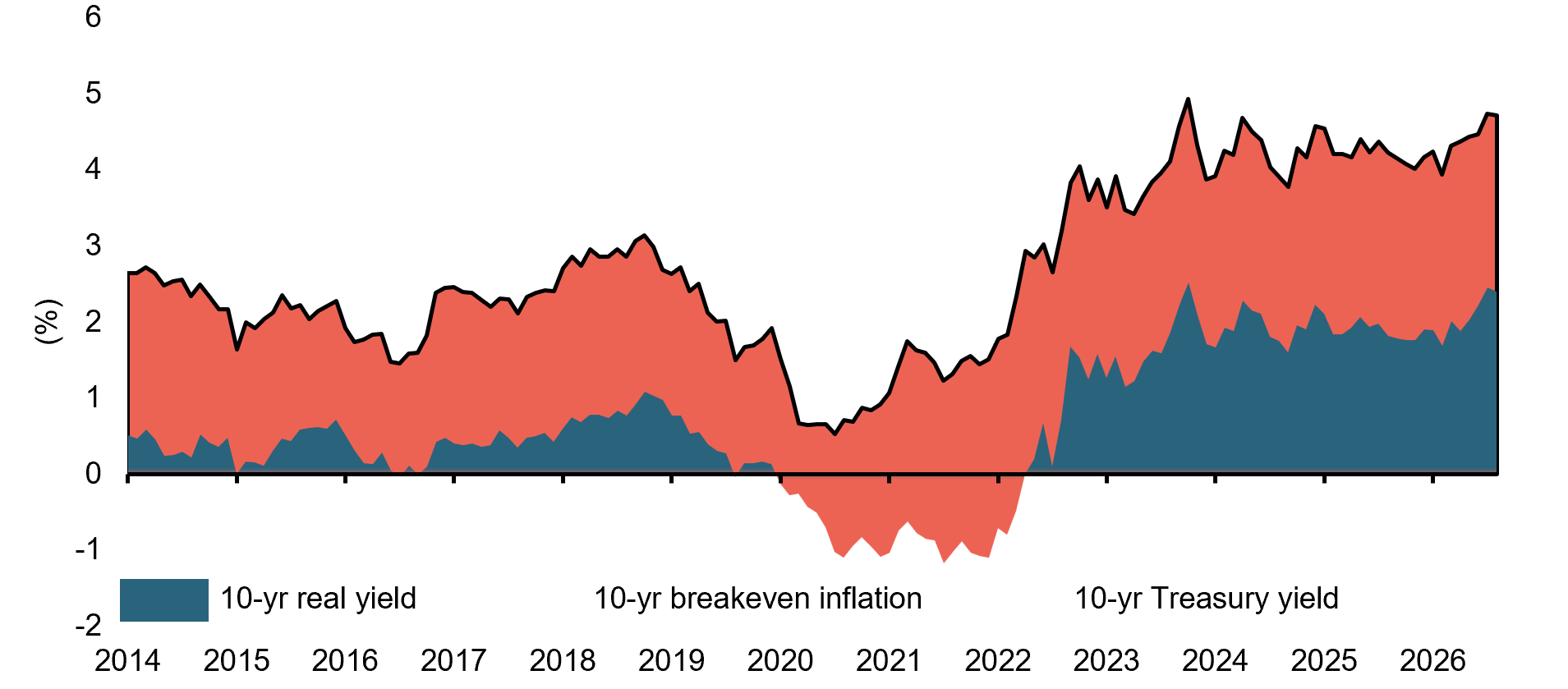
We also decomposed the US 10-year Treasury yield into ACM [2] risk-neutral yield/rate expectations and an ACM term premium, and also into real yield plus 10-year breakeven inflation.
First, we may see long yields as a real yield, “higher for longer” story. Breakevens at about 2.3% are remarkably contained given a nominal yield of above 4.7%; slightly more than half the nominal yield is accounted for by the real yield, which is consistent with inflation credibility remaining intact rather than the markets extrapolating inflation expectations into an unanchoring narrative.
Chart 1: US 10-year Treasury yield composition
Source: Bloomberg
Secondly, the ACM decomposition shows a contained term premium. The risk-neutral yield, representing the expected path of future short-term interest rates, accounts for a much greater part of the 10-year US Treasury yield than the ACM term premium, the additional compensation investors require for bearing duration and interest rate risk. This reinforced the interpretation that markets saw “higher-for-longer” rather than a credibility premium as the primary driver of US 10-year yields. That said, the term premium may contain not only signals about inflation credibility, but also those about supply and demand, uncertainty, risk appetite or fiscal risk, and is therefore not a singular indicator of the Fed’s inflation-fighting credentials.
Appendix: market expectations, updated
The following is a summary description of our model and a definition of our baseline priors, as well as the updated posteriors:
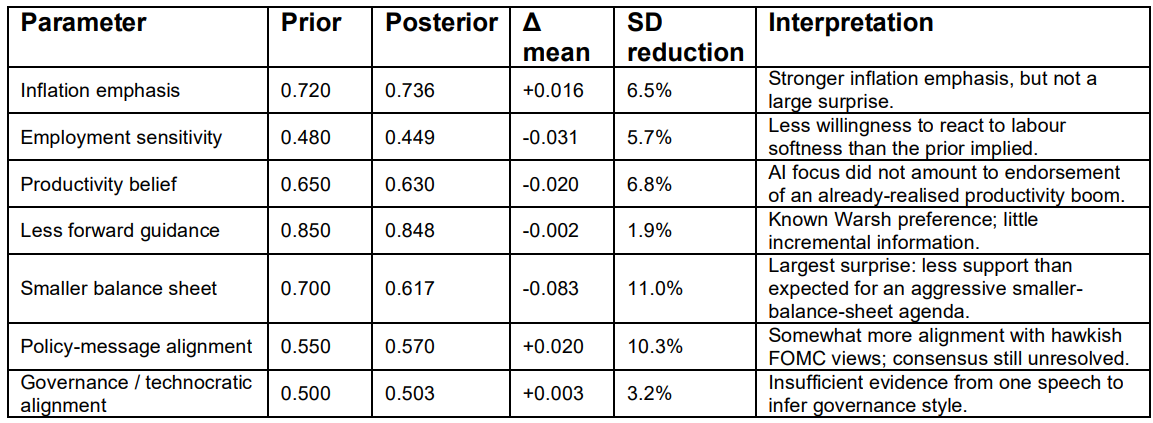
We have seven latent characteristics, each of them representing a distribution, not a point forecast. For each characteristic, the model specified a prior mean, representing the market’s apparent central belief on a normalised 0-1 scale, and a prior standard deviation, representing uncertainty around that belief. A high mean did not necessarily represent high confidence. Below, we display the updated posterior means and standard deviations following the speech—the mean and dispersion need to be read together.
The most useful part of the exercise was updating these prior calibrations using subsequent information (posterior distributions) to update market expectations based on three classifications:
- Class 1: Chair only
Warsh-specific views or preferences, carrying a heavy discount as evidence about the FOMC (e.g., a preference for less forward guidance).
- Class 2: Committee consistent
Views consistent with FOMC language, minutes, staff analysis or broader policymaker communication. We treated this class as moderately informative (e.g., reiterating a state of inflation or labour-market balance already visible in Committee communication).
- Class 3: New FOMC information
New state-contingent policy principles explicitly attributed to the Committee or strongly corroborated by Committee communication. We gave this class the highest potential weight, while allowing for some noise (e.g., explicit Committee willingness to hike if inflation progress stalls).
What the model says the market learned
Source: Amova AM, Macrobond
References
[1] This was also in line with our own analysis of the innovation super-cycle (see Exhibit 1: “Visualising Total Factor Productivity over the innovation cycle” in As US markets become concentrated, Japan remains more diversified).
[2] ACM refers to Adrian, Crump and Moench, who developed the NY Fed’s Term Structure model.