

Japan’s equity market has surged to record highs in 2026, with the Nikkei briefly rising above 70,000 and the TOPIX also reaching a new high. The equity market surge reflects renewed investor confidence in the country’s earnings outlook, corporate reforms and policy direction, as well as a growing focus on companies seen as beneficiaries of AI.
Against this backdrop, the government released its much-awaited Growth Strategy (the “Strategy”) on 21 July—a well-timed announcement to refocus investor attention on Japan’s economic and market prospects following the end of the World Cup.
The Strategy aims to transform the economy into an investment-led growth model through large-scale public-private investment, innovation and structural reform. The government has identified 17 strategic areas of growth and 62 priority products and technologies, spanning AI, semiconductors, digital infrastructure, robotics, healthcare, energy transition, aerospace, materials and content industries.
More than Japanese yen (JPY) 370 trillion (approximately US dollar (USD) 2.35 trillion) of public and private investment is expected to be deployed across these areas by FY2040 (see Exhibit 1).
Exhibit 1: Strategic areas of focus identified by Japan
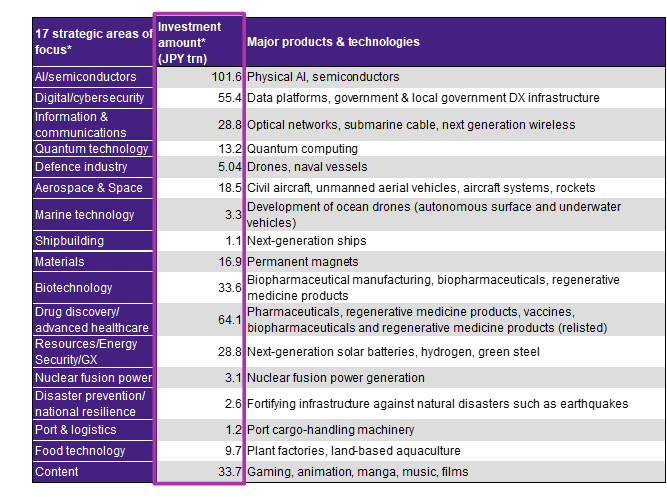
*Includes public and private sector investment and represents cumulative investment through 2026–2040, with the applicable period varying by category; estimates could be subject to revision over time.
Source: Amova Asset Management based on Japanese government documents
The Strategy is expected to generate an estimated JPY 230 trillion of domestic private-sector capital investment per year and nominal GDP approaching JPY 1,100 trillion by FY2040.[1] To achieve this, the government will introduce a new investment framework, multi-year policy support, stronger public-private partnerships and measures to mobilise private capital.
Active Investing in the AI opportunity
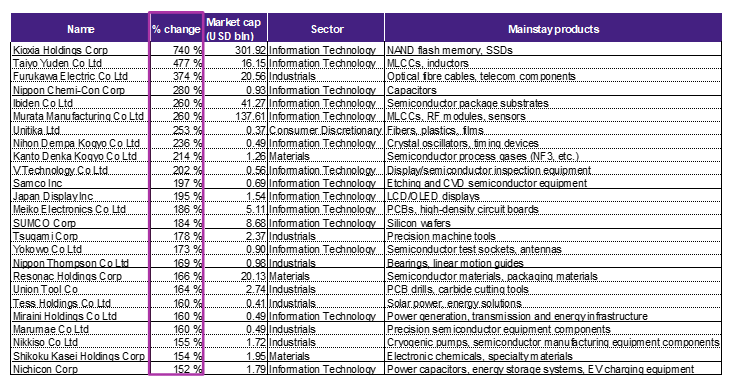
Unlike the US, where AI opportunities are concentrated in a handful of mega-cap technology stocks, Japan offers broad-based exposure across the AI value chain. For example, many AI beneficiaries were the market leaders in the first half of 2026 (see Exhibit 2). The Strategy highlights opportunities spanning semiconductors, robotics, factory automation, industrial equipment, data centres, cybersecurity, communications infrastructure and healthcare technology. These sectors reflect Japan’s competitive advantage in supplying the infrastructure needed to build AI (often described as “AI picks and shovels”) and create a much wider set of potential beneficiaries across the equity market.
Exhibit 2: Top 25 performers in TOPIX during the first half of 2026
Source: Bloomberg as of 30 June 2026
This helps explain why Japan’s equity rally in 2026 has broadened beyond a simple macro or currency story: investors are increasingly identifying company-specific opportunities linked to AI, automation and digital infrastructure.
AI stocks experienced turbulence in July, but in our view, the correction highlights the value of active investing. While the fundamental prospects of some companies are yet to be fully reflected, other firms may have been oversold during the correction. In Japan’s broad AI ecosystem—spanning semiconductors, robotics, automation and digital infrastructure—we believe that active managers can exploit these valuation dislocations to identify underappreciated long-term winners.
The new Growth Investment Guidance
The Strategy additionally seeks to address long-standing structural challenges through startup promotion, financial market development, labour productivity improvements, wage growth, STEM (science, technology, engineering and mathematics) education and workforce reforms. Importantly, it explicitly promotes growth-oriented corporate governance, including action highlighted in the revised Corporate Governance Code (finalised and announced on 21 July). Furthermore, the Strategy has introduced new “Guidance for Growth Investment”[2] (the “Guidance”) designed to encourage greater investment and more efficient capital allocation.
Compiled by the Ministry of Economy, Trade and Industry (METI), the Guidance places renewed emphasis on economic profit (EP)—a measure of the economic value a company creates after covering its cost of capital—as a key framework for evaluating value creation and capital allocation.
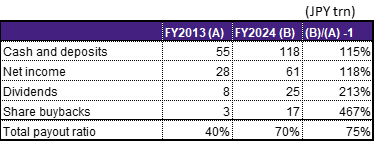
The Guidance argues that Japan’s next phase of value creation should come from reallocating capital towards growth opportunities rather than from a simple increase in shareholder distributions. It also states that Japanese companies have made significant progress in profitability and shareholder returns but have not invested enough in future growth. Between FY2013 and FY2024, corporate profits nearly doubled, cash holdings among TOPIX 500 companies rose from JPY 55 trillion to JPY 118 trillion, and shareholder returns increased sharply through higher dividends and share buybacks (see Exhibit 3).
Any reference to a particular security is purely for illustrative purpose only and does not constitute a recommendation to buy, sell or hold any security. Nor should it be relied upon as financial advice in any way.
Exhibit 3: Profitability and shareholder returns of Japan Inc. have improved
Source: Amova AM based on METI’s Guidance for Growth Investment Data Collection[3]
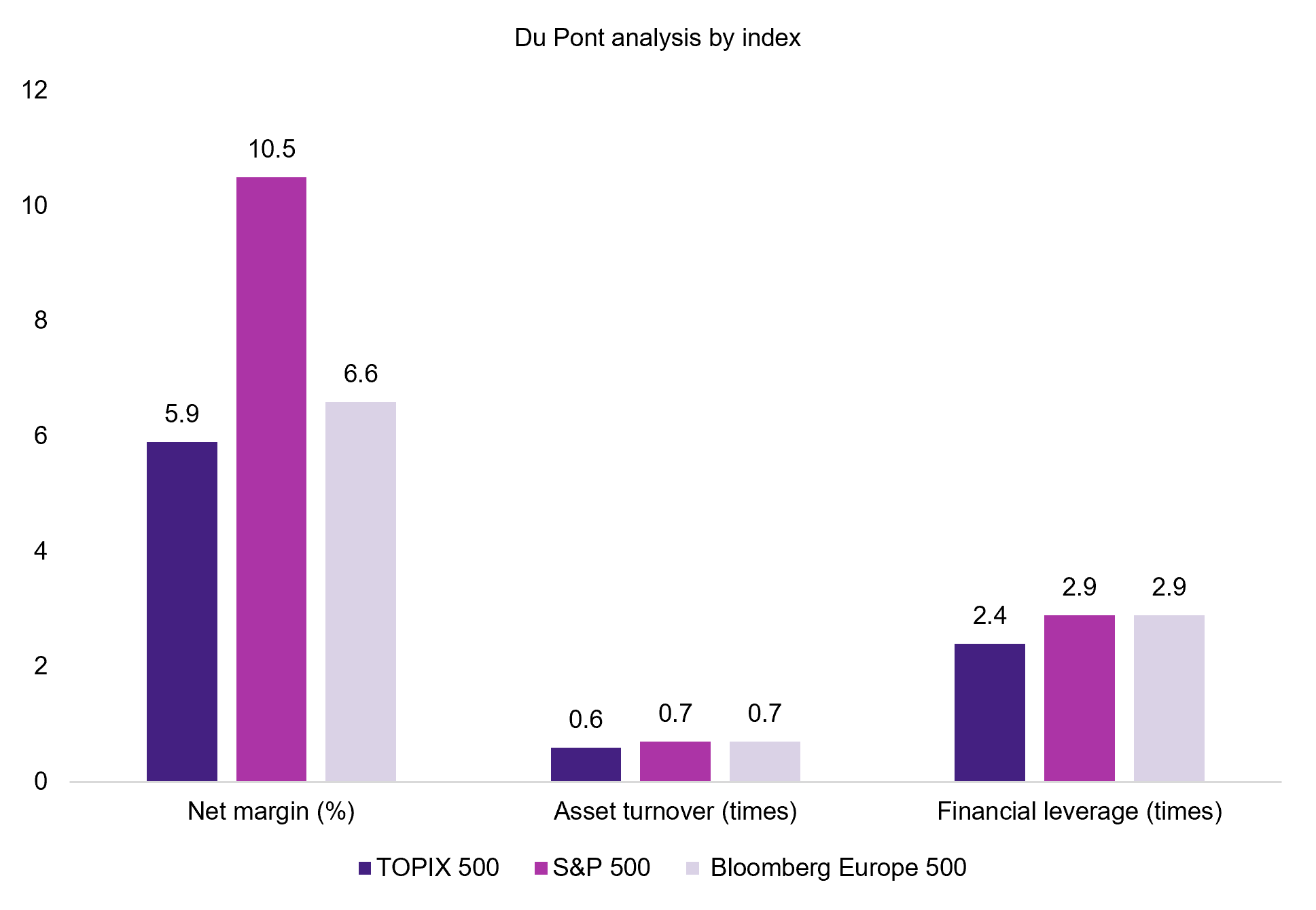
However, spending by Japanese firms on capex, R&D and human capital has remained relatively weak compared with their peers in the US and Europe. The Guidance states that Japan’s ROE improved to 9.4% as of 2024, but remained well below the US level of 20.9%. This reflects lower margins and low financial leverage, with one key reason being the high levels of excess cash on corporate balance sheets (see Chart 1). According to the Guidance, based on FY2023 data, Japanese companies also allocate a smaller share of sales to growth investments (17.7%) than their US (29.4%) and European (27.2%) peers—particularly in R&D and human capital investments.
Chart 1: Potential for margin expansion and improved capital efficiency creates opportunities for Japan
Source: METI based on 2024 data
The Guidance, together with the revised Corporate Governance Code, encourages companies to improve capital allocation, raise productivity, invest in innovation and strengthen competitiveness. The government sees substantial scope to improve profitability, reduce value-destructive business segments and expand investment in high-return areas.
Conclusion
We believe that the Strategy, with its new set of announcements, is broadly positive for Japanese equities. It is expected to support higher capital expenditure and stronger earnings growth; R&D spending could also expand and productivity may increase across a broad range of sectors.
In contrast to previous growth initiatives, which were concentrated in a small number of industries, the Strategy’s emphasis on 17 strategic fields is likely to create opportunities across technology, industrials, machinery, healthcare, materials, energy, financials and infrastructure.
The combination of top-down policy support and bottom-up corporate action is particularly powerful. While government initiatives provide the framework and incentives for investment, companies are increasingly being encouraged through the revised Corporate Governance Code and the new Guidance for Growth Investment to reinvest excess cash, optimise business portfolios and pursue higher-return growth opportunities to create value.
Thus, we believe that the overall strategy has the potential to broaden Japan’s growth drivers (both AI and non-AI) and provide a meaningful long-term tailwind for the overall Japanese equity market.
About the author
Junichi Takayama, Japan Investment Director
Junichi Takayama joined Amova Asset Management in 2013 as Investment Director with the Tokyo-based Japan Equity team. In 2023, he relocated to London, where he acts as a direct conduit for the Japan Equity team to EMEA-based clients.
Junichi started his career as an investment banking analyst at Daiwa Securities SMBC in Tokyo. He then moved to California to join a US activist hedge fund, Taiyo Pacific Partners, before moving back to Tokyo to join Principal Global Investors as a Japan Equity Analyst and last served as a Japan Equity Portfolio Manager.
Junichi has a Bachelor of Arts in Economics from the University of Michigan, Ann Arbor, and an MBA with Honors from the University of Chicago Booth School of Business. He is a holder of the right to use the Chartered Financial Analyst® (CFA), Chartered Alternative Investment Analyst (CAIA) and Certified Member Analyst of the Securities Analysts Association of Japan (CMA) designations.