


Global Equity Investment Philosophy
Our philosophy is centred on the search for “Future Quality” in a company. Future Quality companies are those that we believe will attain and sustain high returns on investment. ESG considerations are integral to Future Quality investing as good companies make for good investment. The four pillars we use to assess the Future Quality characteristics of an investment are:
Franchise - does the company have a sustainable competitive advantage?
Management- does the company make sound strategic and capital allocation decisions?
Balance Sheet - is growth appropriately financed?
Valuation - are the company’s prospects under-appreciated by the market?
We believe that investing in Future Quality companies will lead to outperformance over the full market cycle. Our strategy is based on fundamental, bottom-up research therefore sector and country allocations are a function of stock selection. The Global Equity strategy is a concentrated, high conviction portfolio with a high active share ratio.
Market outlook
Oscar‑winning films often mirror the spirit of their time, and the 2026 winner, “One Battle After Another”, captures the prevailing mood. Yet for all the difficulty endured over the past year, the path forward is becoming clearer. Valuation spreads have normalised, and the headwinds created by extreme style effects are beginning to fade.
Technological innovation is indispensable, but it cannot replace physical capability. You cannot print energy molecules, fertiliser or critical components, even with AI. Nations that retain industrial depth, manufacturing competence and energy security are structurally advantaged. In that sense, the old economy has begun to reassert itself. We would characterise this as the HALO trade: heavy assets, low obsolescence. HALO assets compound relevance as volatility rises, and geopolitics has powerfully reinforced this logic.
The Iran conflict has simultaneously stressed energy markets, national balance sheets, global supply chains and household resilience, reminding investors that energy security remains among the most influential macro variables. Yet even in a HALO world, risks are not evenly distributed.
Momentum within parts of the IT and AI ecosystem has reached levels last seen prior to the Y2K unwind. Valuations across several AI‑exposed beneficiaries, particularly within the industrial layer of the AI stack, now embed assumptions of near‑perfect execution and uninterrupted capex growth. At the same time, over US dollar 162 billion of planned US data‑centre investment has been delayed or blocked, highlighting growing real‑world constraints.
Physical bottlenecks, power, grid access and permitting are becoming defining investment themes. Solving these bottlenecks has become big business and underpins the investment case for holdings such as Curtiss‑Wright and Hitachi. However, valuations already reflect much of this opportunity, explaining why we have been trimming exposure. Many AI beneficiaries are priced for perfection—which is not impossible, but is increasingly improbable. We believe better opportunities lie elsewhere.
The market’s tendency to apply a one‑brush approach to perceived “AI losers” has created genuine dislocations. Not all incumbents are destined to be disrupted. Over the past three months, we have systematically reviewed the portfolio, exiting positions where the bear case has strengthened and reallocating capital towards companies where pessimism has overshot reality. In March, we exited Genpact and Tencent Music Entertainment while increasing exposure to Toast, Compass and Mastercard. Faced with an AI bear narrative, we believe their competitive positioning, data advantages and ecosystem dynamics point to durable relevance. Over time, market‑share gains should reassert their Future Quality attributes as enthusiasm for momentum and AI spending cools.
As with the telephony build‑out, we expect the AI capex cycle to persist, albeit at lower growth rates, benefiting dominant franchises, particularly where cyclical risks are already embedded in valuations. Consumption is likely to remain secondary as capex continues to drive global growth. Beyond AI, defence, energy infrastructure and onshoring remain important sources of physical investment, while non‑AI‑exposed defensive models with pricing power and operational flexibility, such as our recent initiation, US Foods, also appear attractive.
Finally, the dense interconnections that once supported global stability have become sources of fragility. Chokepoints are increasingly weaponised: China with rare earths, the US with dollar finance and Iran with Hormuz. Supply chains optimised for efficiency rather than resilience are vulnerable by design. Against this backdrop, diversification across inflation‑resilient assets and downside‑protected growth is essential. The Future Quality philosophy, centred on pricing power, capable management, strong balance sheets and overlooked durable assets, remains the most reliable way to endure cycles, in our view. In 2026, such discipline may matter more than ever.
Reference to any particular securities or sectors is purely for illustrative purpose only and does not constitute a recommendation to buy, sell or hold any security. Nor should it be relied upon as financial advice in any way. There can be no assurance that any performance will be achieved in any given market condition or cycle. Past performance or any prediction, projection or forecast is not indicative of future performance.
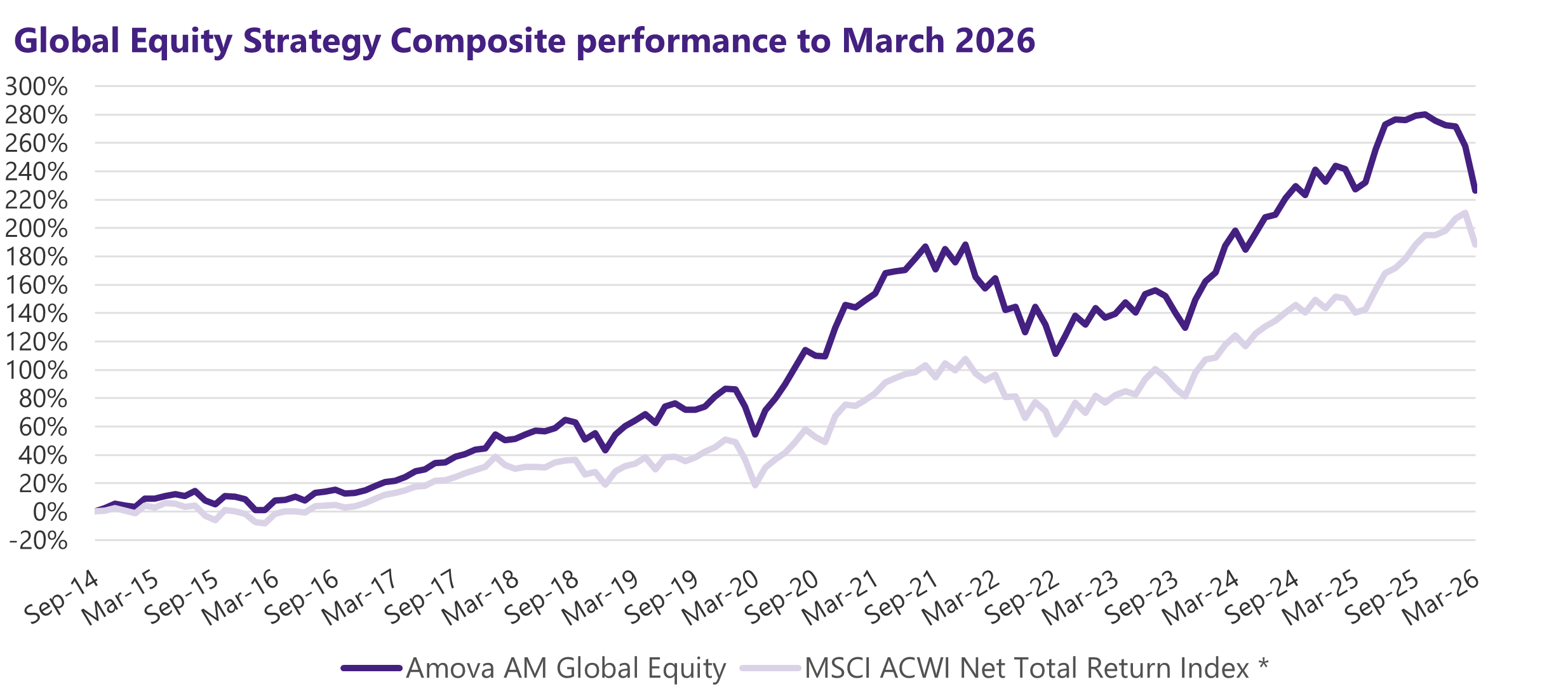
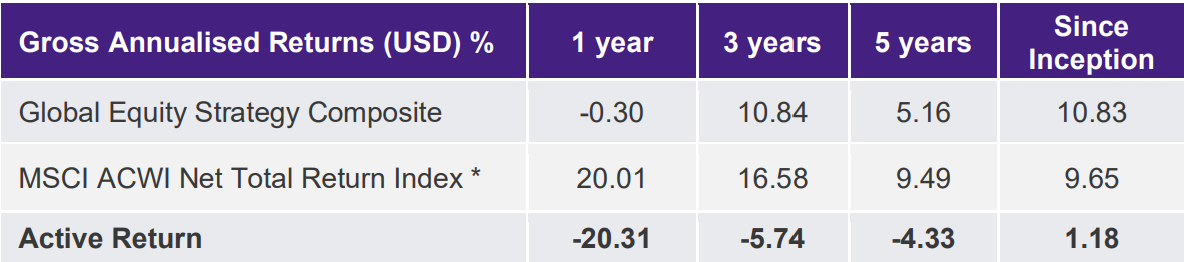
Past performance is not a guide to future returns. Any comparison to a reference index or benchmark may have material inherent limitations and therefore should not be relied upon.
Returns are based on Amova AM’s Global Equity Strategy Composite returns. The benchmark for this composite is the MSCI ACWI Net Total Return Index. The benchmark was the MSCI ACWI ex AU since inception of the composite to 31 March 2016. Returns are USD based and gross of management fees only. Returns in excess of one year are annualised, but those for the periods of less than one year are not annualised. Amova AM claims compliance with the Global Investment Performance Standards (GIPS®). GIPS® is a registered trademark of CFA Institute. CFA Institute does not endorse or promote this organization, nor does it warrant the accuracy or quality of the content contained herein. For more information on how to obtain the GIPS report please contact GIPS_inquiry@amova-am.com Source: Amova AM; Inception date: 01 Oct 2014.
Data as of 31 March 2026
Amova AM Global Equity: Capability profile and available vehicles (as at Mar 2026)
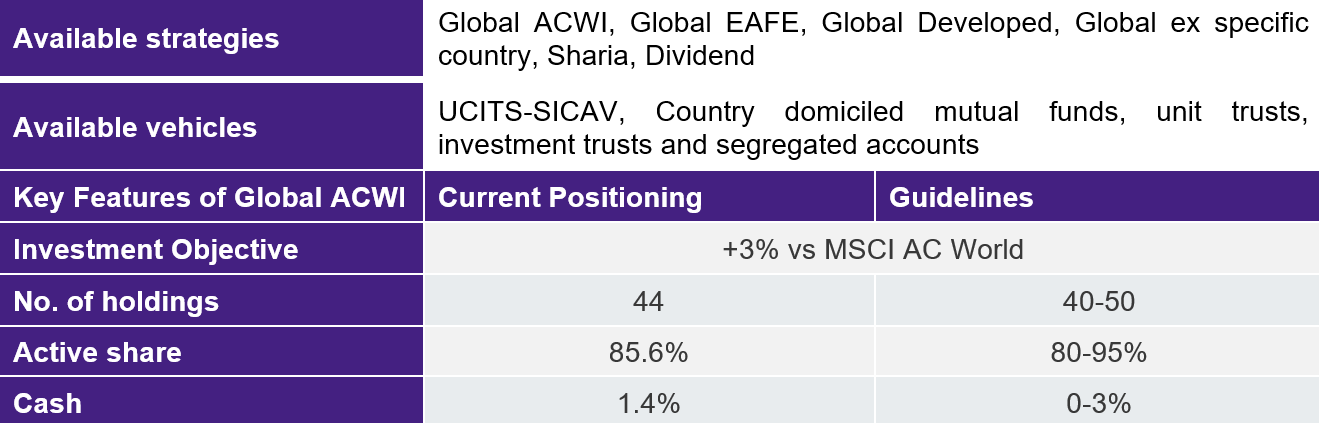
Target return is an expected level of return based on certain assumptions and/or simulations taking into account the strategy’s risk components. There can be no assurance that any stated investment objective, including target return, will be achieved and therefore should not be relied upon. Any comparison to a reference index or benchmark may have material inherent limitations and therefore should not be relied upon.
Past performance is not indicative of future performance. Amova AM Representative Global Equity account. Source: Amova AM, FactSet.
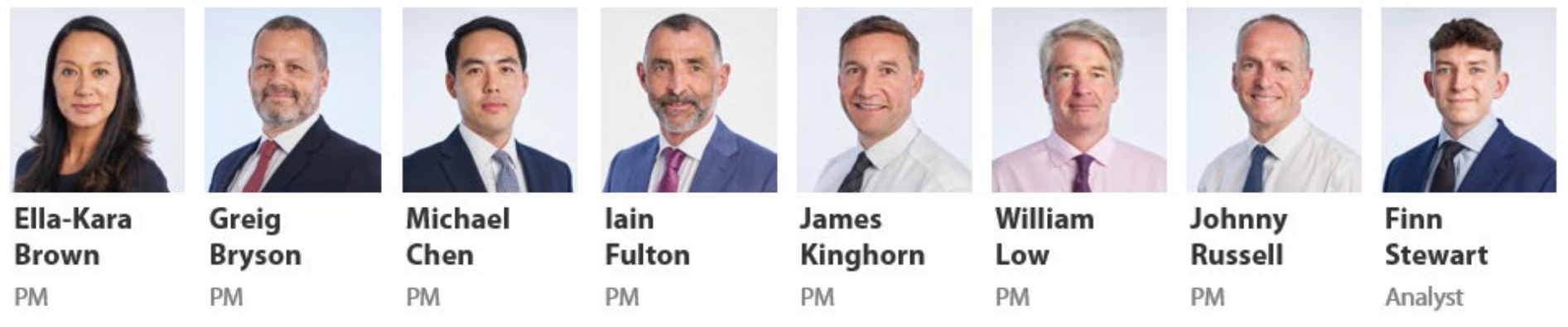
This Edinburgh based team provides solutions for clients seeking global exposure. Their unique approach, a combination of Experience, Future Quality and Execution, means they are continually “joining the dots” across geographies, sectors and companies, to find the opportunities that others simply don’t see.
There are four key areas that make our strategy different:
– a focus on Future Quality companies – a different and clear philosophy
– a distinctive team culture – a tight-knit team with a process built on openness and respect
– unique execution, including rigorous team challenge of every idea
– differentiated portfolios, with a strong track record in stock-picking and ESG integration
Future Quality companies
We believe that companies with superior long-term returns on investment will deliver better performance. We call these Future Quality companies, and it is only these companies that make it into client portfolios. We search for Future Quality through analysis and financial modelling of companies that we expect to deliver over the next five years, and beyond. This approach is supported by academic evidence that businesses with high and improving returns on invested capital provide superior compound performance over the long term. With this investment time horizon, the sustainability of returns is a crucial ingredient of our Future Quality approach. We have found that companies developing solutions to ESG issues and management teams providing value to all stakeholders are more likely to be successful at sustaining high returns on invested capital over the long-term.
Distinctive team structure and culture
We believe that our collective knowledge and experience are powerful tools for delivering investment performance. Since 2011, we have operated a team-based approach to uncovering Future Quality investment ideas and have fostered a strong group dynamic. Individually, each Portfolio Manager is an expert investor with a broad skillset and experience of many market cycles.
We work in a flat structure, where all our Portfolio Managers have a dual role that combines investment analysis and investment management responsibilities. With individual analytical coverage split along industry lines, each Portfolio Manager is a specialist in the stocks and sectors they cover.
We all actively challenge the ideas and analysis of colleagues throughout the investment process, in an open atmosphere of vigorous and constructive debate. Portfolio Analysts work alongside Portfolio Managers, typically researching thematic trends that could influence and uncover future investment opportunities.
We take collective responsibility for approving stocks for the portfolio, and therefore there is joint accountability for performance. As such, it is in everyone’s interest to ensure that the investment analysis is thorough and that no stone is left unturned in the search for Future Quality.
We believe that the broad experience of our Portfolio Managers and distinctive team-based approach that sees everyone contributing to the strategy, increases the probability of successfully uncovering Future Quality.
Unique execution
Our tight-knit team approach and flat structure enable us to execute in a transparent way, including a rigorous team challenge of every idea. By using our strict Future Quality standards, we can identify long-term winners from the broader universe, to narrow down a comprehensive watch list and around 100 deep dive researched ideas. This is within a unique framework of individual accountability for the underlying analysis and company research, combined with the collective challenging of assumptions at the team level. Our proprietary ranking tool creates a disciplined process to compare and rank attractive opportunities and ensures that at the portfolio construction phase, only our best-ranked ideas receive the most committed weights in client portfolios. We believe our culture is key, and the collective ownership of our research process brings the best portfolio outcomes for clients.
Differentiated portfolios
We deliver a high-conviction Global Equity strategy for clients that is not constrained by benchmarks. As such, Future Quality can be sourced from listed businesses across any geography or sector. And, in a world awash with investment prospects, our disciplined, accountable and transparent process helps us to focus solely on building portfolios from companies that best meet our specific Future Quality criteria.
In terms of balancing risk and reward, our track record shows that we consistently deliver attractive returns on a lower risk-adjusted basis compared with peers and the global reference benchmark. The high active share and concentrated number of holdings help ensure that our Future Quality stock-selection process delivers differentiated portfolios.
Risks
Investing involves the risk of loss of capital due to factors such as overall market fluctuations, economic and political conditions, and changes in the value of individual securities. There is no guarantee that investment objectives will be achieved. The following non-exhaustive risk factors may affect investments in the strategy or strategies described in this marketing communication. Actual risks will vary by strategy, and not every risk listed will be applicable to each strategy. However, investors should consider all these potential risk aspects when evaluating the strategy.
Currency risk - this exists when the strategy invests in assets denominated in a different currency. A devaluation of the asset's currency relative to the currency of the strategy will lead to a reduction in the value of the strategy.
Equity Risk - the risks associated with investments in equities may be higher, because the investment performance of equity securities depends on factors which are difficult to predict. Such factors include the possibility of sudden or prolonged market declines and risks associated with individual companies. The fundamental risk associated with any equity portfolio is the risk that the value of the investments it holds might decrease. Equity security values may fluctuate in response to the activities of an individual company or in response to the general market and/or economic conditions.
Liquidity risk - investments that could have a lower level of liquidity due to (extreme) market conditions or issuer-specific factors and or large redemptions of shareholders. Liquidity risk is the risk that a position in the portfolio cannot be sold, liquidated or closed at limited cost in an adequately short time frame as required to meet liabilities of the Strategy.
Operational risk - due to issues such as natural disasters, technical problems and fraud.
Credit Risk - is the possibility that a bond issuer will fail to pay interest and principal in a timely manner.
Emerging markets risk –emerging markets may be exposed to political, fiscal and institutional instability that creates risks associated dealing, settlement, accounting, ownership, custody as well as liquidity (including the risk of internal or external embargos on the sale or acquisition of currencies and securities).
Hedging risk –hedging is performed at a cost, and the returns of the forward or swap currency contracts may not perfectly offset the actual fluctuations being hedged, which may increase the volatility of the strategy. If the counterparty of derivative transaction used within the hedging process defaults and is unable to meet its contractual obligations, the value of the derivatives dealt with that counterparty may become nil.
Debt default risk - high yield debt instruments are materially exposed to the risk that their issuer may not be able to meet its interest payment or principal reimbursement obligations.
Deposits default risk - deposits and money market instruments are exposed to the risk that their issuer may not be able to meet its interest payment or principal reimbursement obligations.
Derivative leverage risk - the derivatives used within the strategy may create leverage that increases short-term volatility and exposes the strategy to larger losses.
Derivatives counterparty risk - a counterparty involved in a derivative transaction with the portfolio, may fail to meet its obligations which could cause losses.
Sustainability risk – The risk arising from any environmental, social or governance events or conditions that, were they to occur, could cause material negative impact on the value of the investment.
Specific sustainability risk can vary for each product and asset class, and include but are not limited to: Transition Risk, Physical Risk, Social Risk and Governance Risk.