


Beyond the military conflict, good and bad news go unnoticed
The crisis in the Middle East continues to dominate global headlines. Since its outbreak, the Japanese equity market has come under pressure, in part reflecting profit‑taking after the strong momentum seen during the first two months of the year (the broad market TOPIX Index is still up +7.06%YTD at the close on March 27). This pattern is not unique to Japan; market sentiment has weakened globally. As a result, developments that would normally attract significant media attention—both positive and negative—have received limited attention amid geopolitical headlines.
Against this backdrop, it is worth recalling that only recently Prime Minister Sanae Takaichi’s landslide victory received extensive coverage in Western media, accompanied by imagery symbolising political momentum and stability. Securing a two‑thirds supermajority in the lower house has provided the government with an unusually strong mandate, materially enhancing its ability to advance structural reforms and execute its policy agenda. Despite being temporarily eclipsed by geopolitical events, this political backdrop remains a meaningful and underappreciated factor for Japan’s medium‑term investment outlook.
Priority technologies and products within Japan’s 17 strategic fields
Japan’s state‑led growth strategy is organised around 17 strategic areas of focus (Chart 1), first announced in November 2025. The government has since moved from framework to execution, formally designating 61 products and technologies across these fields for priority public-private investment under Prime Minister Takaichi’s economic policy. This designation was confirmed at the Council for Japan’s Growth Strategy on 10 March, marking a concrete acceleration of public‑private investment efforts.
From this group of 61, the government has identified a smaller subset of 27 technologies and products as initial roadmap priorities, reflecting the areas where implementation and investment are intended to begin first. The 61 products and technologies were selected based on three stated perspectives, reflecting an effort to advance national resilience and innovation-led economic growth.
- Economic security (the “necessity of reducing domestic risks”)
- Overseas growth (the “potential for capturing overseas markets”)
- Product innovation (the “innovativeness of related technologies”)
For equity investors, several themes stand out:
- AI robotics (“physical AI”) and semiconductors, with goals to secure over 30% of the global AI‑robotics market while also increasing domestic semiconductor sales to Japanese yen (JPY) 40 trillion (approximately 265 billion US dollars) by 2040, improving capex visibility for automation, components, chips, and equipment.
- Data platforms, cybersecurity, and government digital transformation (DX) provide steady, procurement‑backed demand. Dual‑use drones and unmanned systems benefit from mass‑production and export potential.
- Green Transformation (GX) areas—perovskite solar cells, hydrogen, green steel, and permanent magnets—support decarbonisation and supply‑chain security.
The government plans to formulate a roadmap incorporating specific investment targets by the summer.
Chart 1: Highest‑priority technologies within Japan’s 17 strategic fields (initial roadmap: 27 items)
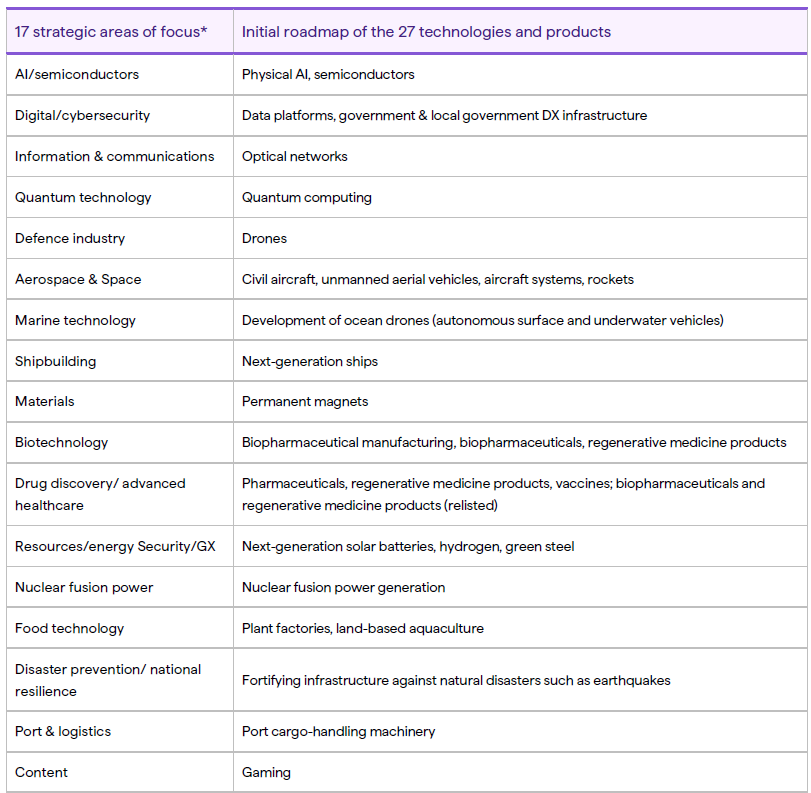
Source: Amova Asset Management based on Japanese government documents. *Not in order of priority*
Cash is king, but opportunity lies in action as corporate governance enters a new phase
Market uncertainty stemming from geopolitical tensions is driving investors toward lower‑beta, defensive sectors. While cash is clearly king and can provide downside protection amid heightened volatility, its value is ultimately realised only when it is deployed productively rather than left idle. Approximately a third of the TOPIX companies are still trading below book value, and there is still much value to be unlocked in the market.
This concern is increasingly recognised at the policy level. Speaking in Davos in January, Japan’s Finance Minister Satsuki Katayama highlighted the problem of sub‑optimal capital allocation within the Japanese economy and the need to revise the Corporate Governance Code to address this issue (for more on cash-rich companies, see my recent article, Japan equities: mobilising cash as a dominant strategy).
Reflecting such a shift, the Expert Panel on the Revision of the Corporate Governance Code convened for its second meeting on 26 February, this marks the third revision to the Code since its original introduction in 2015.
The upcoming revision is expected to be particularly significant. The number of principles will be streamlined, with the current 83 principles reduced by roughly half to improve clarity and effectiveness. In addition, new “Interpretive Guidelines” will be introduced to provide companies with practical reference points when formulating and implementing their governance policies.
Chart 2: Distribution of TOPIX companies by price-to-book ratio
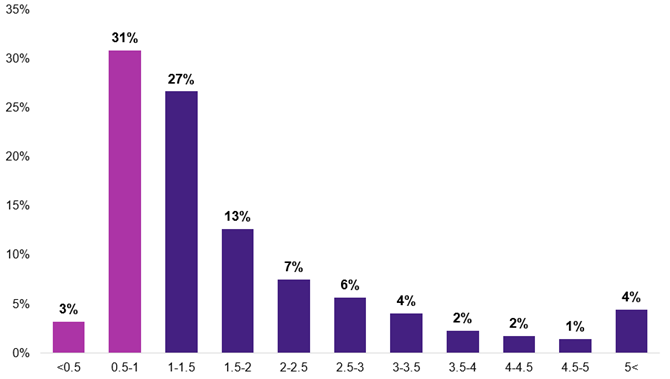
Source: Amova AMbased on Bloomberg data as of 26 March 2026
Against this backdrop, the use of excess cash is expected to be one of the key changes to be considered.
“Taking into account the company’s management strategy and business plans, the board should continuously assess whether management resources—including cash and cash equivalents—are being deployed appropriately as risk‑taking to support sustainable growth and enhance medium‑ to long‑term corporate value” (Principle 4-2: Roles and Responsibilities of the Board – Interpretive Guideline[in Japanese only, page 16]).
This does not imply that cash‑rich Japanese companies are simply being encouraged to return more capital to shareholders. Rather, the more important shift is an expectation of greater transparency around cash deployment—including how much cash will be used, when it is likely to be deployed, for what purposes, and the logic behind it. Improved transparency should, in turn, enhance market discipline and support a more constructive dialogue between companies and shareholders.
In fact, corporate governance reform is not the sole driver behind this change. Japan’s transition from a deflationary environment to a sustained inflationary one is also exerting pressure on corporate balance sheets, as holding excess cash now results in negative real returns and value erosion.
Against this backdrop, we expect more companies to move beyond simply distributing back to shareholders and instead focus on actively creating value through a more disciplined and strategic deployment of excess cash to invest for the future.