


The Amova Asset Management Global Investment Strategy Committee (GISC) convened on 11 March. The Committee maintains a constructive base-case on moderating but positive global growth. At the same time, the ongoing oil and logistics shock prompted by the war in Iran presents uncertainties and the material probability of a global regime shift toward a higher inflation and lower-growth state; therefore, the distribution of risks is significantly wider than in the previous quarter and skewed toward the downside.
Key takeaways
- Tariffs raised the question of cost-side risks in 2025; in early 2026, the Iran war has pushed geopolitical escalation to the forefront. Uncertainty has broadened, and its persistence raises the risk of a shift to a higher-inflation regime.
- The Committee’s base case remains one of investment-led resilience, although the distribution of risks is broader and negatively skewed.
- With inflation expectations on the rise, the Committee foresees firmer nominal conditions rather than a benign easing backdrop.
- The ongoing AI/infrastructure capex boom remains in tension with the war-related energy supply and inflation shock in addition to growth- and inflation-related risks.
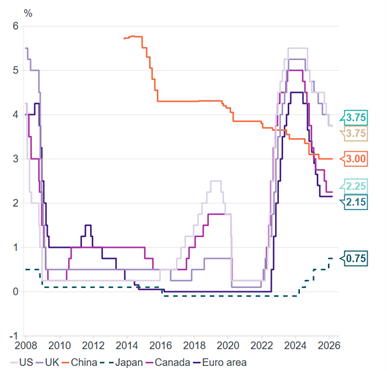
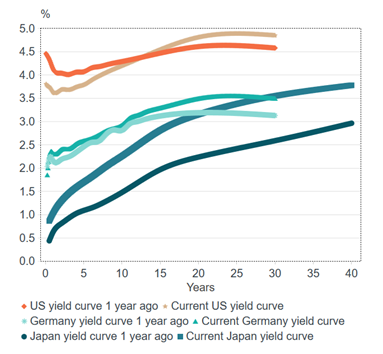
- Even if policy rates have reached neutral levels in many economies apart from Japan, longer-end yields are showing signals of upward pressure across geographies.
- Japan’s fundamentals have been supported by wage gains and corporate reforms, but the risk of a terms-of-trade shock may call for difficult policy choices.
- The slowdown in China’s economy now appears fully priced in; while the government appears to be conserving fiscal firepower, key consumer and property market metrics are showing signs of bottoming.
- There is clear cross-asset dispersion in response to geopolitical risk. Equity expectations remain state-contingent and equity markets have reacted the least, while oil and commodities, followed by long-term interest rates, have reacted more unevenly since the previous quarter.
Global growth: rising probability of market regime transition
The ongoing war in Iran, and its impact on energy prices and logistics, pose a central source of uncertainty for the global outlook, including in the US. As noted previously, financial markets—particularly in the equity complex—continue to appear sceptical that these developments will have a lasting impact on both economic and earnings growth. The market is operating on assumptions contingent upon no market regime shift occurring, which remains the Committee’s base case. That said, the Committee recognises that the probability of a regime shift is rising and assumes a wider margin of uncertainty around the mean.
Separately, risks of escalation in the ongoing Middle East conflict persist. To gauge such risks and their impact upon markets, we have built a framework (see Iran conflict shock: risks may run deeper than markets assume) to track the energy shock transmission loop and continue to monitor progress against our regime transmission ladder, specifically exploring the impact of a terms-of-trade shock upon the Japanese economy. In our quarterly update, however, we separate our base case from the risks of a protracted shock, recognising that the risk of regime transition remains elevated.
Chart 1: Policy rates have adjusted closer to neutral levels (except in Japan)
Source: Macrobond
Chart 2: Government bond yield curves in developed economies are steepening
Source: Amova AM, US Treasury, JBT, Macrobond, data as of March 2026
Global bonds, rates and credit: transmission channels
Global bond markets remain disproportionately more sensitive to inflation risk scenarios than equity markets. As the ongoing war in the Middle East unfolds, concerns are growing that oil and logistics disruptions could exert more persistent upward pressure on inflation expectations. Additionally—and given the historically high indebtedness of developed market economies—the tendency appears to be for steeper yield curves across geographies, rather than a clean bull-steepening.
The war and the ensuing oil shock have quickly made recent inflation data obsolete. Meanwhile, the outlook for monetary policy remains ambiguous. Lingering expectations of central bank easing (outside Japan) coexist with concerns that central banks may find themselves behind the curve if shocks are more persistent than expected. As a result, long-end yields remain on a stubborn uptrend.
For example, markets had only recently priced in some probability of easing by the Federal Reserve (Fed) over the next year, following softer job market indicators. However, escalating uncertainty around the war has caused such expectations to waver. The committee acknowledges the possibility that the Fed may be unable to reduce interest rates over the remainder of 2026, although the base case continues to assume one cut.
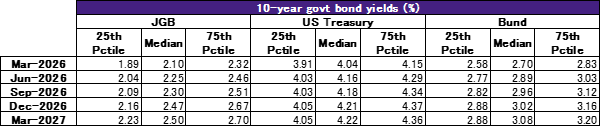
Meanwhile, expectations of further Bank of Japan (BOJ) tightening remain persistent. The Committee expects the central bank to raise rates from 0.75% at the time of writing to near 1.25% over the next year, with 10-year Japanese government bond (JGB) yields continuing to march steadily higher toward the mid-2% range.
The outlooks for long-term US Treasury and JGB yields show significantly wider dispersion compared to the previous quarter, and markedly more dispersion than that expected between long-term US Treasury and 10-year Bund yields. The Committee expects the European Central Bank (ECB), having arrived at “neutral” rates, to remain on hold in the near-term, while 10-year Bund yields rise above 3% by the end of 2026.
One significant risk scenario discussed by the Committee is the potential spillover of stresses currently affecting the private credit markets. For now, the contrast between the rising stresses in the private markets and still-tight public credit spreads remains reassuring. Accordingly, the Committee’s base case is that credit market stresses remain idiosyncratic and concentrated in private markets, which are admittedly more opaque than their public counterparts.
That said, given exogenous stress factors, such as the still-uncertain impact of the ongoing war, we continue to watch public credit markets closely for any signal of contagion. Spillover from private into public credit markets is one avenue by which risks, which are currently isolated to a low-liquidity sector of the credit market, could become more systemic. We highlight, moreover, that stability in the credit markets also underpins the ongoing capex surge and therefore remains a key condition supporting equity market firmness.
US: persistent cyclical expansion meets household uncertainty
The market continues to reflect expectations of continued economic resilience in the US rather than an immediate slowdown. Recognising that financial markets may be more accurate in forecasting state-contingent outcomes rather than pricing transition probabilities, the Committee presents its benign base case within a risk envelope that is more dispersed and skewed to the downside.
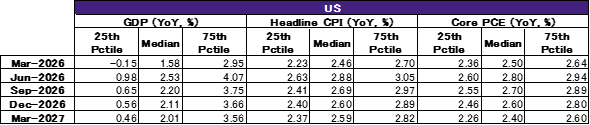
The Committee’s central scenario is for US GDP Growth to remain resilient over the coming year, centred between the mid-1% and mid-2% range year-on-year (YoY). However, the distribution of outcomes has widened meaningfully. Dispersion between the 25th and 75th percentiles has increased, with a probability of 25% or less assigned to growth outcomes ranging from mildly negative to below 1% YoY over coming quarters. Labour market concerns are rising even while the Committee’s central tendency reflects firm nominal growth. Core PCE is expected to struggle to reach the Fed’s 2% target over the coming year. As reflected in our rates and credit section above, the Committee emphasised currently high liquidity conditions, a functioning money multiplier and its impact upon AI capex. Should such liquidity dissipate, the Committee flagged the potential for spillover risks from private debt market stresses as one central risk to beta.
US equity outlook: Committee discussions still focused on corporate earnings support (with the base case still assuming double-digit growth for S&P 500 earnings) likely overpowering macro fear—contingent, of course, on subsiding conflict in Iran. The Committee reiterates the likelihood that equity markets are pricing state-contingent expectations and are less prepared for any regime shift than bond or commodity markets.
Risk appetite remains present, with backwardation in the VIX pointing to episodic volatility, which continues to underpin expectations—especially in tech sector investment. Even in the benign base case, however, the Committee judged that valuations are unlikely to hit new highs. Instead, the burden rests very much on earnings to deliver results to justify high valuations realised to date. A key risk is the current equilibrium not persisting, with liquidity and debt availability turning the cycle, instead of a shortfall in demand relative to supply. Meanwhile, a style rotation toward value and cyclicals may be emerging as equity returns become more dispersed.
Caveats: The Committee foresees the US expansion as stable, but conditional on near-term de-escalation of war in Iran. However, the longer the war persists, the likelier that risks described in the last section of this report will undermine even the robust US real growth trajectory.
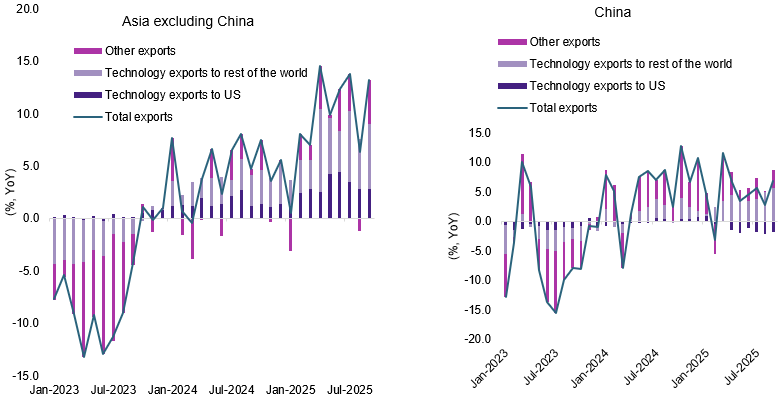
Chart 3: Tech-related global trade flows are booming
Asia includes Cambodia, China, India, Indonesia, Japan, South Korea, Malaysia, Singapore, Taiwan, Thailand and Vietnam.
Source: IMF World Economic Outlook (WEO) September 2025
Japan: structural positives to provide buffer against terms-of-trade shock risks
Committee perspectives on Japan were constructive, with modest yet above-potential GDP growth (ranging between 0.6% and low-1% YoY) foreseen as the base case over the coming year, albeit within a significantly wide risk envelope. The Committee foresees a 25% or less probability of a negative quarter-on-quarter real GDP growth reading in any given quarter.
Wages, labour scarcity and prospects of fiscal stimulus so far remain supportive of domestic conditions. The Committee foresees inflation expectations to remain skewed to the upside, consistent with continued BOJ normalisation. The central bank has only a modest margin to delay the timing of rate hikes due to uncertainty surrounding the ongoing Iran war, given the risk that recently achieved moderation in CPI excluding fresh food could sharply reverse.
Fiscal support is seen as growth-friendly and targeted toward IT investments in particular. However, pressure from the bond market is expected to prevent the government from pursuing excessive stimulus, reducing the feared tail risk of a fiscal free-for-all scenario feared. As mentioned above, while long-term yields are likely to continue trending higher, the Committee’s base case is that they will do so in an orderly fashion. Nonetheless, a key risk highlighted by the Committee in the event of a protracted shock to oil and logistics prices is that inflation pressures may accelerate, putting pressure on the BOJ to hike at a faster pace to avoid falling behind the curve.
Japanese equities are expected to gain near-term support from a cheaper yen as markets anticipate the need for future petrodollar purchases. Earnings upgrades and expectations for fiscal expansion are also seen supporting Japanese equities. The Committee’s central scenario remains one of positive spillovers from the ongoing AI-driven investment boom and Japan’s unique role in hardware, infrastructure and physical AI value chains.
At the same time, the Committee recognises that this base case is highly state-contingent. The Committee examined alternate scenarios in which the Iran war prompts a terms-of-trade shock, potentially presenting the BOJ with a policy dilemma to deliver faster hikes or risk falling behind the curve. Meanwhile, although firm real wages bode well for consumption, the additional potential for domestic supply shocks persists for some sectors. One such hard-to-substitute sector is construction, which is likely to be hit hard by domestic labour supply shortages even if domestic demand strengthens.
For this reason, robust earnings growth over the next quarters may face headwinds as 2026 progresses. The rise in long-term rates may weigh on earnings growth, with the risk of bear steepening strongest where fiscal activism meets imported inflation risks.
As a main scenario, disorderly JGB trading is expected to be kept at bay thanks to the likelihood of the BOJ maintaining its credibility and the administration of Prime Minister Sanae Takaichi engaging in a positive dialog with markets. Correspondingly, the Committee sees scope for the weak yen to gradually strengthen as interest rate differentials narrow. From levels near 160 at the time of writing, dollar/yen is expected to pull back below 150 within the coming year.
Chart 4: Heightened fiscal stimulus expectations
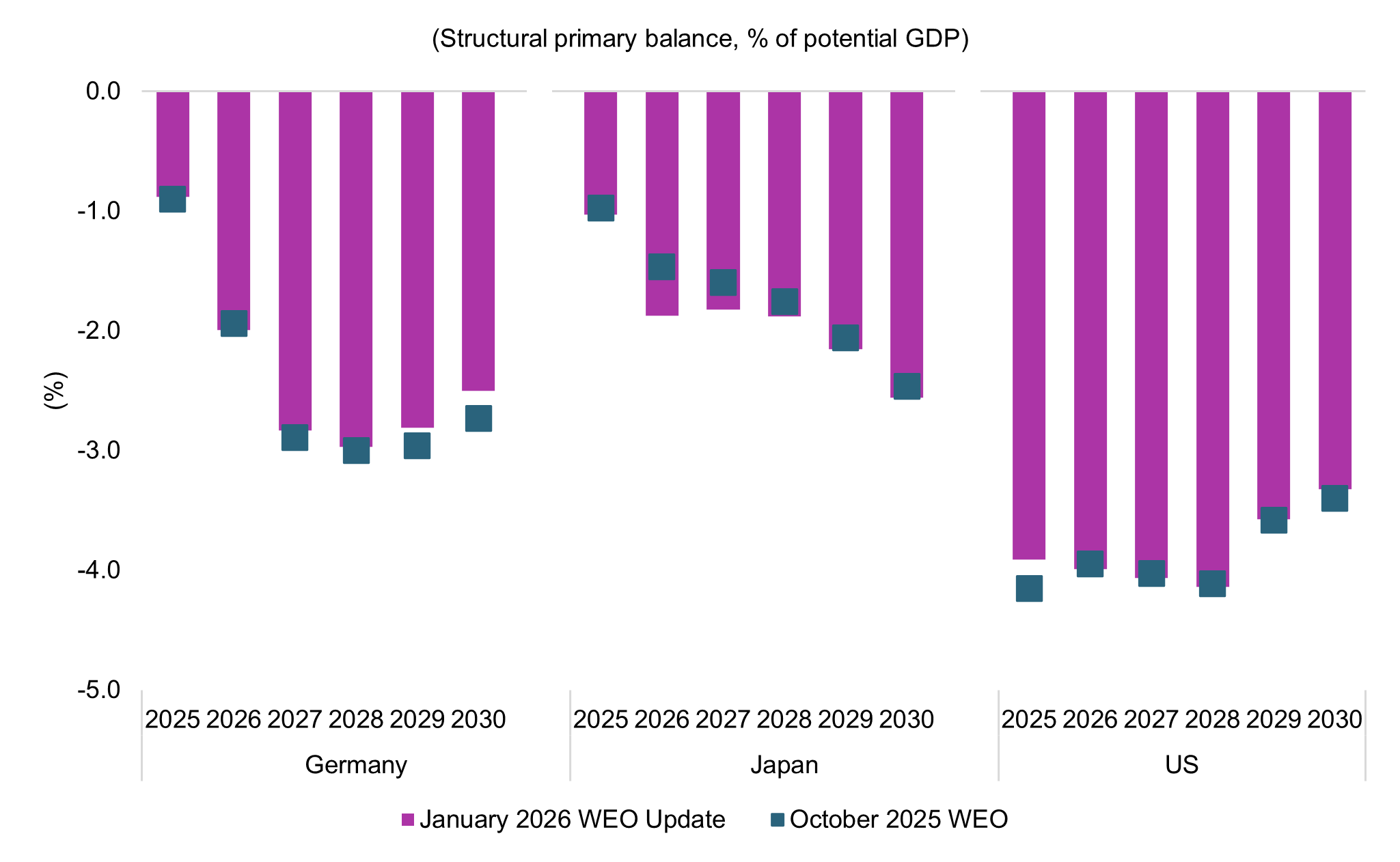
The general government structural primary balance is the cyclically adjusted primary balance corrected for broader range of noncyclical factors such as changes in asset commodity prices.
Source: IMF WEOJanuary 2026
Europe: modest growth with sensitivity to energy shocks
European markets have benefitted from ongoing global growth, ECB easing and more accommodative financial conditions than those in the US. Since then, the ECB appears to have settled around its neutral policy rate of just above 2%. Europe remains vulnerable to the possibility of a more persistent energy and global logistics shock, which may overshadow positive earnings surprises if energy costs rise again.
That said, the already conservative expectations for Eurozone growth may also mean there are smaller margins for downward revision. We note that dispersion in expectations has risen less for Eurozone fundamentals and bond markets than for the US and Japan since the prior quarter. As a base case, Eurozone GDP is expected to remain steady within the mid-1% range over the coming year; headline inflation is seen staying below 2%, while core inflation is expected to ease toward the ECB’s 2% target within the same time horizon.
From an equity perspective, Europe still looks like a relative valuation and diversification opportunity, rather than a near-term earnings acceleration story. In the near-term, valuations are anticipated to remain significantly subdued in comparison to those in the US, supporting the case for diversification—particularly in the face of rising tail risks associated with a potential equity risk-premium shock centred on US technology.
China: with slower growth priced in, the country’s future is constructive
As China downgraded its annual GDP annual growth targets from 5% to 4.5%-5%, the bad news already appears to be priced in. Recent data suggest growth is moving toward the upper end of the revised range, with Q1 prints on both the industrial and consumer sectors coming in above expectations. The Committee sees growth remaining in the mid-to-upper end of the growth target range over the coming year.
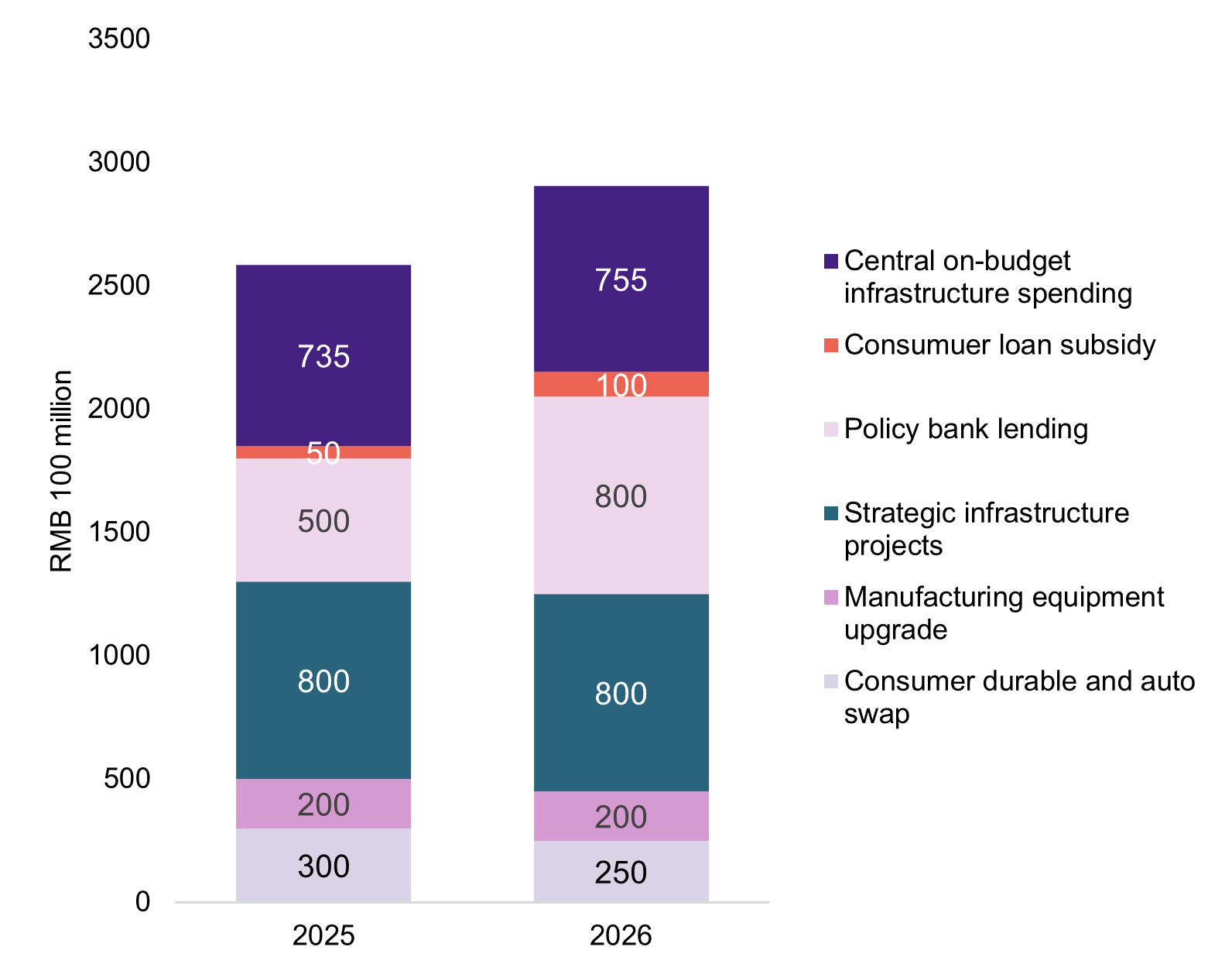
Inflation remains subdued, providing scope for targeted fiscal and industrial support, which the Committee expects will remain positive for growth over the coming year. Although China has downplayed fiscal support aimed directly at consumers, the approach may reflect a desire to preserve fiscal ammunition during a time of uncertainty. Meanwhile, China’s planned fiscal policy is anything but contractionary. While the policy tone continues to emphasise supply-side and tech-oriented investment, China’s strategic energy diversification—spanning imported fossil fuels and years of investment into renewable energy—may pay off.
China, as the world’s second-largest economy, remains exposed to the impact of the ongoing energy and logistics shock, and therefore the Committee assigned a 25% or lower probability that China underperforms its new 4.5–5% GDP growth target range. Yet it is also possible that China’s recent diversification of energy sources may provide some degree of insulation in the face of energy and logistics shocks, which could translate to growth in the upper end of its stated range.
Chinese equity markets show strong anticipated earnings growth. However, like equity markets elsewhere, risks of any terms-of-trade shock may not be fully priced in. Conversely, the orientation of the government’s new five-year plan toward investment in technology—not only in AI infrastructure but also biotech and energy infrastructure—may mean that risks of government crackdowns in the private sector could be lower compared to 2022.
Meanwhile, Renminbi (RMB) policy appears compatible with gradual appreciation and a less aggressive counter-cyclical stance; appreciation by the currency may serve as a helpful buffer in the event of terms-of-trade shocks. Assisted by recovery in Chinese equities, the Hang Seng is expected to continue showing improvement in EPS growth, even though valuations may remain under pressure given ongoing uncertainty surrounding the energy and logistics supply shock.
Chart 5: China expands fiscal stimulus in 2026
Source: PRC Macro
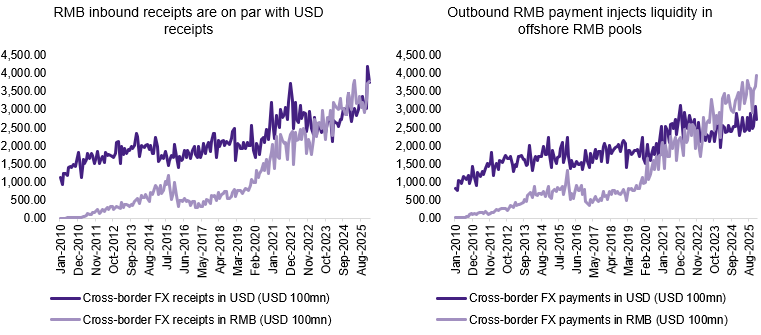
Chart 6: De-dollarisation of inbound/outbound Chinese trade
Source: Wind/PRC Macro
Global FX and commodities
The likelihood of broader-based dollar weakness as market focus gradually shifts to adjustment toward fair value remains the Committee’s base case. As in the bond markets, dispersion across FX outcomes has increased relative to the previous quarter, particularly for dollar/yen. Part of this adjustment is expected to be gradual yen strengthening (rather than appreciation driven by disorderly risk-off flow), while steady gains by the renminbi is seen as another important factor as China targets greater internationalisation of its currency both in trade and investment.
Commodity currencies may react to whether the energy shock behaves more like an inflationary tax or instead signals solid global demand. As mentioned above, dollar/yen is expected to retreat gradually below 150 over the coming year. euro/dollar may rebound modestly toward 1.20 and the Australian dollar is seen rebounding into the mid-70 range against the greenback.
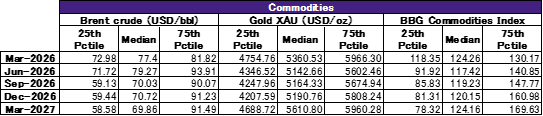
Oil markets are still not pricing a permanent shock scenario, and while the tail risk is elevated and dispersion in expectations is meaningfully greater than last quarter, the Committee’s base case is for the shock to ease rather than escalate. Although gold remains elevated, its recent surge alongside risk assets showed its tendency to give up gains as oil rallied. Outlooks for both gold and the commodities complex have become more dispersed since last quarter, reflecting expectations for greater volatility. Risks related to war and energy disruptions are non-trivial, and volatility in commodities remains a factor to watch for signals of spillover.
Principal risks to the outlook: regime transition watch
Uncertainty remains elevated compared to the previous quarter, and as such, the central case must be accompanied by caveats and risk factors that bear constant monitoring. The principal risk factors highlighted by the GISC fall roughly into the following categories:
- Energy shock and escalation in the Middle East (probability 10-40%; impact: High)
This risk scenario was the most broadly cited among Committee voters, and was seen uniformly as high impact, albeit with a wide dispersion of subjective probabilities. Representative scenarios included an escalation of the Iran conflict into a broader regional confrontation or proxy war. Within the scenarios, extended disruption to shipping within the Strait of Hormuz and/or withdrawal of insurance were seen as significant risks.
Persistently elevated oil prices and spillovers were seen as likely to contribute to heightened stagflationary risk. In the event of an extended shock, the Committee noted that central banks could find themselves constrained in their ability to ease to respond to softer demand conditions amid a global inflation resurgence, creating a drag on both investment and consumption via higher costs of capital and living. If protracted, these dynamics could leave equity markets vulnerable to risk aversion and volatility.
- Persistent inflation/global tightening shock (probability 50%, impact: Medium-High)
In an area that is independent but not unrelated to the war-related risks of inflated costs of capital and living, a minority of Committee members highlighted the risk of miscalibrated central bank policy. Those who did perceive the risk assigned it both high impact and probability.
In this scenario, the inflationary pressures are not driven solely by a war-related energy shock, but also by the ongoing investment demand surge in technology. Should central banks underestimate the persistence of inflation expectations—even in the absence of a renewed energy supply shock—policy settings could remain tighter for longer than previously anticipated. Such an outcome would limit the scope for rate cuts and weigh on growth. In this scenario, higher real rates, compression in equity market valuations and bond market volatility were the anticipated responses.
- AI investment/technology cycle disruption (probability: 20-50%; impact: medium-high)
Scenarios in this risk cluster centred on the possibility of credit tightening curtailing the AI capex investment boom. Supplier margins could be squeezed by excessive competition, with firms falling behind the technological frontier facing an accelerated risk of business-model obsolescence.
The impact of any sudden surge in costs of funding would be particularly consequential. Under such a scenario, returns on investment for hyperscalers could be eroded by soaring costs of credit, rapidly cooling the investment boom and weighing on stock prices. If such a development is isolated to the tech sector, the likely outcome could be a sector-specific re-rating, equity market rotation away from tech and re-assessment of AI capex sustainability. The scenario could be consistent with interim volatility in the equity market as sectors re-rate.
- Private credit shock/financial system stress (Probability 15-25%, Impact: medium-high)
Although our central scenario remained that of stress being contained within private credit markets, the Committee flagged risks of spillover into the broader financial system. The representative scenario was redemption restrictions at private credit funds triggering liquidity stress and resulting in tighter financial conditions. This scenario could be accompanied by regional bank stress, spillover into public credit markets and widening spreads, and a more general repricing of risk assets. Though viewed as a lower-probability outcome, the Committee also discussed a more acute tail risk in which near-term forbearance leads to a prolonged period of balance-sheet strain instead of an immediate systemic blowout. Such an outcome could prolong a slowdown in growth.
- Long-rate and fiscal sustainability shocks (probability 15-25%, impact: high)
The likelihood of a shock to fiscal sustainability may be higher now than in previous cycles, simply because of the historically elevated debt-to-GDP ratios in many developed economies. These risks were generally seen to compound in the event of overlapping fiscal spending, private credit expansion and heightened inflation expectations triggered by the Iran war.
In Japan, while the fiscal situation has seemingly improved alongside reflation, the debt-to-GDP ratio remains high in both gross and net terms. Recent fluctuations in the JGB market in response to anticipated fiscal stimulus underscored the sensitivity of long-duration debt to perceived fiscal credibility. GISC voters cautioned that a combination of renewed fiscal expansion and delayed BOJ tightening could result in a bear-steepening of the JGB yield curve, resulting in spillovers to corporate funding rates and household borrowing costs.
Cross-risk takeaways: systemic considerations
A key theme emerging across the risks flagged by Committee members was the heightened inter-connectedness of potential risk scenarios. Energy and geopolitics dominate the perceived tail risks, yet they are also related to inflation and risk of policy miscalibration. Central banks may find themselves constrained in their ability to ease in either lower-growth or higher-growth scenarios, if inflation remains more persistent than expected.
Meanwhile, the risks of a reversal in AI capex may provide an added risk layer, one that is not independent of potentially tighter liquidity conditions in credit markets and a higher cost of funding. Fiscal credibility and the capacity of central banks to independently control inflation expectations also remain closely linked risk factors.
While joint events are usually less probable than individual scenarios, combined shocks can produce nonlinear impacts— sometimes far larger than the sum of individual shocks. The Committee therefore judges that the possibility of a systemic shock is not zero, with an extremely high impact if realised.
Chart 7: Contributions of global shocks to the variation in domestic interest rates
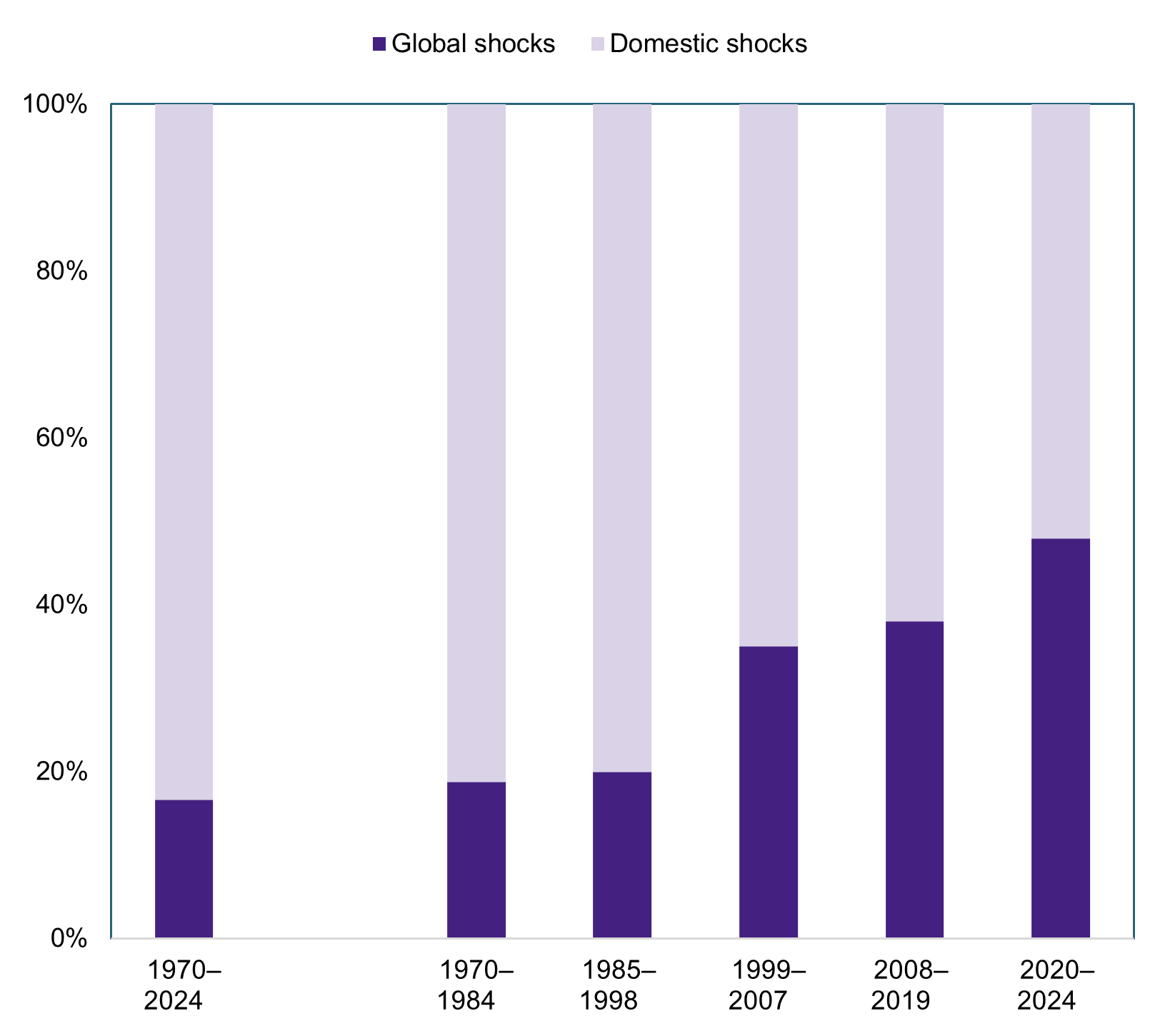
The chart shows the forecast error variance decompositions of domestic policy interest rates (in percent of total variation, averages across 13 advanced economies) over a 40-month horizon based on the FAVAR model developed in Forbes, Ha, and Kose (2026). The model consists of four global variables (output growth, inflation, interest rates, and oil prices) and three domestic variables (output growth, inflation and interest rates).
Source: From earth to heaven: The changing drivers of monetary policy | CEPR
Appendix 1: GISC Outlook guidance
Global macro indicators
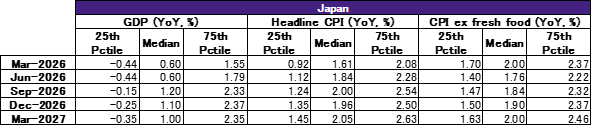
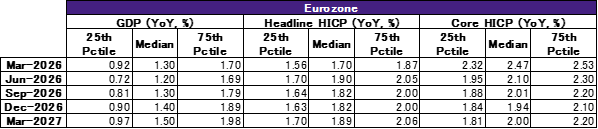
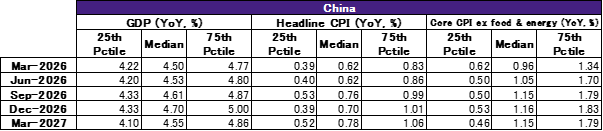
Central bank rates, forex, fixed income and commodities
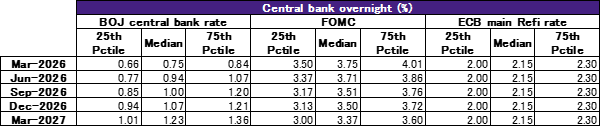

Equities








