


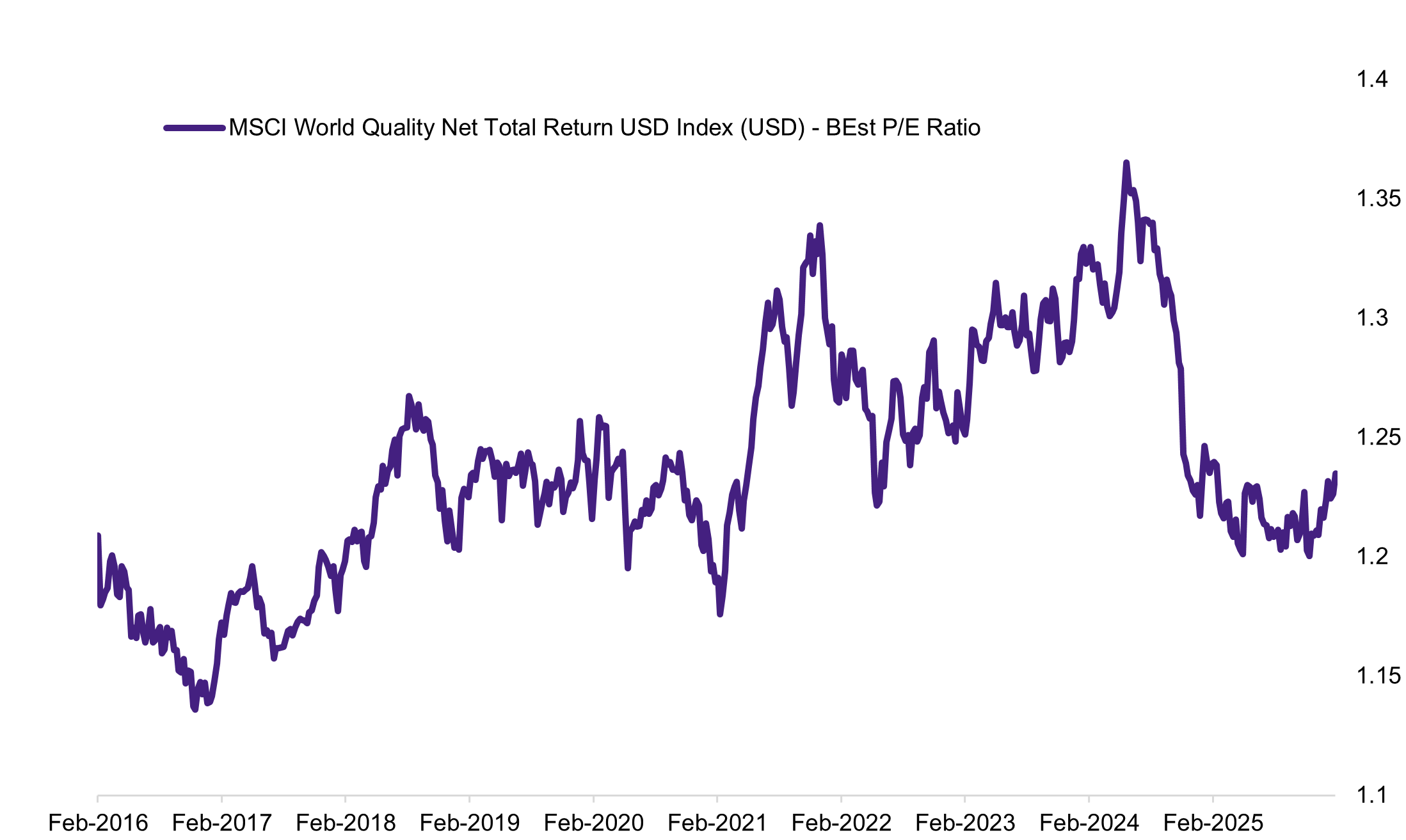
The most significant driver of recent equity market performance, in the US and across other major regions, has been an aggressive style rotation away from higher quality growth stocks in favour of value-oriented names. In early 2025, global sentiment was dominated by concerns about sharply higher tariffs and the risk of a US recession. However, as the year progressed, those concerns eased. At the same time, interest rate cuts from the Federal Reserve supported a more constructive growth outlook. In Europe, this dynamic was reinforced by an increase in fiscal spending, particularly in Germany and other countries, focused on defence and infrastructure, a shift that has longer-term implications for the region’s growth profile. Meanwhile, in Japan, a return to nominal GDP growth and a more inflationary backdrop have supported stronger consumption and renewed optimism around domestic growth.
Together, these factors led to an upgrade in growth expectations and the premium investors were willing to pay for defensive, high-quality companies sharply declined. As a result, there was a notable repricing across markets, with capital moving out of quality and growth and into value-oriented or more cyclical segments.
Chart 1: Quality stocks’ (MSCI ACWI Quality USD Index) relative valuation (PE 2 years forward) has declined
Source: Bloomberg 2026
The race to define AI winners and losers
Second, the scale of AI-linked capital expenditure has exceeded even the most bullish expectations. In early 2025, the market expected around USD 300 billion global AI and data centre capital expenditure; by the end of the year, that figure had broadly doubled. The scale and speed of spending, driven by the race towards artificial general intelligence (AGI) among the largest tech companies, exceeded even optimistic forecasts. Companies with the most direct exposure to AI-related capex have seen strong momentum, while others have lagged.
This shift had several implications for our global equity strategy. First, leadership within the large platform companies evolved. OpenAI had been the clear front runner, but confidence increasingly shifted towards Google’s Gemini offering, which proved more competitive than many had expected. We did not hold Google, but instead were positioned in other hyperscalers, including Microsoft and Amazon. The rapid re-rating of Google over a short period created a performance headwind for us, particularly in the second half of the year.
The scale of AI-related capex also created significant pressure along the supply chain. The portfolio has had meaningful exposure to established leaders in AI compute, notably Nvidia and Broadcom. These positions performed reasonably well and remain core holdings. However, they were outpaced by more cyclical and historically lower-quality businesses that benefited from supply constraints. DRAM manufacturers such as SK Hynix, Samsung Electronics and Micron Technology saw sharp upgrades to earnings expectations as tight supply led to higher pricing.
Steepening yield curves
Although short-term rates in the US were cut, longer-dated bond yields remained elevated and, in some regions, moved higher. This resulted in a steeper yield curve, an environment that tends to favour more broadly exposed financial institutions. The portfolio did have exposure to selected financials and added to some positions. However, a similar pattern emerged as in other sectors. Higher-quality financial firms, which had historically delivered superior returns and offered resilience in lower-growth environments, were aggressively de-rated as the macro backdrop improved. In areas such as insurance and diversified financials, several quality franchises experienced sharp valuation compression. Given the portfolio’s bias towards those types of businesses, this has remained a further headwind but also an area we see future potential in as quality businesses sell at a discount.
How we responded in Q4 2025
The most significant adjustments in the fourth quarter related to sales, particularly among companies seen as major beneficiaries of the AI cycle. The market has begun to question not only the scale of capital being deployed into AI, but also the ability of certain platforms to generate attractive returns from that investment. In response, we sold our positions in Oracle and Meta.
The decision to exit Meta reflected a core principle of the Future Quality strategy: long-term share prices are driven by returns on capital. Historically, Meta generated highly visible and capital-light cash flows by reshaping the global advertising market. Incremental revenues were strong, while incremental costs were low, as users effectively supplied content at no cost. That profile has changed materially. Capital expenditure has risen from around USD 15 billion a few years ago to approximately USD 135 billion, largely directed towards large language model development and AI infrastructure. A significant portion of that spending has uncertain revenue visibility. At the same time, competition has intensified, particularly from Google, whose Gemini model has performed strongly. The resulting shift lowers expected returns on capital. Given the scale and persistence of this investment cycle, and the fact that spending is unlikely to moderate in what has become an arms race, the risk to long-term shareholder returns increased.
Adding to the supply chain
While platform economics have become more capital intensive, parts of the semiconductor supply chain continue to benefit from the AI build-out. We initiated a new position in ASM International, a specialist in advanced semiconductor manufacturing equipment. Its technology is critical for increasingly complex chip architectures, which are essential for future AI-related capacity expansion. The investment reflects our continued confidence in infrastructure enablers of AI, where visibility remains strong, and the position has performed well since purchase.
Adding industrial, cyclical and financial exposure
We increased our exposure to capital goods through a larger position in Sandvik, a global leader in mining equipment. After years of underinvestment in the sector, demand for new machinery is rising as capital expenditure in commodities and infrastructure improves. The company combines strong margins with improving growth prospects and attractive returns on capital. With yield curves steepening and economic prospects improving, we also increased our exposure to banks through a position in Spain’s CaixaBank, which we believe will continue to win share and improve profitability as it leverages their significant IT investments and robust balance sheet. Provided European growth remains supported by fiscal stimulus, credit quality should hold up. The shares trade on single-digit earnings multiples, offer attractive dividend yields and generate returns on equity in the mid-teens, aligning with our Future Quality criteria.
The overall shape of the portfolio has not changed dramatically, and our core AI infrastructure holdings, including Broadcom, Nvidia and Amphenol, remain in place. However, financials now represent a somewhat larger weighting, while consumer exposure has been reduced.
“Don’t throw out the baby with the bathwater”
Markets are trying to identify which businesses will ultimately benefit from AI and which will struggle. However, market repricing is not always rational. Entire groups of stocks are being sold or bought together, often through ETFs and, in some cases, with leverage. Rather than differentiating between individual business models, investors are treating broad categories as homogeneous, an approach that can often result in sharp and sometimes indiscriminate price moves.
In some cases, the market may be too pessimistic, implying certain companies are vulnerable to AI when in fact the underlying business model remains robust. In other cases, disruption will prove real and more structural.
To give an example, Compass Group is a global contract catering business, operating across hospitals, schools, sports stadiums and offices. The share price has fallen, driven in part by a perception that it is somehow an AI loser. However, we fail to see this logic, as there is little immediate evidence that AI could materially disrupt the company’s core business model in the near term. In periods of rapid thematic rotation, nuance often gets lost. Companies such as Compass may be sold not because of deteriorating fundamentals, but because capital is being reallocated elsewhere. In such an environment, high-quality but less fashionable businesses can be marked down indiscriminately. It would not be surprising to see some reversal as the earnings season progresses and company-specific results provide greater clarity.
Our expectation for Compass is that the underlying business model remains intact. If so, the recent weakness presents an opportunity to own this and other durable franchises at more attractive valuations. Identifying these dislocations, where price and long-term fundamentals diverge, is central to our Future Quality approach.
Where are we now?
The broad rotation away from quality and defensive businesses towards deeper value and more cyclical areas appears largely complete. While style dynamics can persist, a substantial repricing has already taken place. The premiums traditionally attached to quality and growth franchises have largely disappeared. Relative to history, these companies now look materially more attractive. As a result, while style rotation has been an important driver of returns, its influence may diminish through 2026. From here, company selection and alignment with the prevailing economic environment are likely to matter more than broad style exposure.
That said, the current environment remains challenging. Some companies are being marked down more than fundamentals would justify. Others may face genuine structural challenges in an AI-driven world and could see long-term earnings power impaired. Our task is to distinguish between the two. While the short-term environment is difficult and, to some extent, mechanically driven, it also creates the conditions for attractive long-term entry points. As positioning normalises and fundamentals reassert themselves, the dispersion between genuine winners and weaker businesses should become clearer.
Second, the AI investment cycle continues to create winners and losers. The scale of capital expenditure and the speed of disruption remain a defining feature of the market. The key question is no longer simply who is spending most aggressively, but who will ultimately earn an adequate return on that capital.
Summary
The role of a stock picker in this environment is to look beyond broad thematic positioning and assess the durability of returns on capital. Once the initial wave of repositioning subsides, we expect the focus to return to fundamentals. That is where significant opportunities are likely to emerge, particularly where valuations have moved ahead of, or fallen well below, realistic long-term prospects. Our emphasis therefore remains on identifying Future Quality businesses capable of sustaining high returns on capital, while adjusting exposure in response to shifts in capital intensity, competitive dynamics and the broader macroeconomic backdrop.