


On the surface, Japan’s Q4 2025 GDP was broadly disappointing, expanding only 0.1% quarter-on-quarter (QoQ) in real terms, and 0.6% in nominal terms (vs 1% expected). Capex also crept higher by 0.2% versus an expected 0.6%, which was a disappointment though not a reversal of the expansionary backdrop, driven by corporate pricing power and reflationary wage-price dynamics. Inventories decreased by more than expected (-0.2%), providing a small, incremental drag, and net exports also delivered a small negative surprise (0% QoQ). A great focal point, however, was the GDP deflator, which was up 3.4% year-on-year (YoY) vs 3.2% expected, underscoring the contribution that inflation, rather than stagnant demand, had made to the gap between nominal and real growth.
Some of the QoQ estimates reflect revisions to Q3 data, and on a seasonally adjusted basis, quarterly figures in 2025 showed greater swings than usual. It is therefore useful to look at both full-year data as well as YoY data, which help smooth out these technical fluctuations.
From a full-year perspective, Japan has delivered resilience in a year of significant uncertainty. Its full-year 2025 real GDP growth is estimated at 1.1%, which is well above potential (the Bank of Japan (BOJ) estimates it at around 0.5%). Private demand rebounded to expand 1.6% over the year after contracting in both 2024 and 2023. A big part of the recovery was driven by domestic consumption and private non-residential investment, all of which grew by well above 1% over the full year.
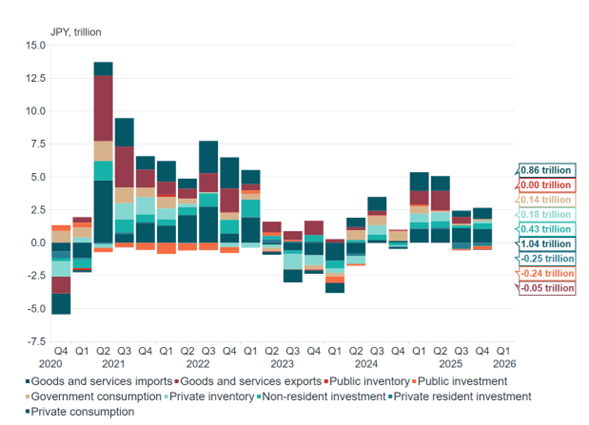
However, even these above-potential real growth outcomes pale in comparison with nominal growth exceeding 4% YoY in the sub-components mentioned above. This gap underscores the extent to which household’s potential to engage in greater consumption is being eroded by price rises. Meanwhile, a weak yen is weighing on terms of trade, which reduces Japan’s real purchasing power. Despite ongoing growth in the volume and value of exports over the full year (+0.6% YoY in real terms, +0.7% in nominal terms), the rising value of imports has constrained Japan’s global purchasing power. We may also see many of these dynamics play out in YoY data (see Chart 1 below, which shows YoY real GDP growth in yen terms).
Chart 1: Japan real GDP by expenditure component (constant prices, YoY change, yen)
Source: Amova Asset Management, CAO
What matters going forward? Wages, inflation and the yen
First and foremost, the BOJ has highlighted why we should pay greater attention to wage-price dynamics as a forward-looking indicator of Japan’s reflationary potential. For households, real balances matter; specifically, this means whether wages are growing more quickly than the prices of goods and services in their consumption basket.
Wage-price dynamics also have important second-order effects on production capacity. Many quarters of labour supply shortages—which the BOJ now characterises as “chronic”—have weighed upon Japan’s capacity to effectively utilise its physical capital before it is fully depreciated. To the extent that labour scarcity has become a constraint on capacity utilisation, increasing human capital would be paramount to maintaining the momentum of Japan’s reflationary dynamics.
In this context, announcements surrounding the “shunto” spring wage negotiations and firms’ continued investment in labour-saving technologies should be closely watched. Factors affecting labour supply growth in Japan, such as immigration, also warrant close attention.
The fiscal-monetary policy mix: complementary is optimal
Whether inflation in Japan is demand-pull (wage-driven) or cost-push (influenced by price rises, foreign exchange and terms of trade) remains a complex question, and it cannot be resolved simply by contrasting household real vs. nominal consumption. The firm GDP deflator clearly shows that prices are driving a wedge between the volume and value of consumption.
A weak yen has been a key contributing factor to this terms-of-trade drag. With Japan’s interest rates remaining far below those of its developed economy counterparts despite experiencing similar rates of inflation, the relatively cheaper yen has facilitated the financing of risk investments across the globe (as shown by the Ministry of Finance’s portfolio flow data). These flows may have contributed to the yen’s chronic weakness. All else equal, this dynamic may increase pressure on the BOJ to prioritise the normalisation of interest rates to contain imported inflation.
Expectations for significant fiscal stimulus have accompanied Prime Minister Sanae Takaichi’s decisive snap election victory. However, the more meaningful contribution of this increase in political support may be that it gives the government the ability to stand back and allow an independent BOJ to fight inflation while it focuses on long-term fiscal sustainability.