


Introduction
Fixed income markets have entered a fundamentally different era. After more than a decade defined by low yields and predictable central bank policy, investors now face structurally higher interest rates, shifting inflation dynamics and more frequent episodes of volatility. At the same time, traditional credit allocations can be narrow in scope, often capturing only a small portion of the global opportunity set.
Against this backdrop, multi sector credit has emerged as a compelling approach for institutional investors seeking resilient income, diversified exposure, and the flexibility to adapt to changing conditions. Multi sector credit is not a new asset class, but a more modern way of accessing existing ones through a broader lens, with a wider toolkit, and with a focus on long‑term risk‑adjusted outcomes.
A broader, more balanced approach to credit
One of the defining characteristics of multi sector credit is the ability to allocate across the full spectrum of public credit markets. Rather than being constrained by the composition of a benchmark, multi sector credit strategies are free to explore the breadth of opportunities available across investment grade bonds, high yield credit, corporate hybrids and selected structured credit sectors.
Each of these segments behaves differently through market cycles. Some offer defensive attributes during periods of stress; others provide meaningful income or compelling valuations in times of dislocation. By bringing these sources of return together into a single, coherent allocation, multi sector credit introduces balance that is difficult to achieve through traditional corporate credit portfolios.
Adapting to changing credit cycles
Credit cycles have become more complex, particularly as macroeconomic conditions evolve at different speeds across regions. In this environment, rigid exposure can become a disadvantage. Multi sector credit offers a more dynamic approach, one that acknowledges the most attractive opportunities may shift quickly from one segment of the market to another.
For example, periods of rising interest rates may favour floating‑rate assets. Furthermore, market stress often leads to dislocations in high yield and emerging market credit and there may be merit in moving up the capital structure, favouring higher‑quality issuers or segments with stronger structural protections. Multi sector credit’s flexibility makes this rotation possible.
Diversification that works harder
Diversification is a clear benefit of a multi sector credit approach, but not simply in the traditional sense of holding a large number of securities. Rather, multi sector credit combines credit assets whose underlying return drivers are fundamentally different. Hybrid instruments, for example, will tend to exhibit characteristics that blend equity-like sensitivity with credit exposure, while structured credit instruments may respond differently to periods of volatility than corporate bonds.
By blending these exposures carefully, multi sector credit can help reduce the vulnerability that comes from concentrating risk in any one area of the credit market. The result is a more stable return profile over time, one that is less dependent on the performance of a single sector or rating cohort.
Chart 1: Risk/reward of fixed income asset classes
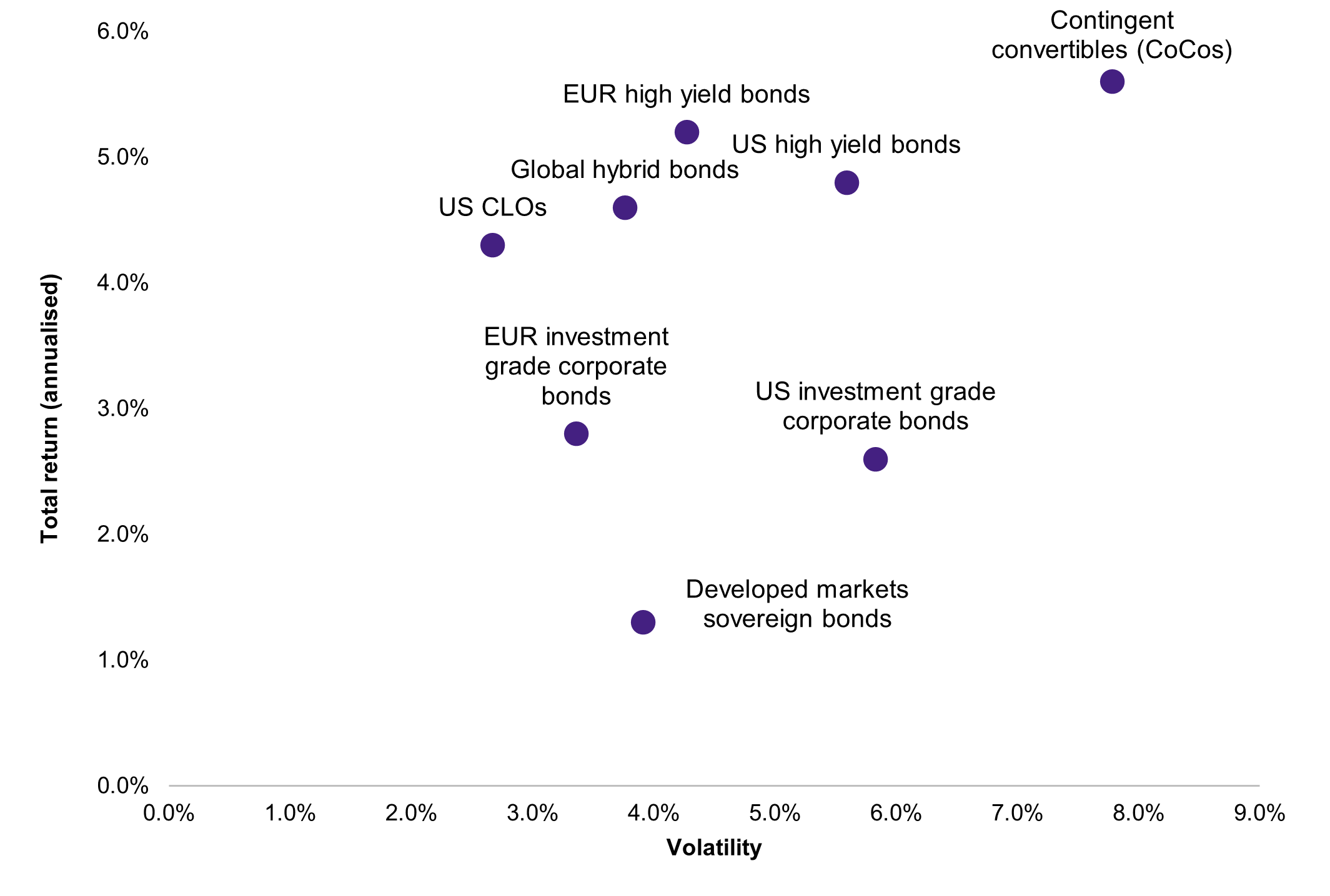
Source: Amova Asset Management, Bloomberg, ICE Indices, IG, Jan 2018 - Dec 2025. Non-USD returns hedged to USD. Past performance does not guarantee future returns.
Balancing liquidity and income
A defining feature of multi sector credit strategies is the balance they strike between liquidity and income generation. Strategies with a focus on liquidity typically invest in broad, highly tradable asset classes enabling daily or frequent dealing and allowing investors to access their capital quickly. These approaches often seek to capture credit returns through the most liquid segments of the market.
Conversely, others prioritise higher income by allocating more heavily to less liquid assets, such as sub-investment grade credit or alternative credit exposures. While these less liquid strategies may offer the potential for enhanced yields and differentiated sources of return, they often require investors to accept longer lock-up periods, with fund liquidity then ranging from monthly to quarterly.
Ultimately, the liquidity profile is shaped by the underlying asset mix. Investors must weigh their need for immediate access to capital against their desire for higher income, recognising that greater income potential often comes with reduced liquidity. Understanding this trade-off is essential when selecting the most appropriate solution.
Chart 2: The liquidity profile is shaped by its underlying asset mix
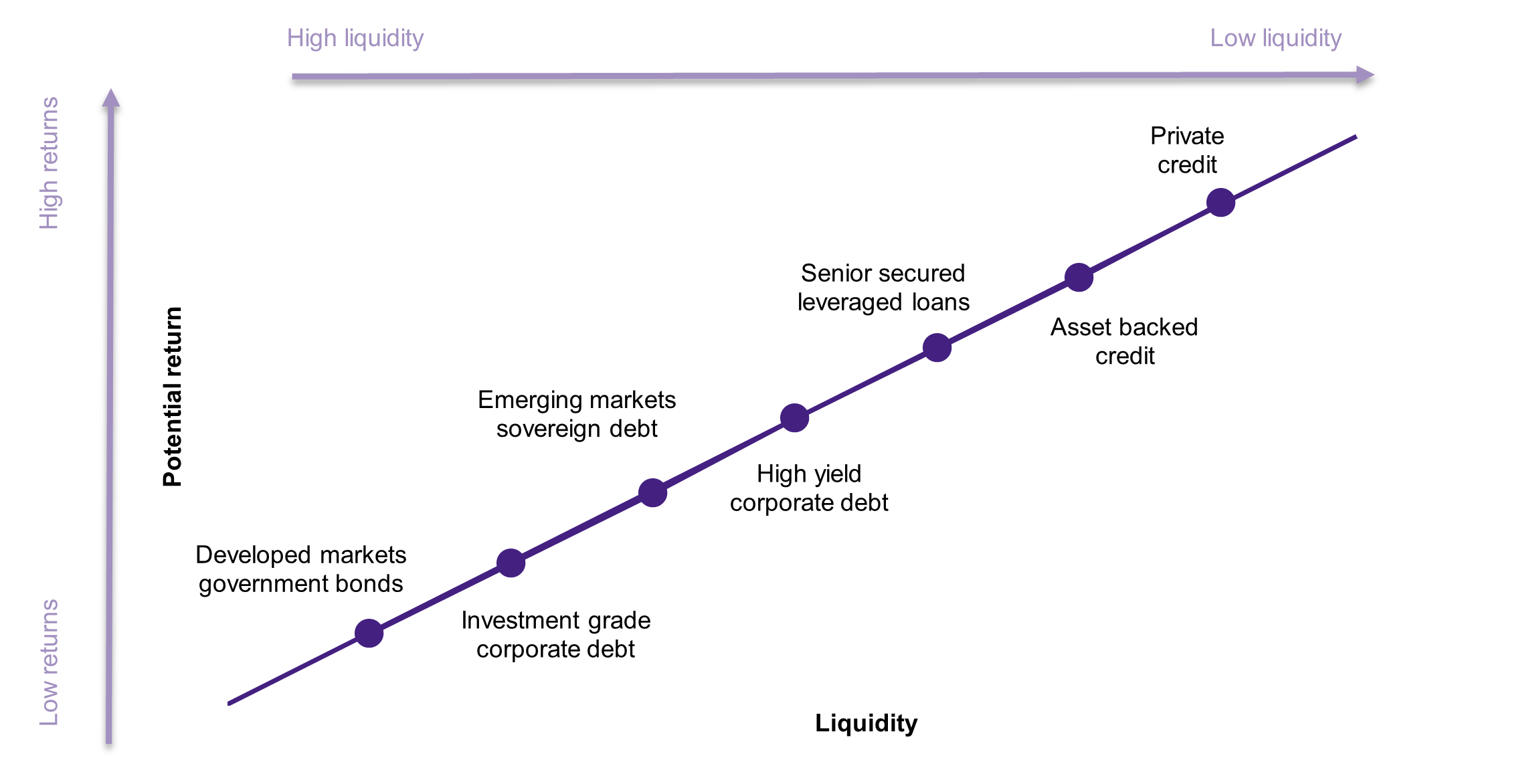
Source: Amova AM. For illustrative purposes only.
The importance of income in long-term returns
Across market cycles, income has been a dominant contributor to total return in credit portfolios. Multi sector credit seeks to harness this through a diversified set of income sources, each with its own structural characteristics. High yield credit, CLOs, senior secured loans and other structured instruments can offer elevated levels of carry while providing differing sensitivities to rates and spreads.
This income‑driven approach can create a powerful effect. In periods of muted capital appreciation, stable income becomes a key driver of long‑term results. This should be an important consideration as the global rate‑cutting cycle is coming to an end. Additionally, income has the added effect of providing an additional layer of resilience, helping to smooth volatility across cycles
Chart 3: Current fixed income asset class yields
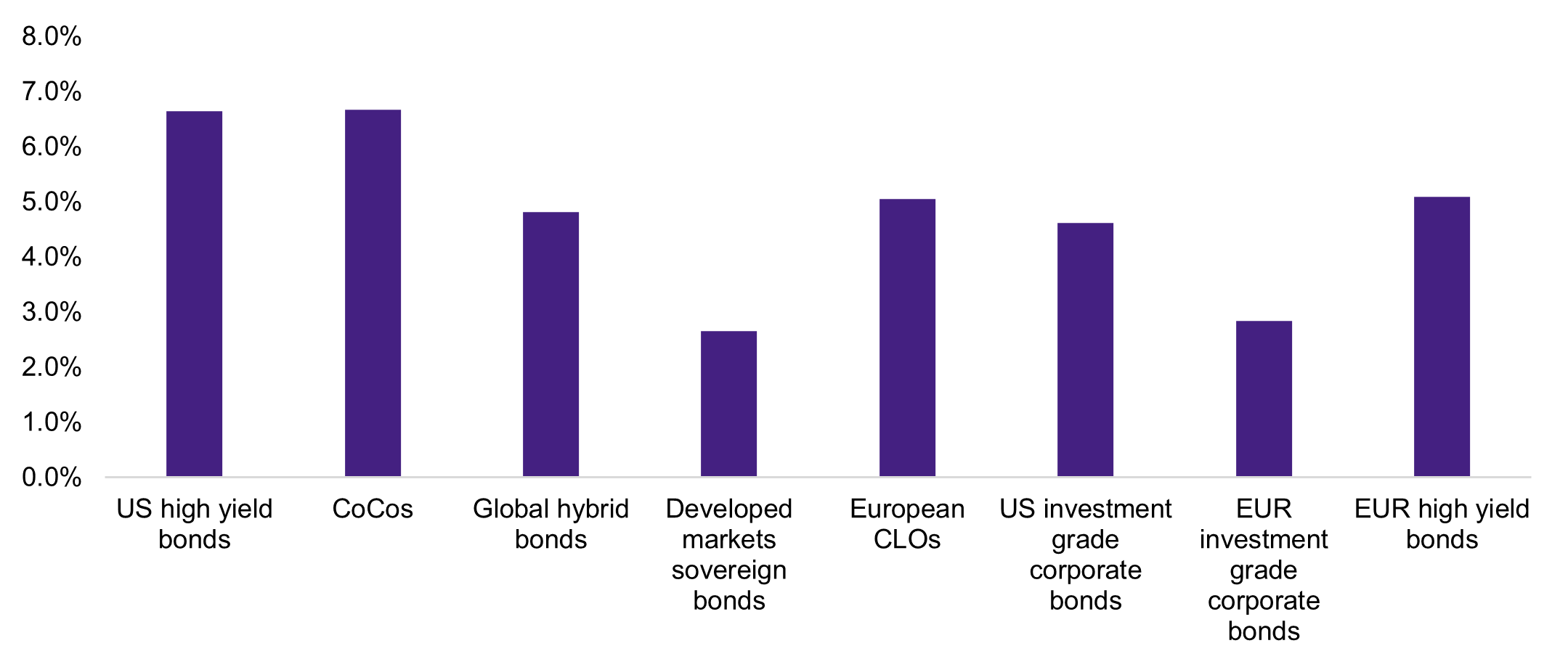
Market weighted yields as of Dec 2025.
Source: Amova AM, Bloomberg, ICE Indices, IG, BAML. Past performance does not guarantee future returns.
Why multi sector credit, and why now?
Today’s credit markets display an unusual combination of characteristics: periods of compressed spreads in some areas; substantial value in others; and technical forces such as flows, liquidity and issuance that vary meaningfully across segments. In such an environment, rigid approaches can miss opportunities or fail to adjust to heightened risks.
Multi sector credit offers a way to approach credit with greater flexibility. It provides the following:
- Access to a wide and evolving opportunity set
- A more natural alignment with credit cycle dynamics
- A diversified source of income
- A more balanced risk profile
- The ability to capture dislocations as and when they arise
Conclusion
Multi sector credit can be seen as the modern response to a more complex fixed income landscape. By combining flexibility, diversification and a broad lens on global credit markets, multi sector credit offers institutional investors a more adaptive and resilient path to long‑term return generation.
As markets transition through different phases of the cycle, strategies that can move across the full credit universe rather than remain anchored to a single segment may be better placed to capture opportunity, support capital preservation and deliver durable income.