


As widely expected, the Bank of Japan (BOJ) kept rates on hold at 0.75% in January following its 25 basis point (bp) rate hike in December. Since the end of its Negative Interest Rate Policy in March 2024, the BOJ has been increasing overnight rates gradually, with hikes of 25bps occurring roughly every six months—or even more slowly. Given this background, in the absence of a sudden acceleration in inflation or inflation expectations, the central bank’s decision to keep rates on hold is consistent with its gradual normalisation regime.
BOJ points to normalisation continuing—or exceeding—its current pace
However, elements within the BOJ’s statement signal that policy has some ways to go before reaching “neutral”. One such indicator is the dissent by BOJ board member Hajime Takata, a known hawk. His dissent demonstrates that the BOJ remains under marginal pressure from within to continue withdrawing stimulus over time.
Another indicator that the BOJ is likely to continue withdrawing stimulus—at least at the same measured pace seen since 2024—is the upward revision to its inflation projections in its quarterly Outlook. January’s Outlook now places inflation above target for longer than in October’s projection. The lower end of the Policy Board’s forecast barely dips below the BOJ’s 2% target in fiscal 2026 and 2027, with members projecting core CPI at 1.9–2% in FY 2026 and 1.9–2.2% in FY 2027, compared to 1.6–2.0% and 1.8–2.0%, respectively, in October. This upward shift comes despite a modest upgrade to the FY2026 growth outlook (from 0.7% to 1%). The modest downgrade to the FY2027 real growth outlook—reflecting the upgrade to inflation projections—remains a note of caution on inflation.
Fiscal risk keeps policy bias tilted toward hikes
We also note that the BOJ continues to treat “the effects of government measures to address rising prices” as factors to be regarded as transitory when gauging price moves, while prioritising the continuation of “the mechanism in which wages and prices rise modestly in interaction with each other”.
Although the BOJ, per its institutional protocols, refrains from endorsing or criticising government fiscal measures, its signal that it plans to look through fiscal pressures on prices in favour of upward-trending wage-price developments, combined with its increased focus on foreign exchange developments, provides markets with some insight into how independent monetary policy may interact with prospective fiscal expansion.
Yen too weak: excess carry in play
Importantly, the BOJ now flags foreign exchange—specifically yen weakness—as an explicit risk to the economy and prices. This marks a material shift from the October Outlook, when foreign exchange was noted but played a less central role.
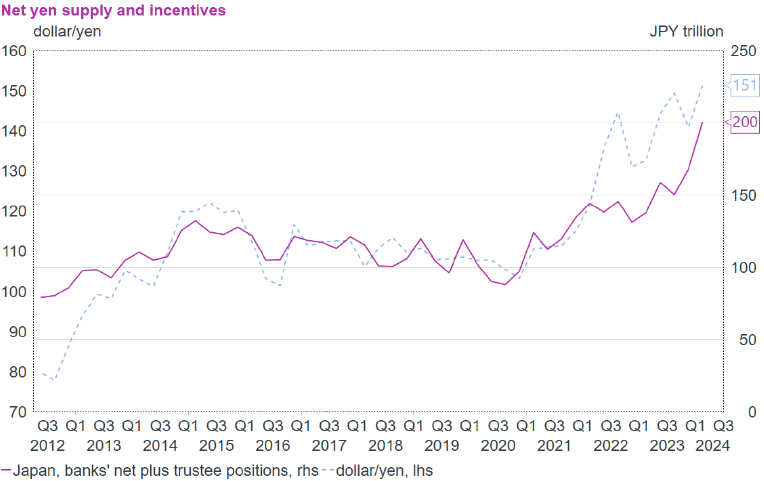
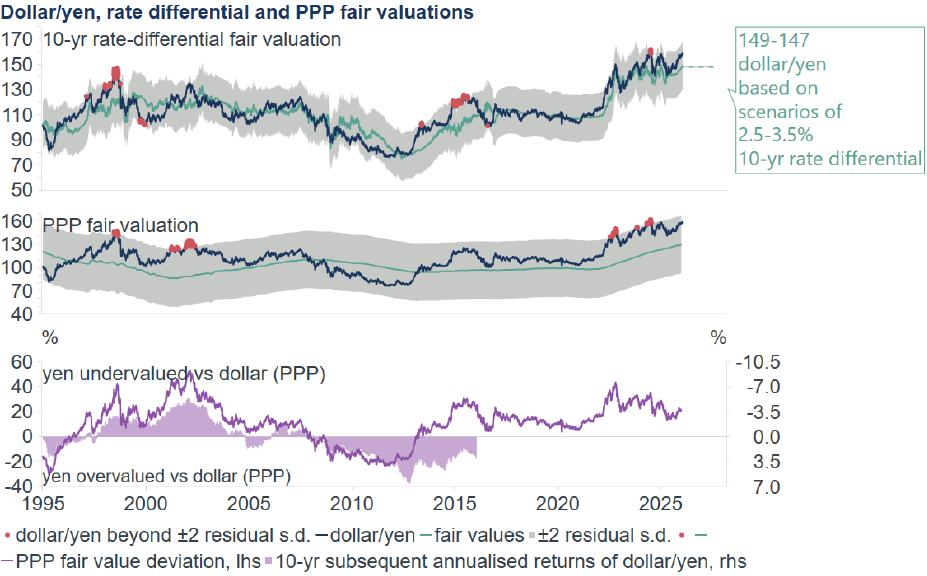
The recent selling of the yen and Japanese government bonds that accompanied announcements of fiscal expansion by the Japanese government may potentially invite unwanted inflation. We illustrate below how dollar/yen moves have been motivated by high demand for yen-funded positions, or the yen carry trade. This surge in the yen carry has not only pushed the Japanese currency further away from purchasing power parity (which we estimate around 100 yen per dollar) but also to a level inconsistent with shorter-term fair value estimates based on relative real yields versus the dollar.
Chart 1: Cross-border yen claims and dollar/yen (per BIS data)
Source: Amova Asset Management, Macrobond
Chart 2: Estimates of fair value in dollar/yen
Source: Macrobond, US Treasury, BLS, SBJ
Timing: fast carry, slow policy
From a policy perspective, the BOJ’s upward revision to its inflation outlook, continued above-trend growth, as well as its declared resolve to continue hiking rates so long as data meet the projections set out in the Outlook, all argue for the central bank to at least maintain the same pace of hikes seen since the start of its normalisation cycle in March 2024. The caveat here is that the pace of normalisation has been slow; even at its fastest, the BOJ has delivered only two rate hikes per year. This provides opportunities for faster-moving market players, such as carry traders, to continue to challenge the BOJ’s resolve by keeping the yen under pressure. That said, the medium-term signal is that the BOJ now has stronger incentives to curb yen liquidity, which until now has provided plentiful opportunities for risk asset investments. Given the extent of the yen’s weakness—beyond justification in relative real or nominal interest rates—the possibility of hawkish surprises going forward also remains significant.